
Precious Manomano
Herald Reporter
AS the Government intensifies efforts to protect wheat crops during the critical harvesting period, over half a million quelea birds have been eradicated across all provinces.
This decisive action reflects the urgent need to safeguard agricultural productivity, as reports from the Ministry of Lands, Agriculture, Fisheries, Water and Rural Development indicate widespread quelea bird activity.
Authorities have mobilised on-the-ground teams to implement protective measures and maintain ongoing surveillance in all 10 provinces.
Farmers have made significant progress in harvesting nearly 2 000 hectares of wheat, yielding an estimated 7 409 tonnes.
This surge in production comes as farmers gear up for the summer cropping season, underscoring the importance of timely interventions to protect their livelihoods.
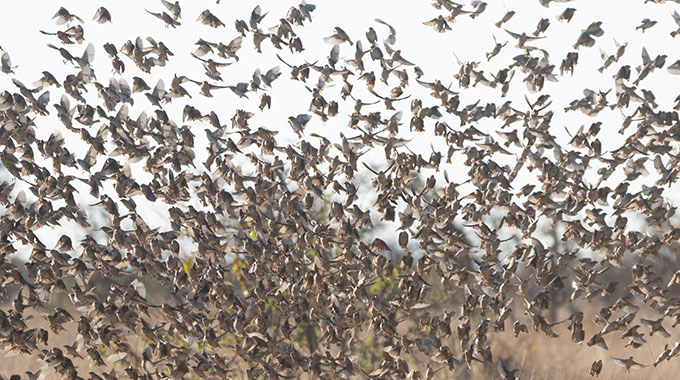
The quelea bird is small but very destructive and poses a severe threat to crops such as wheat.
Capable of consuming up to 10 grammes of grain daily per bird, quelea birds can flock in numbers exceeding a million, leading to devastating losses.
In fact, a single invasion can decimate over 40 000 tonnes of wheat in just one day, making prompt action essential for preserving crop yields.
Reports indicate that Mashonaland East, for instance, authorities reported the elimination of 4 000 quelea birds using Fenthion 640 ULV in Goromonzi, while another 5 000 were killed at Chibvute Farm.
In the Midlands, the Sherwood-Pricabe Farm saw the destruction of 5 000 birds, and in Manicaland, a staggering 44 963 birds were eradicated at Mapari Ranch in Buhera.
Masvingo province also reported significant numbers, with 40 920 birds killed using nets in one area and over 101 000 in Chiredzi alone.
Permanent Secretary in the Ministry, Professor Obert Jiri, expressed the Government’s commitment to implementing a comprehensive pest control strategy.
“We are utilising every tool at our disposal, from drones and aircraft to on-the-ground teams, to ensure our wheat crop is protected,” he said.
“The private sector’s role in financing and operational support is critical as we work to achieve national food security targets.”
This strategic approach combines traditional methods with modern technology, including aerial spraying, which has proven effective in various locations.
The Government has established a nationwide surveillance and rapid-response programme designed to effectively monitor and manage quelea populations. Surveillance teams, supported by ward-level monitoring centres, are actively tracking roosting sites across all major wheat-growing areas. This proactive stance allows for swift action when threats to crops arise, especially during the most vulnerable growth stages.
In addition to these interventions, experts emphasise the importance of agronomic discipline among farmers.
They are encouraged to adopt best practices such as irrigating early in the morning to minimise evaporation losses, scouting fields weekly for pests and rust diseases, and applying herbicides when necessary.
Such practices are critical for maximising grain formation and ensuring the overall health of the wheat crop.
As Zimbabwe navigates the challenges posed by quelea birds, the Government remains steadfast in its commitment to employing an integrated arsenal of control measures.
Recently acquired resources, including nine Agras T40 drones for targeted spraying, enhance the effectiveness of pest management strategies alongside traditional netting techniques.
The collaborative efforts between the Government and the private sector reflect a robust commitment to safeguarding national food security.
Zimbabwe’s proactive measures to combat the quelea bird threat illustrate a comprehensive understanding of the challenges facing its agricultural sector.
With continued innovation, collaboration, and a focus on sustainability, the nation is poised to protect its winter wheat crops and secure the livelihoods of its farmers.
The commitment to leveraging advanced technology and strategic partnerships will be crucial in ensuring that the agricultural sector not only survives but thrives in the face of adversity.