

 admin
admin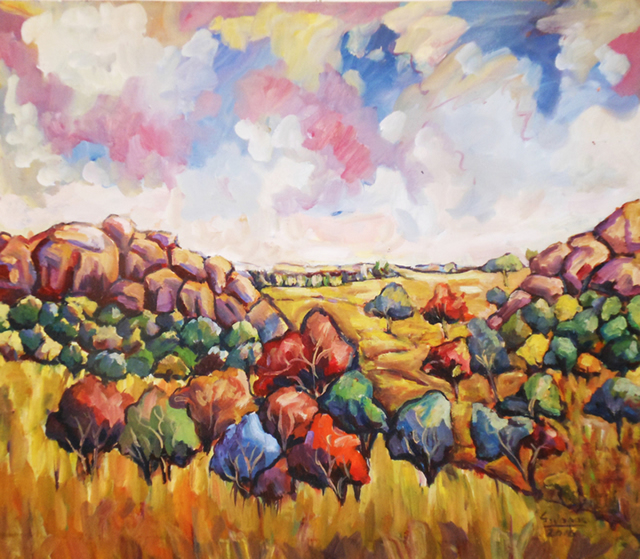

Stephen Garan’anga : Own Correspondent
Once again it is that period of the year when Gallery Delta Foundation for Art and the Humanities presents an array of paintings by a select of artists depicting the wonders of nature and its impact on the environment. Currently the Gallery is showing “Terra IV”, an exhibition of mostly landscape paintings and a couple of three dimensional work recently created by natural contemporary landscape expressionists.It is no secret that since the existence of time nature has proved to have the ultimate powers of earth unleashing destructive forces which default, carve, reshape, sweep and bathe the planet.
The unstoppable forces which have a purpose for the existence of all living organisms often toss people’s intelligence, leaving them humble and licking their wounds, forcing them to respect what they do not create.
Nature rightfully positions humans where they thrive best, masterminding their creativity but being mindful of the ultimate powers and not trying to defy them. Ultimately people are better-off appreciating and drawing inspiration from these wonders, exposing their beauty to their kind and encourage their safeguarding as opposed to the current unimaginable volumes of destruction.
Zimbabwe has some of these beautiful natural wonders and “Terra IV” is quite a compact package revealing mankind’s appreciation of nature.
The tasked artists this time around include Valentine Magutsa, Batsirai Muskwe, Webster Mubayirenyi, Gilbert Jonasi, Brian Bradshaw, Mostaff Muchawaya, Munyaradzi Mugorosa, Helen Lieros, Daryl Nero, Kate Raath, Greg Shaw, Cosmos Shiridzinomwa, Richard Witikani and the late Robert Paul (1906–1980) and (Martin Van der Spuy 1951–2004).
Cosmos Shiridzinomwa has “Neighbours”, “Happy Day” and “Planting” in which “Neighbours” and “Happy Day” depict urban high-rising building landscapes giving precedence to the horizon in his turbulent shorty linear and slender brush strokes in representational abstract.
In both paintings the irregular shaped and wobbly-like buildings appear to be dancing in celebration of what appears to be a clean environment and fresh air around them on a brighter day.
“Planting” appears and tells something entirely different in a human landscape still conceding a bit to the horizon in the same technique. Innumerable mask-like bald-heads of seated figures and standing half bodies are congregated somewhere in an opening, attentively listening to some word.
The massive congregation resembles one of the many local white garmented and bald headed African apostolic faith sect followers. They are the most popular and involuntarily ever recruiting sect as many flock to them because of their consequential situations. The devotion of this sect’s members is phenomenal and it starts with the identity they have established for themselves which include their dressing, conduct, hierarchy and lifestyle.
Greg Shaw the sole provider of three dimensional work has a very powerful and delicate double series of mixed media constructions literally narrating water pipes’ lives in “Pipe Dreams” 1 and II. But in another sense they express the lot which is bottled inside of many beside the deceiving external appearance.
Their construction incorporate segments of pipe casted dirt of colour, sparkling fancy gold and stainless steel pipe joints, rings, a galvanised elbow joint and an on and off turning nob to highlight a few.
“Pipe Dreams 1” has at its summit an entry point with a ragged circular off crimson on/off turning nob fixed in its galvanised pipe joint exposing the interior contents of colour carried and caused by pumped water.
These leave us wondering how much of the rust and fine alluvial dirt we consume in what appears to be sparkling clean water. The entry point lead us to an elbow joint that turns down along the wall the rest of the construct.
The piece about a meter long has the elbow joint connected to a pipe of casted light brown soil that goes down barely 20 centimetres before sandwiching about three centimetres of black casted earth to its final length below 30 centimetres.
A fancy gold plated hexagonal nut with a protruding spherical middle cast before ensuing few centimetres of thick spiral groves attach to yet another earth casted pipe of a bit of black, then a light brown, a much darker brown and another lengthy black clayey soil that connects to an above similar fancy gold connection.
The piece is finalised by a black earth cast pipe with a little bit of similar light brown soil toward its final three quarters before being concluded by another black to its holding thin metallic point. The appearance of the piece is as amazing just like the part II piece.
The previous year Greg was again the only provider of an awesome three dimensional work in “The Sentinel” which was in cooperation of stripped hard cardboard box exposing its interior ripples smeared in various shades of brown earth, forming bricks of an aged security brick wall.
They were stuck up past the middle of two almost similar rectangular platforms like fairly small sized canvases. Above the brick-wall were six horizontal strips of rusty security razor wire against a distant background of again horizontal strips of dominant thicker dark blues and thinner shades of lighter ones signalling a deem day-end creating a perfect horizon with the foreground brick-wall.
In-between the two portrait landscapes at equal distances apart was a formidable vertical termite engraved hardwood plank seemingly retrieved from the same earth to bisect the landscape but bearing the same brick-wall and razor-wire at same heights as the two pieces.
The plank extended about 25 centimetres below the baseline of either pieces exposing its once sunk darker underground brown earth colour. Just above the uppermost razor-wire line tied around it was a plank that extended beyond the rectangular pieces to about forty-five centimetres of its broken tip to conclude the masterpiece.
The 2016 edition of the landscape works’ exhibition has over forty must see beautiful paintings before it’s shut down after a month’s duration.



 Online Reporter