admin
admin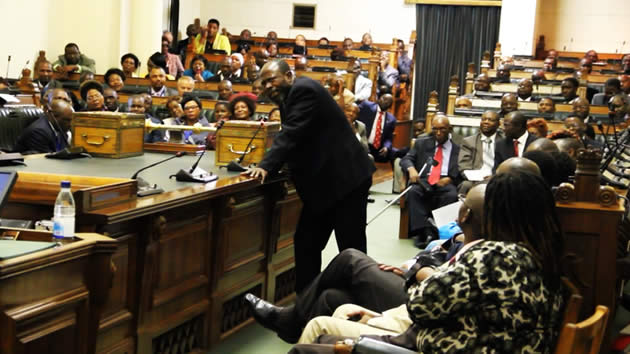
Zvamaida Murwira Mr Speaker Sir
While the establishment of Parliament’s portfolio and thematic committees has been hailed as a huge step towards enhancement of the legislature’s role, questions still abound if that has helped in achieving the intended objectives. An area of debate has been to what extent should the Executive respond by way of implementing recommendations proffered by these portfolio committees during Parliament’s plenary sessions?
Over the years, portfolio committees have been in the limelight for their investigative and inquisitive role as they seek to play their oversight role to the Executive.
They have unearthed some irregularities that have taken place in Government ministries and departments.
Another important role that they have carried out is to conduct public hearings across the country and establish people’s views on Bills before Parliament or on a topical subject.
After gathering evidence from witnesses on a subject or a Bill, reports are presented to the full House.
The reports also carry recommendations the committees hope should be considered by the Executive through the responsible minister if the issues relate on public policy or a Bill.
The issue now is how many of these recommendations have been taken on board by the relevant ministries?
How many ministers have come to Parliament to respond to issues raised by portfolio committees in their reports to plenary?
The electorate commends ministers who have made themselves available to Parliament and responded to reports that tabled by portfolio committees.
Sadly, others have since the demise of the inclusive Government not cared to respond.
Perhaps it is too early to judge the current Parliament insofar as responding or taking on board recommendations is concerned.
However, most important is that the Constitution is clear on the issue of Bills.
It says efforts must be made to conduct public hearings for a Bill that is before Parliament.
It is therefore in the spirit of the Constitution not to render these public hearings academic when their recommendations are not considered.
Section 141 of the Constitution sub-titled “Public Access to and Involvement in Parliament” says: “Parliament must (a) facilitate public involvement in its legislative and other processes and in the process of its committees (b) ensure that interested parties are consulted about Bills being considered by Parliament unless such consultation is inappropriate (c) conduct its business in a transparent manner and hold its sittings and those of its committees in public though measures may be taken (i) to preserve order in parliamentary proceedings.”
The requirement to consult in terms of the Constitution is peremptory, though it provides for exceptions if there are no resources to undertake the process.
What the above clause demonstrates is that the Constitution values public participation on Bills hence the need to avoid portfolio committees to embark on an academic process whose recommendations will not be considered.
Examples abound, particularly on Bills where very little attention, if any, is given to recommendations proffered by portfolio committees after an extensive consultative process.
One quick example is the effort Parliament gives to annual National Budget consultations.
The Portfolio Committee on Budget and Finance carries out public hearings throughout the country gathering people’s views.
In addition to that, the whole Parliament, with the majority of Government ministers including the Finance Minister, captains of industry and other stakeholders, make a retreat to Victoria Falls for almost a week brainstorming on how the following year’s annual Budget should be structured.
This has happened almost every year and vibrant ideas came up.
With respect to last year’s retreat, it was commendable that Finance Minister Patrick Chinamasa sat in throughout the retreat. This is in contrast with former Finance Minister Tendai Biti who would catch the next flight back to the capital soon after making his presentation, leaving officials from his ministry to listen to the remaining inputs.
The point now is that the whole process could be a waste of time if the relevant minister does not consider what comes out of such a meeting.
In his speech during a pre-Budget seminar in Victoria Falls Speaker of the National Assembly Cde Jacob Mudenda said: “The execution of our constitutional mandate of making laws for the ‘peace, order and good governance of Zimbabwe’ must be grounded in the values enshrined in the Constitution, the supreme law.”
Said Cde Mudenda: “Section 119 of the Constitution of Zimbabwe states that Parliament must protect the Constitution and promote democratic governance in Zimbabwe.
“Parliament has power to ensure that the provisions of the Constitution are upheld and that the State and all institutions and agencies of Government at every level act constitutionally and in the national interest. All institutions and agencies of the State and Government at every level are accountable to Parliament.”
Parliament, therefore, has an onerous responsibility to spearhead sound corporate governance practices through its oversight function by acting as a constitutional watchdog and ensuring that all State institutions are administered in the national interest and in line with the values and principles enshrined in the Constitution.
Some ministers have not shown preparedness to respond to recommendations.
Some have not bothered to implement them or explain to the Legislature why they failed to implement proposed recommendations.
The failure by Cabinet ministers to respond or act on portfolio committee reports frustrates the work of these committees.
Reports tabled by these portfolio committees are then be rendered academic by the failure to be respond to them by the Executive.
A lot of resources are used by the Portfolio Committee on Budget and Finance in gathering views from people across the length and breadth of the country.
The committee then compiles a report for the minister responsible to consider.
Legislators subsequently hold debates where they make suggestions on what can be done to enhance revenue generation and other fiscal policies.
The issue of the National Budget is just but one example as there are many other reports that have been made including motions that have been debated and adopted by the plenary sessions of Parliament.
Members of Parliament raised this issue recently during a parliamentary workshop by the Zimbabwe Lawyers for Human Rights aimed at enhancing their oversight.
Legislators said that while they had raised issues that needed to be considered, the response from the Executive had been frustrating.
Clerk of Parliament Mr Austin Zvoma told the legislators that their role was not to govern but to provide checks and balances through their oversight role.
Mr Zvoma said the Constitution was clear on the doctrine of separation of powers that the Executive is there to govern and it should govern without hindrance while the role of the Legislature is to play an oversight role.
University of Zimbabwe law lecturer Professor Lovemore Madhuku who was one of the panellists told the legislators that the role being carried out by legislators of making “noise” was enough in a democratic society such as Zimbabwe.
He said that role of highlighting deficiencies and giving advice was big enough for the legislators.
However, MPs still felt that while all that was true there was need for the Executive to seriously consider what they said during debates in the spirit of pulling the nation together.
Feedbak [email protected]


 Online Reporter