Judith Phiri [email protected]
SPEAKER of Parliament Advocate Jacob Mudenda has called for increased funding to accelerate the rehabilitation and upgrading of the Bulawayo–Victoria Falls Road, proposing additional tollgates and other innovative financing models to fast-track the rehabilitation of this strategic transport corridor.
Adv Mudenda said the 2027 National Budget should prioritise infrastructure development and mobilise private capital through public-private partnerships, diaspora infrastructure bonds and build-operate-transfer (BOT) arrangements.
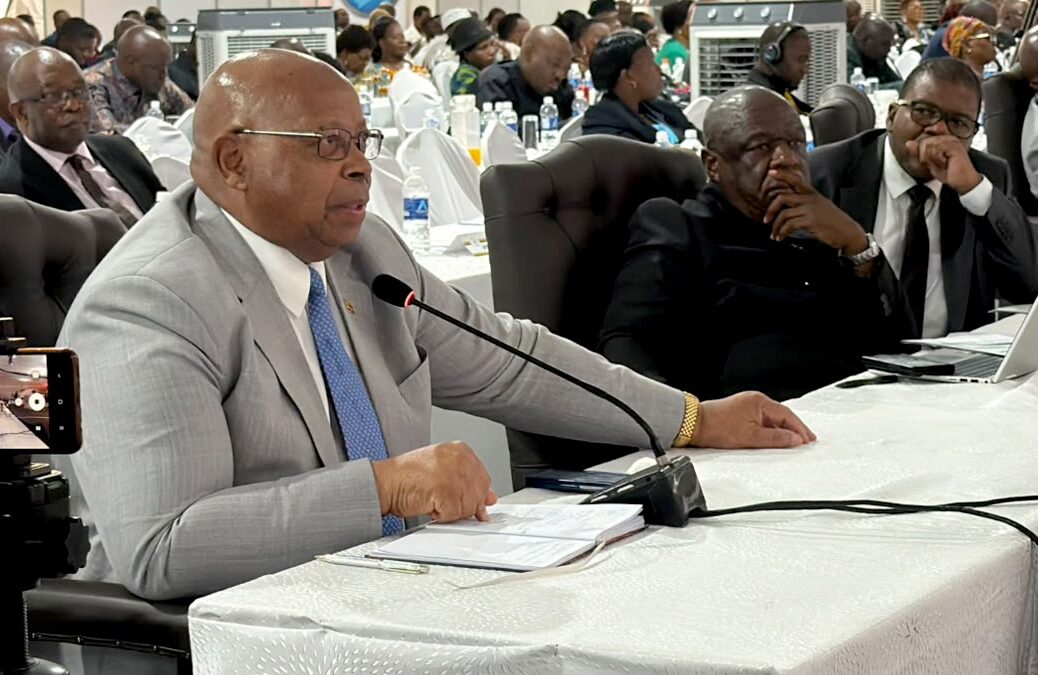
He was speaking at the 2027 National Pre-budget Seminar in Bulawayo yesterday, where he challenged policymakers to explore sustainable ways of financing major national projects without placing excessive pressure on the fiscus.
“Why not put more money on the Bulawayo–Victoria Falls Road? Put more tollgates; I know some people criticise me, but the truth is sometimes it’s painful,” he said.
Adv Mudenda said additional tollgates, similar to those along the Harare–Bulawayo Road, could help raise funds for the rehabilitation and upgrading of the highway.
The Bulawayo–Victoria Falls Road is an important transport link connecting Zimbabwe’s second-largest city with one of its leading tourism destinations. Its improvement is expected to support tourism, trade and the movement of agricultural produce, minerals and other such goods.
Adv Mudenda said infrastructure financing should also come from institutional investors, including pension and insurance funds provided the investments were commercially viable and safeguarded the interests of contributors and policyholders.
“This should be done through appropriately structured public-private partnerships suitable for prescribed asset investments, diaspora infrastructure bonds and build, operate and transfer (BOT) arrangements so that strategic national projects advance without over-burdening the fiscus,” he said.
Adv Mudenda cited the Public Service Pension Fund’s reported investment of nearly US$60 million in a modern dry port near Forbes Border Post in Mutare as an example of how institutional capital could support infrastructure development.
The facility is intended to strengthen the eastern trade corridor by developing a regional logistics hub.
Adv Mudenda said pension and insurance funds represented substantial potential sources of investment, citing reported asset figures for the National Social Security Authority (NSSA), Old Mutual and the Public Service Pension Fund.
He said NSSA’s management reported an asset base of just over US$1 billion in February 2026, while Old Mutual’s 2024 annual report disclosed asset base of US$1,2 billion. Treasury reported Public Service Pension Fund capitalisation of US$700 million as at August 2025.
Adv Mudenda said the 2027 Budget should place emphasis on acceleration of mineral beneficiation and agricultural value addition, arguing that Zimbabwe needed to retain more economic value from its natural resources.
“Relatedly, the commitment to continue promoting value addition and beneficiation of minerals and agricultural products is integral to our economic transformation agenda. Nowhere is the imperative more vivid than in the lithium sector, where the country exported 520,9 thousand tonnes of lithium concentrate in the first half of 2026 alone, earning US$671,7 million,” he said.
Adv Mudenda said greater domestic processing could increase the value generated from mineral exports, pointing to Indonesia’s restrictions on raw nickel ore exports and subsequent investment in local smelting and refining as an example of pursuing beneficiation.
“The 2027 Budget must drive Zimbabwe’s own beneficiation agenda through targeted incentives that build domestic value chains and convert the mineral endowment into industrial capacity, employment and enduring national wealth,” he said.
On climate resilience, Adv Mudenda said the economy remained vulnerable to drought and other climate shocks, calling for increased investment in irrigation, drought-tolerant crop varieties and disaster-response capacity.
He said the 2027 Budget should respond to climate risks, including the possibility of below-normal rainfall across parts of Southern Africa, by strengthening the country’s capacity to withstand drought.
“The 2027 Budget should, therefore, deepen investment in irrigation infrastructure, drought-tolerant crop varieties and disaster-response capacity, guided by the six pillars of drought mitigation adopted by Cabinet,” said Adv Mudenda.
He also called for the expansion of irrigation and agro-industrial activities around existing water bodies to reduce dependence on rain-fed agriculture.
Adv Mudenda said the “Dam-As-An-Economy” concept should be fully implemented and supported by a dedicated budget allocation, with major dams serving multiple economic purposes.
“That is why the Dam-As-An-Economy concept has to be embraced unequivocally, fully operationalised and given a dedicated budget line. Every major dam must become an economic ecosystem sustaining irrigation, aquaculture, tourism, renewable energy, agro-processing and rural industrialisation,” he said.
The Speaker urged the Executive to identify funded projects and implementation timelines for unlocking the productive potential of big dams such as Tugwi-Mukosi, Zimbabwe’s largest inland dam and other major water bodies.
Adv Mudenda also called for adequately funded social safety nets to protect vulnerable households, particularly in rural areas, from climate-induced food insecurity and livelihood losses.
The four-day seminar is being held at the Zimbabwe International Conference and Exhibition Smart City under the theme, “Accelerating Economic Transformation and Building Resilience to Climate and Global Shocks”.
The event brings together Government ministries and Parliamentary Portfolio Committees to deliberate on policy measures, sectoral priorities and funding requirements ahead of the presentation of the 2027 National Budget, scheduled for November 19.
The deliberations align with Parliament’s budget oversight and consultation processes, with recommendations expected to inform the allocation of public resources in line with the country’s development priorities.