Chronicle Editor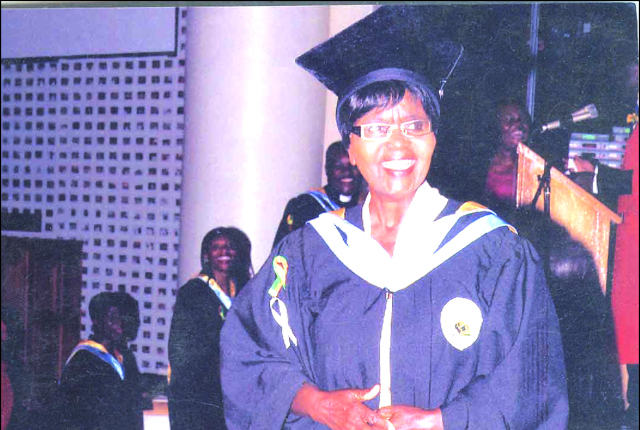
• ‘I had to give my children a chance’ • Colonial setbacks a factor • Hubby shares in delight
Leroy Dzenga Features Writer—
AT an age when most people prefer sun-basking and confining their daily routines to less demanding commitments, 77-year old Hatifari Munongi of Marlborough,Harare, chose to take the bull by its horns.
Despite her age and accomplishments, she wanted to make one more stride.
Haunted by a dream she had sidelined for over four decades, her enrolment at Women’s University in Africa in pursuit of a Bsc Honours Degree in Sociology and Gender Development Studies was meant to appease her burning desire to be a university graduate.
The Herald caught up with Mbuya Munongi who was full of joy at her home after her graduation.
She explained why she signed up for a daunting three years of assignments, in class tests and examinations when she already has grandchildren.
“Growing up, I was in constant competition with my brother who was brilliant in class. I always knew that I had the ability to achieve a lot academically, but things were not as easy for us in the colonial era.”
According to her, living without an academic degree felt like a betrayal of the brilliance she had shown in her schooling days.
“When we were in primary school, I skipped Standard 2 because my teachers thought I was brilliant. I joined my brother in Standard 3 and competition ensued,” said Gogo Munongi.
They would later proceed to Waddilove Institute for Standard Four to Six.
“Unfortunately for us, the colonial system presented many obstacles for black students at the time. The two viable options available were either nursing or teaching for us,” she said.
Gogo Munongi chose to go into teaching, a profession which played cupid for her and her husband.
“I studied and attained my diploma in Education. As soon as I ventured into teaching, I met my husband who was also a teacher,” Mbuya Munongi said.
Her husband read for his Ordinary and Advanced Level, but Mbuya Munongi could not follow suit because of the strain presented by child bearing and employment.
She, however, did not allow this to be a permanent hurdle for her.
“In 1966 after I had given birth to all my three children, I decided to resume my studies. I started with ZJC which I passed and then I proceeded to do my O-Levels,” she said.
Mbuya Munongi said studying for her Ordinary Level was the hardest academic battle she found herself in, she was at the prime of her teaching career and her children were in need of their mother.
“I had to write one subject a year to strike a balance. It took me five years to attain five Ordinary Levels writing one after the other,” she narrated.
After getting her Ordinary Level passes, her children were now of school going age. Because of limited resources she had to again suspend her studies to allow her children to get a befitting education.
“By the time I had my O-Levels, I could not immediately continue because my children also wanted to go to school. We had to prioritise them and I had to shelve my dream once again,” Mbuya Munongi said.
She made sure her children read to the highest level, her first daughter Barbara Mushayandebvu holds a Degree in Nursing and is the chairperson of the Operating Room Nurses Association in Canada.
Her other two children, Vimbai and Tafara, who hold college degrees, are practicing nurses in the United Kingdom.
She said in 1982 she was invited by an American University to read for a degree in early childhood development on a scholarship, but her then young children could not afford to grow up without a mother in proximity.
In the early 90s Mbuya Munongi picked up from where she had left off, but studying towards a different end.
Between 1994 and 1996, she went to Bible school and qualified to be one of the first female black ministers in the Methodist Church in Zimbabwe.
After attaining a Diploma in Religious Ministry, she served as a Minister in the Methodist Church in Zimbabwe until her retirement from active ministry in 2010.
“I served in the Methodist Church in Zimbabwe Marlborough Circuit until 2006 when I retired. The retirement was just a formality as I am still involved in the same activities as before,” she said of her role in church.
After being satisfied that all her children were on their feet, she decided to revisit her dream of getting a university degree.
“Three years ago I found myself sitting and I thought to myself that I am out of excuses, I had to get that one thing I have always wanted,” she said.
This saw her enrol at the Women`s University in Africa doing a BSc Honours Degree in Sociology and Gender Development.
“With two diplomas under my belt, I did not have any problems getting a place at the university since I met all the minimum requirements,” said Mbuya Munongi.
She was sceptical about how she was going to grasp the module on computer literacy, which has become a standard part of the tertiary curriculum.
Her fears must have gotten in the way of her comprehension as she failed them on the first attempt.
“First year, the only module I failed were computers. However, I did not give up. I rewrote them and I passed. I was determined to prove myself,” she said.
During the course of her studies, she fell in love with one particular module which stood out as her favourite.
“My favourite course was Social Theory, the lecturer was very good. He would give clear examples which were easy to follow,” said Mbuya Munongi.
The module touches the day to day lives people lead and it was easy for her to come up with examples since she has seen a lot unfold.
Understanding the dynamics of life beyond the layman’s perspective was the reason why she chose to read Sociology from an array of available options.
“In my life I have had the opportunity to live in different environments and meeting different people. Social interactions have always fascinated me, hence my need to study how they really operate,” she said.
Most of her classmates were younger than her, a difference that worked to her and their advantage.
“I was fortunate to be in a group of students who accepted me as I accepted them.
“They were sympathetic, if I did not understand something they would slowly take me through the paces to make sure I grasped the concepts,” she said.
Mbuya Munongi said her experience in life came in handy in dealing with real life scenarios to use in writing assignments and examinations.
“There were times when I had to lead the discussions because I have seen a lot more than all of the people I was in class with. Especially in cases where a historical insight was needed, so we complemented each other,” she said of the age difference between her and classmates.
Despite some of the lecturers being young enough to be her children, Mbuya Munongi said she still accorded them their due respect.
A gesture they reciprocated with taking extra care when teaching complex concepts to accommodate her.
Her time at the university inspired her dissertation research which was centred on the “experiences and challenges faced by elderly students at tertiary institutions”.
Her husband, Sekuru William Munongi was elated at his wife’s achievement.
“As you can imagine, I sacrificed a lot, there was a time when I would want to sit down with my wife and talk, but she would be at school,” he said.
Mbuya Munongi’s study routine which involved waking up at half past three in the morning on a daily basis, weighed heavily on her husband.
“Some of the times I would wake up in the early hours of the morning to check on her. I would see her reading her Bible preparing for a sermon, with her school books awaiting her attention. I felt the workload was unfair on her, but she was determined,” he said.
He said the uncertainty involved in driving at night after she had finished her lecturers made him anxious.
Asked on whether she wishes to continue studying, Mbuya Munongi said she is entertaining the idea of pursuing a Master’s Degree.
“I am still deciding on my next move. There is one thing about fulfillment, there can never be satisfaction and a Master’s Degree is a possibility,” she said.
Her passion for education does not allow her to rest as she is working at Marlborough Primary School`s Cultural Centre, teaching culture and Shona language.
Mbuya Munongi’s story is evidence that late is nothing but a mere word in vocabulary, its meaning can be made void by a determined state of mind.
Feedback: [email protected]


 Online Reporter