Online Reporter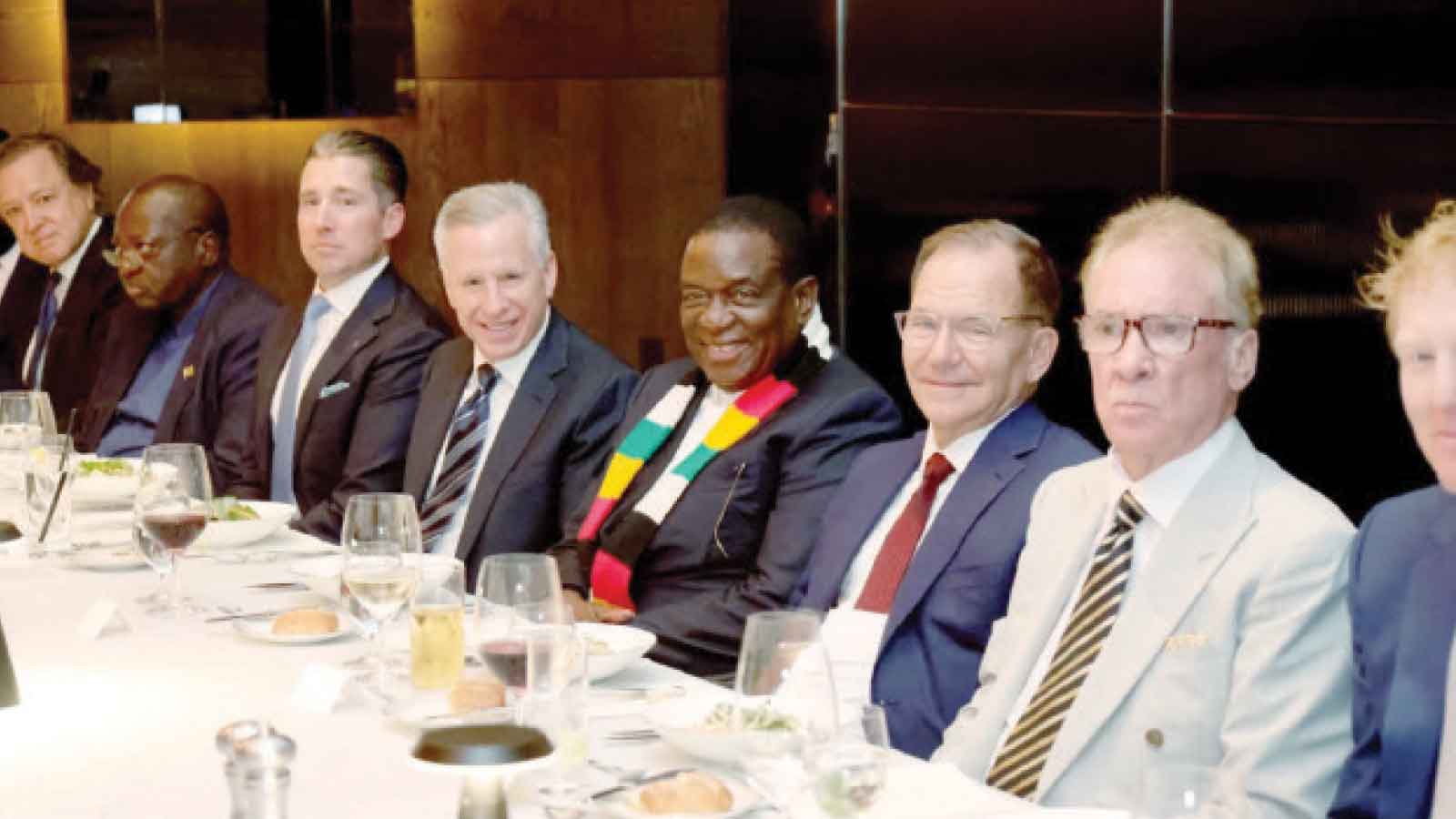
Communion with Bishop Lazarus
Phew!
What a week it was.
Well, last week, the centre of the political universe shifted to New York, as it always does this time of the year for the United Nations General Assembly, when delegates from more than 193 countries around the world typically huddle together in New York City for a marathon of diplomatic engagements that shape the future and fate of the world as we know it.
While it is tempting to label it a mundane annual diplomatic procession where delegates get an opportunity to frolic in the neon lights and glitzy billboards of a city considered to be a major global centre for finance, culture and entertainment, it is anything but.
We should never forget that the UN itself was a creature that was born out of failure — and the memory of millions dead.
After the First World War, which claimed close to 22 million lives, the League of Nations was created to keep the peace.
But it had a congenital defect, as it was weak by design — the United States never joined. Decisions often required unanimity. It had no real army, no enforceable authority and no answer when major powers simply ignored it.
In the 1930s, it watched Japan invade Manchuria, Italy invade Ethiopia and Nazi Germany tear up treaties.
By the time the Second World War erupted, the league was only but a ghost.
The war itself was a relentless human meat grinder, as between 70 million and 85 million people perished, including from our own continent, Africa. When the war ended in 1945, the world was determined not to repeat that mistake.
Better a weak UN than nothing at all
The UN Charter, signed in San Francisco and entering into force on October 24, 1945, created a new organisation with a clearer mandate: “to save succeeding generations from the scourge of war”.
It was designed to give every country — however big or small — a platform to speak on global affairs through the General Assembly, where each state has one vote.
Also integral to this global architecture was the Security Council, which was given primary responsibility for international peace and security, with real powers to impose sanctions and authorise force.
Notwithstanding its perceived weakness, it, however, remains the world’s only truly global forum, a standing table where rivals can talk, small states can be heard and crises can be confronted before they burn out of control.
It is meant to backstop world peace — not as a guarantee, but as a mechanism.
You see, its promise is not that war will never happen, but that the world will never again have to face it without a common place to stand.
While it is fashionable to call the UN weak, it has to be appreciated that its weakness is also the price of its universality.
It cannot force great powers to behave. But it can give the weak a microphone, the small a vote and the aggrieved a hearing.
Strip that away, and the only language left is the language of power.
For small and middle powers, the alternative to a flawed UN is the law of the jungle, where the strong do what they can and the weak suffer what they must, as well as pure unilateralism — no charter, no assembly, no council, no rules, no restraint.
So, yes, the UN might be weak, but the alternative could be worse. Much worse.
Empty brains see empty chairs
For the lunatic fringe in our teapot-shaped Republic, the participation of our delegations at the UN is often foregrounded by the usual, but now tired, spin on purported empty chairs in the General Assembly Hall when our leaders deliver their speeches during the General Debate, that annual high-level meeting where world leaders and sovereign nations pronounce themselves on critical global issues.
All they see are rows of empty blue seats, a few scattered diplomats scrolling their phones and the occasional delegates seated somewhere at the back.
The internet, ever eager, dubs this “the empty chair problem”.
The implication is deliciously cynical: World leaders fly thousands of miles to lecture a ghost town.
The General Debate, we are told, is a vanity project, a series of soliloquies delivered to no one. But here is the thing about empty chairs at the UN: They are rarely actually empty.
They are, in fact, aggressively, bureaucratically, maddeningly occupied — just not by the people you see on camera.
What our cynics do not know is that the hall is not a theatre.
It is a workplace. And like any workplace, people step out.
The delegate of a small island nation is not skipping your speech because he does not care about your thoughts on multilateralism.
He is skipping it because he is in a bilateral meeting with the delegate of another small island nation.
And that meeting could be happening in a windowless room three floors down, and it could have started minutes late because the elevator was held up by a security detail for a president who is currently speaking in the hall.
Then there is the phenomenon known as “the listening room”.
Every speech is simulcast to overflow rooms, delegation offices and — crucially — the permanent missions across town.
Ambassadors don’t need to sit in the hall to hear you. They can watch you on a screen while drafting a press release, eating a sandwich or arguing with their foreign ministry back home.
And let us not forget the seating chart.
The General Assembly Hall is a carefully calibrated diplomatic ecosystem.
The front rows are reserved for the big fish — the P5 (the five permanent members of the UN), while the back rows are for everyone else. But the back rows are also where the real work happens.
That is where you will find the delegates who are actually negotiating the text of a resolution, swapping intelligence or trying to figure out if the speech they just heard signals a shift in policy or just a bad translation.
It also has to be considered that the General Debate is a marathon, not a sprint.
It runs for six days, with speeches from morning until night.
No one — not even the most dedicated diplomat — can sit through all of it. So, they usually don’t.
This, however, cannot be construed as disrespect.
Busy in the corridors, building a Security
Council runway
The inherently unflappable President ED and his lieutenants were clearly not waiting for the applause.
On the sidelines of the United Nations General Assembly, they ran a schedule that read less like a diary and more like a diplomatic treadmill.
They remained laser-focussed on delivering on the key objectives that matter: deepening Zimbabwe’s integration in the comity of nations and clearing the pathway ahead of Harare’s assumption of a non-permanent seat on the UN Security Council for 2027-2028 term, a task that begins in three months.
They met Zimbabwe’s diaspora in a continuing effort to tap their skills and expertise, engaged potential US investors and convened a business forum to showcase the many opportunities that exist back home.
In-between these schedules, the Zimbabwean delegation attended the high-level meeting on China’s Global Development Initiative, whose main objective includes poverty eradication, food security, energy, health, digital transformation and infrastructure.
Zimbabwe also attended the 50th annual meeting of Ministers of Foreign Affairs of the G77 and China, a grouping that advocates for a more representative, equitable and development-centred multilateral system, values that Harare will also advance in the Security Council .
There were many other engagements of this nature.
The bilateral diary was just as packed, as there were critical liaisons with Azerbaijan, Algeria, Austria, Benin and Malta, among others.
A new trajectory to prosperity
The Second Republic has clearly made a break with the past, where megaphone and combative diplomacy suited the politics of those heady political times when Zimbabwe was under siege owing to the Fast-Track Land Reform Programme at the turn of the millennium.
As small as Zimbabwe was, and is, it gave as good as got, trading pound for pound with formidable foes, and did not capitulate.
After securing the irreversibility of the land reforms and consolidating its gains, the Second Republic has strategically changed course.
It now seeks peace and prosperity through renewed economic diplomacy.
Scripture does not leave engagement with other nations and the pursuit of peace as optional extras.
It commands them.
Peace is not a diplomatic luxury either; it is a divine mandate.
Jesus said: “Blessed are the peacemakers, for they will be called children of God” (Matthew 5:9).
Paul wrote: “If it is possible, as far as it depends on you, live at peace with everyone” (Romans 12:18).
Hebrews also commands: “Make every effort to live in peace with everyone” (Hebrews 12:14).
But here is the lesson from New York that the cynics miss: Peace and prosperity are not manufactured on the blue chairs of the General Assembly Hall.
They are forged in the corridors — in the bilaterals, the MoUs, the visa waivers, the business forums and the quiet handshakes between delegations that never make the evening news.
The chair is where you make a speech. The corridor is where you make a deal.
The plenary is where you state your position. The margins are where you change your fortunes.
Zimbabwe understands this.
That is why Harare was busy filling its diplomatic dance card — deepening integration, expanding partnerships and laying the groundwork for its Security Council term.
And this is precisely the reason Harare’s economy has been taking off at break-neck peace.
Economic diplomacy is our trump card.
Bishop out!