Online Reporter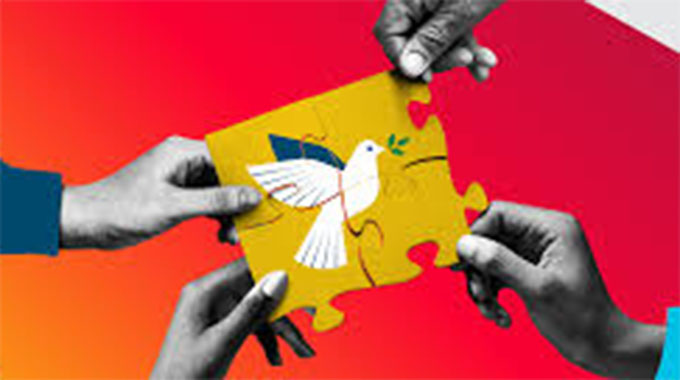
Flora Teckie-Correspondent
We all yearn to live in a peaceful world.
But what are the prerequisites for peace?
Peaceful co-existence starts with us, from inside our homes and from our neighbourhoods. It starts by newfound friendships, seeing no one as a stranger, but all as members of one human family.
Honouring diversity, and not making differences a cause for conflict and contention, in the Bahá’í view, requires a new way of thinking and acting, based on the acceptance of the oneness of our human family and respect for the rights of every individual.
Furthermore, a conscious, deliberate, and sustained effort is necessary to foster mutual understanding among individuals and diverse groups in our communities, and in global society.
As members of one human family, we have become more and more interdependent.
More than ever before, we now have conditions for the establishment of lasting peace on earth. The scientific and technological advances of our times offer practical ways by which problems of humanity may be solved.
They also provide the means for the administration of the complex life of a united world. Despite such advances, there are persistent barriers to peace.
Overcoming barriers to peace
One of the greatest barriers to peace is racism.
The Universal House of Justice, the international governing council of the Bahá’í Faith, states: “Racism, one of the most baneful and persistent evils, is a major barrier to peace. Its practice perpetrates too outrageous a violation of the dignity of human beings to be countenanced under any pretext.
“Racism retards the unfoldment of the boundless potentialities of its victims, corrupts its perpetrators, and blights human progress. Recognition of the oneness of mankind, implemented by appropriate legal measures, must be universally upheld if this problem is to be overcome”.
We are one human species. Physical differences such as skin colour or hair texture are superficial and have nothing to do with any supposed superiority of one group or another.
According to the Bahá’í Writings, we are like flowers in one garden, the fruits of one tree and the leaves of one branch. Although we differ from one another physically and emotionally, and have different talents and capacities, we all spring from the same root; we all belong to the same human family.
Another barrier to peace is the extremes of wealth and poverty.
According to the Universal House of Justice, “The inordinate disparity between rich and poor, a source of acute suffering, keeps the world in a state of instability, virtually on the brink of war.
“The solution calls for the combined application of spiritual, moral and practical approaches. A fresh look at the problem is required, entailing consultation with experts from a wide spectrum of disciplines. . . and involving the people directly affected in the decisions that must urgently be made”.
Inequality of men and women is another barrier to peace. The empowerment of women, and attaining their equal status with men, in the Bahá’í view, is necessary for the transformation of our communities and it is also a prerequisite to world peace.
According to the Universal House of Justice, “The emancipation of women, the achievement of full equality between the sexes, is one of the most important, though less acknowledged prerequisites of peace.
“The denial of such equality perpetrates an injustice against one half of the world’s population. . . There are no grounds, moral, practical, or biological, upon which such denial can be justified.
“Only as women are welcomed into full partnership in all fields of human endeavour will the moral and psychological climate be created in which international peace can emerge”.
In our attempts to solve global problems and set human affairs right we cannot ignore the role of religion. No serious attempt for achieving world peace can ignore religion.
However, the distortion of religion and the misuse of religious authority have contributed to much of the confusion in society and have caused conflicts between individuals and groups.
“The challenge facing the religious leaders of mankind is to contemplate, with hearts filled with the spirit of compassion and a desire for truth, the plight of humanity, and to ask themselves whether they cannot, in humility before their Almighty Creator, submerge their theological differences in a great spirit of mutual forbearance that will enable them to work together for the advancement of human understanding and peace”, says the Universal House of Justice.
Another barrier to peace is lack of provision of education to everyone. Education is vital to the development of each individual’s potential, and must be provided to all.
Nurturing through education, an appreciation for the richness and importance of the world’s diverse cultural, religious and social systems, will help free learners from prejudices that are the main causes of conflicts and wars.
Moral and spiritual education, in addition to intellectual education; as well as education for international understanding and peace, is an essential element in creating a peaceful social order.
• Feedback: [email protected] or [email protected]