

 Chronicle Editor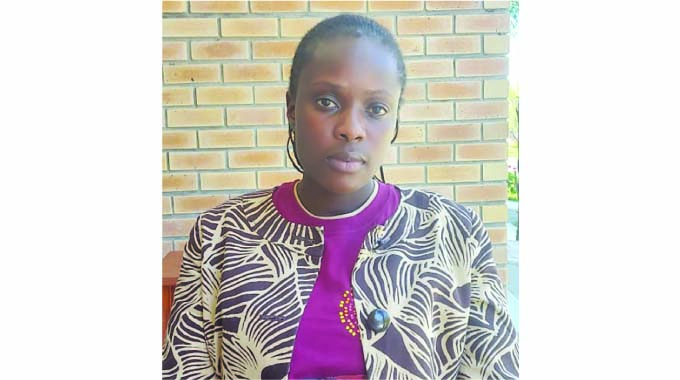
Sukulwenkosi Dube-Matutu, Matabeleland South Bureau Chief
WHILE her dream of becoming a lawyer has stalled despite attaining an impressive 15 points, 24-year-old Miss Nomkhuleko Ncube has found purpose in being a peer educator who shares sexual and reproductive health and economic empowerment issues with young girls in Gwanda.
Her experience as a peer educator has motivated Miss Ncube who aspires to become a human rights lawyer.
Coming from rural Fumugwe, Miss Ncube has been exposed to the social, economic, sexual risks and challenges faced by adolescent girls and young women.
Miss Ncube who is self-driven, bold and exudes a lot of confidence was selected to be a ward facilitator under the DREAMS (Determined, Resilient, Empowered, Aids-free, Mentored and Safe) programme last December. She was later elevated to become the Gwanda district ambassador for the programme.
The programme helped her undergo a three-month training in mineral processing at the Zimbabwe School of Mines.
DREAMS seeks to empower adolescent girls and young women through youth-friendly reproductive health care and social asset building. It is a USAid-funded programme which also mobilises communities for change with school and community-based HIV and violence prevention. It is being implemented by the Zimbabwe Health Intervention (ZHI).
Miss Ncube said her dream of becoming a lawyer still stands and her training has started with her advocating for the rights of her peers and facilitating change within the community.
She completed her A-levels in 2016. In 2019, she enrolled with the Midlands State University as a law student but she dropped out in her first semester due to financial challenges.
“I did my primary education at Bethel Primary and Form 1 and 2 at Bethel Secondary in Gwanda. I then transferred to Sikhulile High School where I did my Form 3 to 6. I passed with 15 points at A-level and then I immediately knew that my dream of becoming a lawyer was becoming a reality,” she said.
“I however, failed to go to university the following year due to financial challenges. My mother used to work in South Africa but she returned home. My maternal grandmother sold a beast and I managed to secure a place at Midlands State University as a law student. But I had to drop out of university after completing the first semester of my first year.”
Miss Ncube said although she grew up learning at rural schools, that did not stop her from dreaming big. She said she benefited a lot from literature which the school received from the Edward Memorial Library in Gwanda as it helped her perfect her language and sharpen her mind.
She said the DREAMS programme had empowered her economically as she was getting an allowance as a facilitator and ambassador. Miss Ncube said she first went through an interview in order to qualify for the programme and then received training. She said as an out of school club facilitator, her responsibilities include screening adolescent girls and young women for enrolment.
Miss Ncube also conducts peer education on HIV/ Aids and sexual reproductive health-related issues and economic strengthening education.
“As a facilitator, I’m also a go-between for service providers and the adolescent. If a service provider is coming, I mobilise adolescent girls and young women for clinical services being provided by stakeholders for example HIV testing, STI screening and treatment, PREP, family planning among others,” she said.
“I was appointed as a DREAMS ambassador in June and my main task is to sell the programme to the community and to promote uptake of services to adolescent girls and young women. I also engage community leaders and traditional leaders to bring them on board.”
She said she has found purpose in changing the lives of adolescent girls and young women.
Miss Ncube said the hardships and challenges that she has faced in life have helped her motivate and support others while the experiences of her peers served as life lessons for her as well. Miss Ncube said there were many challenges that adolescents and young women face which can best be solved through peer to peer interaction.
“Peer to peer interaction is a good motivation and learning tool. Sometimes people of a different age group may not understand and relate to our challenges because of the age gap but as peers we can work through our challenges together while getting guidance from our elders. My training as a lawyer has already started through my work.
I’m all about representation and being a voice for the voiceless. In the next five years, I see myself studying law. With my DREAMS experience my mind is now set on being a human rights lawyer,” she said.
Speaking during a ZHI meeting recently, Gwanda District project co-ordinator, Ms Nichola Sibanda said the DREAMS programme which is being implemented by ZHI working with other partners that include Government Ministries and departments, OPHID, Matabeleland Aids Council/ Population Services for Health and CeSHHAR seeks to bring different interventions of ensuring that adolescent girls are kept occupied and economically empowered.
She said the aim of the programme was to reduce new HIV infections among adolescent girls and young women with the programme targeting ages 10-24.
“Under the DREAMS programme, we emphasise service layering to ensure that adolescent girls are empowered and safe from HIV and Aids. If we don’t reach out to an adolescent girl, the probability of HIV and Aids will increase.
Our goal is to reduce new HIV infections among adolescent girls from ages 10 to 24 by 2026 in Zimbabwe. This will be possible through strengthening HIV and sexual violence prevention,” she said.
“Our target under the DREAMS programme is to empower the adolescent girl and young woman by dialoguing with the communities in order to change mindsets and identify challenges faced by adolescents.
We also have school and community-based HIV and violence prevention strategies where we screen adolescents and enrol them into the DREAMS programme.”
Ms Sibanda said in Gwanda, DREAMS is offering education support to 525 children in 35 schools. 20 young women from the district have undergone training with the Red Cross and are on attachment at Manama Hospital.
15 young women have received training under the Zimbabwe School of Mines.
DREAMS was announced on World Aids Day 2014 and since 2015, it has expanded from the original 10 to 16 countries in sub-Saharan Africa including Botswana, Cote d’Ivoire, eSwatini, Kenya, Lesotho, Malawi, Mozambique, Namibia, Rwanda, South Sudan, South Africa, Tanzania, Uganda, Zambia, and Zimbabwe and Haiti.
According to statistics, around 5 000 adolescent girls and young women aged 15 to 24 globally become infected with HIV every week. — @DubeMatutu


 Blessing Chizhande
 Online Reporter