

 admin
admin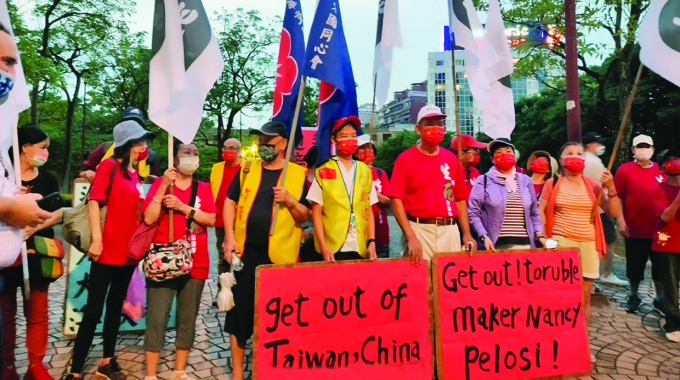
Gibson Nyikadzino Correspondent
The acts of provocation by the US government towards the People’s Republic of China over the former’s decision to let House Speaker Nancy Pelosi visit Taiwan are a reflection of the US’ impressions to violate the legitimate sovereignty of the Chinese.
Taiwan is not recognised by the United Nations (UN) for its lack of sovereignty because it is regarded, under international law, as a province of mainland China.
UN Resolution 2758 adopted in October 1971 at the 26th session of the UN General Assembly put the Taiwan question to rest.
Reads the resolution: “The UN General Assembly recognises that the representative of the Government of the People’s Republic of China is the sole legal representative of China in the United Nations and that the People’s Republic of China is one of the permanent members of the UN Security Council, and decides to restore all rights to the People’s Republic of China and recognise the representatives of its government as the sole legal representatives of China in the United Nations organisation and immediately repel the Chiang Kai-shek’s representatives from the seats of the United Nations Organisation and all its affiliated agencies which they have illegally occupied.”
Even under the 1933 Montevideo Convention on statehood, Taiwan falls short of qualifying for sovereignty as using the declaratory and the constitutive applications, its existence is delegitimised even if the US wants to resurrect it through provocation.
For all reasons, mainland China remains de jure the only legitimate country to maintain sovereignty over Taiwan. Mainland China should therefore implement its One-China policy.
But US provocation of mainland China is not only political. Recently, a group of Democrats and Republicans introduced a bill that would authorise the Joe Biden administration to create a new military aid program for Taiwan.
Modelled after the 1940s Lend-Lease Act that allowed the US to arm the allied powers during World War II, the bill resembles legislation recently passed to boost weapons supplies to Ukraine. The US wants to arm separatists.
For geo-political, trade, economic and maritime interests, the US is provoking mainland China along the Taiwan Strait as it facilitates mechanisms to torpedo China’s rising regional and global influence. In terms of maritime interests, the US wants to use Taiwan to stop China have control over the South China sea and expand its naval-power east-wards.
This also brings to the fore the establishment, in September 2021, of a military alliance by the United States, the UK and Australia that became known as the AUKUS.
The perception that led to the formation of AUKUS was the alliance’s intention to undermine mainland China and counter its assertiveness and influence in the region, especially in the South China Sea.
In terms of trade, by mainland China incorporating the province of Taiwan, it therefore means major ship lanes that go in and out of the South China Sea will be dominated by the People’s Republic of China.
Major US allies such as Japan will therefore be cut off from trades and supplies because the sea is also a road to wealth.
What are likely outcomes?
Zhang Jun, China’s permanent representative to the UN, on Monday said what the US is doing with Taiwan, threatening to alter the one-China principle, is tampering with “a red line” that will not be crossed.
“China firmly opposes any separatist move towards ‘Taiwan independence’ and any interference by external forces and allows no room for ‘Taiwan independence’ in whatever form,” said Zhang.
In a call with US President Biden last Friday, China’s President Xi Jinping told his counterpart that “those who play with fire will perish by it” and that when it comes to Taiwan, China hoped “that the US will be clear-eyed about this.”
The message being sent by President Xi is credible and is that the consequences of the actions by the US in Taiwan outweigh the goals and objectives it intends to meet. It is deterrence at panning out and warning the US that it should be wary about the actions it wants to embark on.
The statement issued by China’s Ministry of Foreign Affairs on Pelosi’s visit to Taiwan revealed the attitude of China on this issue.
It says “No country, no forces and no individual should ever mis-estimate the firm resolve, strong will and great capability of the Chinese Government and people to defend state sovereignty and territorial integrity and to achieve national reunification and rejuvenation. ”
It also indicates that China will definitely take all necessary measures to resolutely safeguard its sovereignty and territorial integrity in response to the US Speaker’s visit. All the consequences arising therefrom must be borne by the US side and the “Taiwan independence” separatist forces.
Let China sleep
A lot of literature attributes a remark about China to Napoleon Bonaparte. “Let China sleep,” he said, “for when she wakes, the world will tremble”.
China is not issuing empty threats about the Taiwan issue. What it is saying is credible. There is credibility in its deterrence mechanism for it has an effective military capability, it can impose unacceptable costs on the USA him and that it can use all its capabilities in the event it has been attacked.
The US is provoking a situation it will not handle, and this is different from many other scenarios that have been witnessed before.


 Online Reporter
 dyton mupawaenda