

 admin
admin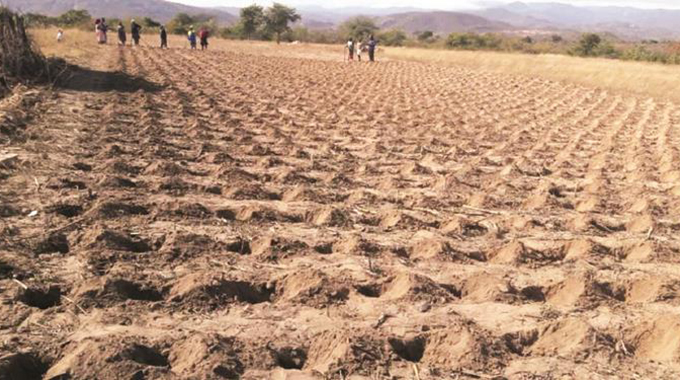
Elton Manguwo
THE Government has reminded farmers that the climate-proofed Pfumvudza/Intwasa programme whose inputs are being distributed countrywide signified a new wave of entrepreneurship and commerce in the agriculture sector at small-scale level.
Lands, Agriculture, Fisheries, Water and Rural Development permanent secretary Dr John Basera yesterday observed that the programme was the genesis of taking farming as a business at household level, as the country looks to develop the agriculture sector into an 8, 2 billion-dollar economy by 2025.
At least 3, 5 million households will this year benefit from the Pfumvudza/Intwasa programme, as the country moves to ensure that small-scale farmers are food secure while making sure they pay attention to the commercial side of things that sees farming as a business.
“The best way to avoid dependency is to use the Pfumvudza concept, as it represents a sustainable model. Each household will be presented with a standard input package that ensures surplus to do away with double dependency syndrome,” said Dr Basera.
In addition, the Pfumvudza/Intwasa practice safeguards the principle of using less to produce more reducing the cost of production that might gate keep the participation of most farmers in the food production sub-sector at a time the Ministry is seeking to transform the agriculture sector to be business driven in line with the Government’s thrust of developing rural areas in accordance to Rural Development programme 8, 0.
Dr Basera added: “The Government will support production on three to five plots to ensure there is surplus for repayment of inputs to the Grain Marketing Board (GMB) while leaving some for farmers to sell.”
Financing of the 3, 5 million households under the Presidential input schemes is a contract between the Government and a household as a productive social investment programme. The contract ensures food security at household level while the surplus is supposed to be sold to the GMB.
More thoroughly, Pfumvudza/Intwasa is a precise farming model that modifies and takes note of the four project parameters of business that are: time, cost, quantity and quality. This aims to increase the quality and quantity that is produced per unit area while simultaneously reducing the cost and time expended on that unit area.
The permanent secretary further highlighted that the climate-proofed Pfumvudza programme was not over-subsidising agriculture like some people wanted to believe but was a smart subsidy system in which the Government does not have to supply the rural farmers with food.



 Online Reporter