Lovemore Kadzura
Post Reporter
A QUIET agricultural revolution is unfolding in Mutasa District, where smallholder farmers are breaking production records, creating jobs and transforming communal farming into thriving commercial enterprises.
Driven by access to finance, improved livestock genetics and Government-backed agricultural support programmes, dairy and pig farmers are steadily reshaping the district’s economic landscape while contributing significantly to national food security.
The success stories emerging from the district highlight the growing potential of smallholder agriculture to drive rural industrialisation and wealth creation. One of the standout examples is Cynara Dairy Cooperative, whose milk production has surged from just 4 000 litres annually when it was established in 2018 to 84 000 litres today.
The cooperative’s growth has been underpinned by strategic financial support and a commitment by members to adopt modern dairy farming practices.
Meanwhile, the province’s rapidly expanding pork industry is facing a major challenge. Producers are being forced to rely on abattoirs and cold-storage facilities outside Manicaland, limiting their ability to maximise profits through value addition and processing.
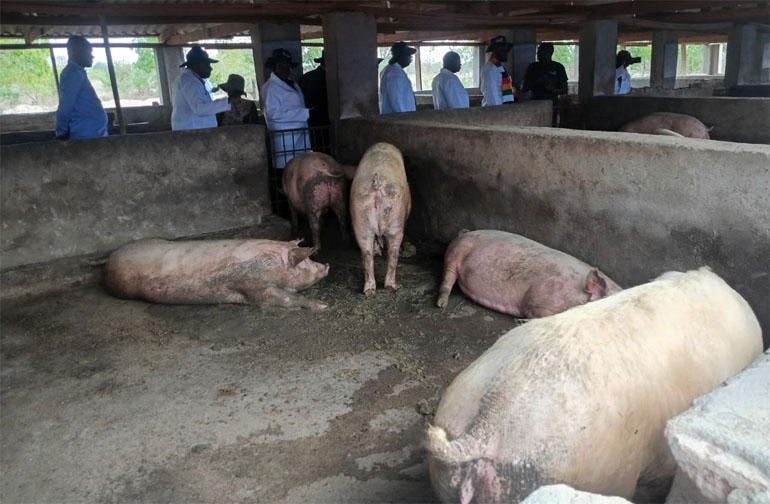
These issues came into sharp focus during a tour of Finjay Plot at Osborne Dam in Mutasa South, where farmer, Mr Gideon Toronga, runs one of the largest piggery operations in the province. Despite operating from a communal area, the project has grown into a major agricultural enterprise, housing more than 1 000 pigs, including 145 breeding sows, while providing full-time employment and supporting local grain producers.
Mr Toronga said inadequate processing infrastructure remains the biggest obstacle to further growth.
“Our sow unit currently has 145 breeding animals, with each sow producing an average of 10 piglets. We have invested heavily in quality genetics and artificial insemination to improve productivity, and we plan to increase our sow population to 250 by mid-2027,” he said.
The enterprise requires about one-and-a-half tonnes of feed every day and purchases maize, soya meal and wheat bran from local suppliers.
The project employs 14 permanent workers and regularly hires casual labour from surrounding communities.
However, Mr Toronga said the absence of suitable abattoirs and cold storage facilities in Manicaland means locally produced pork is processed elsewhere before being returned to the province as finished products.
“We are supplying pork to Harare and Marondera because there are no facilities in Manicaland capable of handling the volumes we produce. The pork is processed outside the province and sold back as a finished product, meaning local producers lose a significant share of the value chain,” he said.
For dairy farmers, the story has been one of remarkable growth.
Cynara Dairy Cooperative chairman, Mr Faranando Munsunzuru, said the cooperative received a US$48 400 loan from Women’s Microfinance Bank, which enabled members to purchase 24 in-calf heifers.
The investment has transformed production levels and improved household incomes for dozens of families.
“When we started in 2018, we produced only 4 000 litres of milk annually. Last year, production rose to 84 000 litres, and our target is to reach 300 000 litres by 2030. All the heifers have calved and we now have more than 50 cattle. We grow our own feed and draw water from a reliable source located three kilometres away, making us less vulnerable to drought,” said Mr Munsunzuru.
The cooperative comprises 62 members, including 26 women and 21 youths, and supplies milk to Dairibord Zimbabwe every two days.
Mr Munsunzuru said the project has dramatically improved livelihoods.
“Our children are attending school without interruption, and members can now comfortably meet household expenses. The cooperative has enabled us to move from subsistence farming to commercial agriculture,” he said.
Permanent Secretary in the Ministry of Agriculture, Professor Obert Jiri, commended smallholder farmers for their growing contribution to national milk and pork production.
He said Zimbabwe’s commercial dairy sector currently produces about 115 million litres of milk annually, while smallholder farmers contribute an additional 30 million to 40 million litres through various milk collection centres across the country.
“In terms of raw milk production, Zimbabwe is self-sufficient. Smallholder farmers continue to play a critical role through milk collection centres that aggregate production from rural communities,” he said.
Professor Jiri also assured livestock farmers that Government was implementing measures to protect the sector against drought-related challenges.
“As we prepare for drought conditions, we are focusing on feed availability, water supply and livestock health. Ward drought mitigation centres have been established across the country to assist vulnerable communities where necessary,” he said.
He noted that the pig industry remains one of Zimbabwe’s fastest-growing livestock sectors after poultry, largely due to improved genetics and increased adoption of modern production technologies.
“The pig sector has recorded impressive growth. However, feed costs remain a significant challenge. Farmers also need to invest in local abattoirs and processing facilities so that they can benefit fully from value addition instead of selling live animals,” he said.
Professor Jiri added that Zimbabwe is currently self-sufficient in pork production and does not rely on imports to satisfy domestic demand.
Minister of State for Manicaland Provincial Affairs and Devolution, Advocate Misheck Mugadza, attributed the growth of smallholder dairy farming to Government interventions spearheaded by President Mnangagwa.
He said access to loans, livestock financing and support for silage production had enabled many communal farmers to transition into successful commercial agricultural producers.
“The success we are witnessing among smallholder dairy farmers is a direct result of deliberate interventions aimed at improving productivity, increasing incomes and empowering rural communities,” said Minister Mugadza.
Pigs, milk, profits power Mutasa boom