admin
admin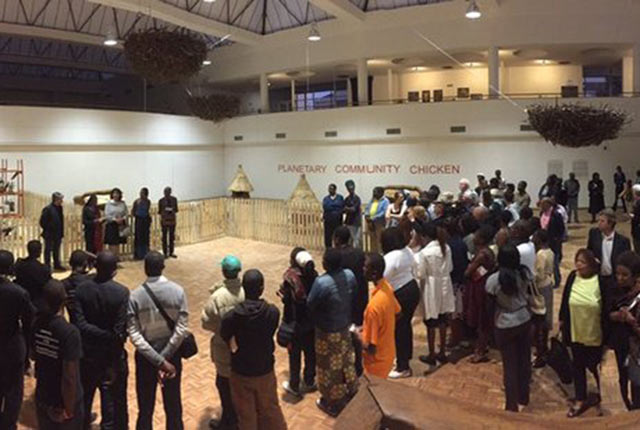
At the Gallery
The worlds of agriculture, science and art converged at the opening of Belgian artist, Koen Vanmechelen’s exhibition. Planetary Community Chicken is the inauguration of a new leg of the Cosmopolitan Chicken Project; a project in which the artist cross-bred various genii of chickens with the intention to
create an epitome breed.
The Cosmopolitan Chicken Project had been in development since 1999 and the resultant breed, the Cosmopolitan Chicken, is now at the National Gallery of Zimbabwe. Vanmechelen outlined that a normal chicken from any part of the world carries four million units of genetic information whereas the Cosmopolitan Chicken carries 30 million units of genetic information, astounding!
The Courtauld Gallery, the main ground floor space within the building has been transformed into an enclosure consisting of the chicken coop; featuring two Senegalese style hutches and two Zimbabwean hutches. All of these structures are dagga under thatch. On the northern end of the Gallery stands a shelf where a series of polythene bags are being generated for mushroom growth. The connection between the chickens and the mushrooms comes into play when this proximity between waste and growth is established.
Three nests suspended from the gallery’s ceiling are abound with ostrich eggs, perhaps the directly artistic feature of the exhibition as the artist describes it as the history of the chicken and its direct connection to the dinosaurs.
Vanmechelen lays out that eight years ago research found traits connecting the chicken with the Tyrannosaurus Rex; a rough contrast between the ferocious creature it used to be and the domesticated fowl it is now. The two giant portraits above the whole exhibition are to the scale of these extinct beasts and the horizontal view of the nests and portraits aligned invokes the unimaginable reality of what had been!
Notably, the chicken droppings are the main driver of the fungiretum as the future of Hope Foundation director, social entrepreneur Chido Govera explained; “When I was 11 I learnt to farm mushrooms. It was really a turning point in my life because I could convert agricultural waste, such as animal droppings, into food but not just any food, valuable food,” Govera said.
“Out of that I embarked on a journey were over the years I have been able to learn more about mushrooms including some of the interesting things that science is starting to unearth now, which is the power of the mushroom in solving problems concerning soil contamination and to solve water retention problems.”
Her experience travelling the world teaching people about mushrooms would culminate in the ease of the initiative to be taken up in every country where agrarian practices are the focal point of economic activities.
The synergy between Vanmechelen and Govera’s projects have a lemniscal effect; a food cycle which is representative of consumption, regeneration quid pro quo. Vanmechelen stressed however, that the project is neither about mushrooms nor chickens; rather these vehicles serve as metaphors for humanity, the keystone being cross-acculturation globalisation and a shift towards a unified human identity.
There is the important factor that chickens, like humans are constantly re-modelled. A further delve into the identity aspect was outlined by the artist as the French tricoleur chicken which has been developed in recent times (the plumage of the bird takes after the flag of France, notably, the Gallic Rooster is a symbol of the Republic) wherein the purpose of the cross breeding of the Planetary Chicken using the local roadrunner was announced.
At face value, mushrooms are a veritable engine as in many poor communities, people survive on staggeringly little or no income, however, a plethora of waste material from livestock can be converted into mushroom growth, the link with chickens is established there in.
Vanmechelen’s tie-in would amount to the Planetary Chicken being resistant to disease, highly virile and geared for optimal egg production. These two facets bring together the need to solve world hunger through making foodstuffs accessible to the communities affected by shortage through empowering them with sustainable vehicles.
“Koen and I have already been working together for more than three years now, I found what he is doing interesting work since we started engaging on the Cosmogolem Project, which we used for Expression Workshops where children express their hopes and dreams.”
Vanmechelen backed Govera’s statement; “We are two people on a journey to find a means to build sustainable communities that can thrive economically and socially.”
The engrossment of Vanmechelen’s method of work attracted the Gallery upon reception of proposed detailed specifications within the artist’s concept for the exhibition in the Gallery.
According to Doreen Sibanda, the executive director of the National Gallery of Zimbabwe, the connection between the two projects was evident upon visiting Govera’s Foundation. “Vanmechelen first visited us on introduction by our Board of Trustees Vice Chairman, Rosetta Peters, we were immediately impressed with his presentation about the significance of chickens; not in their literal sense, but as a metaphor for humanity.” She added “We also had the opportunity to visit Chido Govera to see her mushroom project where we experienced the potential of these elements which included agriculture, science, philosophy and art coming together.”
Could this synergistic mix end up with a xenogenetic fracture that could extinguish the species from the face of the planet? For all that is known, the benevolent aspect of creating a sustainable creature that can fare all the world’s climates is indeed a most appreciable idea as access to food can be spread to even the most far cast communities of the world.
The initiation of such a project in Zimbabwe is an inarguable honour which shifts the perceptions of the purpose of the Gallery, not only for the exposition of art but as a stage to create discourse around social issues with narratives across different disciplines. This project straddles both worlds as the spectacular placement of image, food, live birds, eggs and other elements represent the dramatic moment in which art and life collide.



 Online Reporter