admin
admin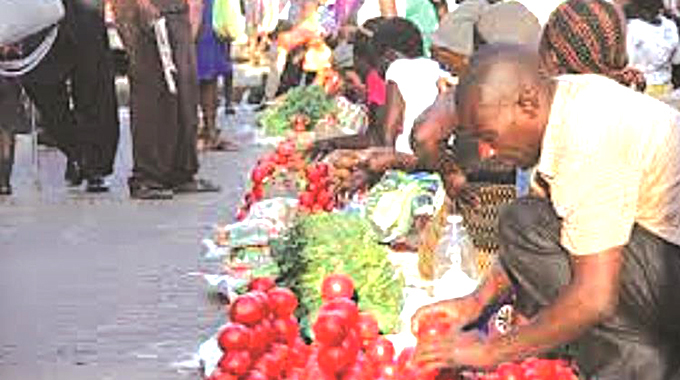
Tanaka Mahanya Features Writer
Police have been fighting running battles with vendors after informal traders started trickling back onto Harare’s pavements, a year after being pushed out by Harare City Council, to designated vending sites.
In September last year, council, together with the Zimbabwe Republic Police (ZRP) moved vendors from the central business district (CBD), under an operation code-named “Restore Order”.
Council allocated the vendors substandard stalls at an open space opposite National Tyre Services along Seke Road, and at the already crowded Mupedzanhamo market.
Some of the vendors are selling their goods in the open surrounded by dirt. It is worse for those selling clothes as they become soiled.
When clothes are dirty, the vendors sell them at discounted prices resulting in losses. After realising that the stalls are insufficient, vendors trickled back to streets and pavements in the CBD where they realise more profits without having to pay rentals.
But a year after, vendors are increasingly becoming disappointed as council is reneging on some of the promises it made, yet every month, they pay money. Slowly, their numbers are increasing in the CBD each day, especially as soon as dark falls, as day they will be playing cat-and-mouse with the police.
Since last year, police officers and vendors have been involved in running battles as vendors refuse to leave the streets, as they claim this is their only source of income.
At various intervals, anti-riot and municipal police have been fighting vendors seeking to drive them out of Harare streets to designated vending sites.
During the course of all this chaos, innocent people have been caught in the crossfire as vendors refuse to leave the streets, claiming that the designated vending sites were not only substandard but “too small” to accommodate them all.
Mupedzanhamo is not only oversubscribed, but turns into a virtual “wetland” when it rains due to a poor drainage.
In a bid to reduce the incidence of waterborne diseases, Government and City of Harare forced vendors out of Harare’s streets in September. But the vendors fought back, damaging property and buildings in the process, much to the chagrin of shop owners.
They claim that this is their only source of income, hence they cannot leave, as they will not be able to put food on the table let alone send their children to school.
In October, 10 informal traders were arrested after they ignored a Government directive to leave the streets, pinning their hopes on the little money they get.
Vendors claim as long as council does not renovate and build more vending sites, then they are unlikely to leave the streets any time soon.
Residents are tired of city fathers’ shortcomings and countless projects that seem to suffer a stillbirth.
For example, in July 2018, Harare City Council and its partner, Consortio International Zimbabwe, promised to construct a $30 million multi-purpose business complex at Shawasha Grounds in Mbare that will include a state-of-the-art flea market to accommodate 6 000 informal traders but nothing has been done to date.
This has created a problem — that of hundreds of second-hand clothes vendors selling their wares from roadsides and every other convenient open space. In the event that council wants to relocate vendors to new or alternative vending spaces, they should make it a priority that adequate infrastructure is put up first.
It is unfair for them to take vendors to makeshift sites with poor or non-existent amenities because they will simply troop back into the CBD.
With all this chaos, one is left wondering if Harare City Council is aware of its responsibility to take back the capital city to its “Sunshine City” status.
A lot still needs to be done to ensure that as we approach 2020, vendors have up to standard vending sites with amenities — and within easy reach of their clientele.



 Online Reporter