Online Reporter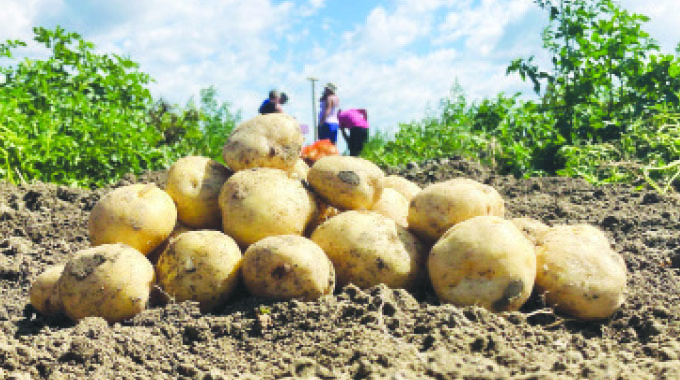
Patience Maturure, Agriculture Reporter
AT least 700 000 tonnes of potatoes are expected to be harvested this season, surpassing the national requirement of 500 000 tonnes and yielding a surplus of 200 000 tonnes.
Potatoes have become a significant substitute for the staple maize.
The Government declared potatoes one of the strategic crops to enhance food security and nutrition at the household and national levels.
The Ministry of Lands, Agriculture, Fisheries, Water and Rural Development Summer Plan shows that a target yield of 128 260 tonnes of winter potatoes and 571 750 tonnes from the summer cropping season is expected.
“The Summer Plan is the implementation tool for the Agriculture, Food Systems and Rural Transformation Strategy 2 (AFSRTS2:2026-2030).
“The plan presents a robust framework to harness the agricultural enablers, co-factors, causes and multipliers to systematically sustain increased production and productivity,” the plan revealed.
The focus will be on increased agro-ecological tailoring of crops and at enhancing climate-proofing at the household level (Pfumvudza/Intwasa) and at the National level (expansion of area under irrigation).
Research has shown that 15 percent of the population consumes potatoes/rice as a staple food.
Rice and potatoes have become alternative staples and a large proportion of the population also consumes alternative or substitute meals to staple food.
Zimbabwe has a well-established history of potato production. Apart from giving high returns per invested dollar to the farmer, the crop contributes significantly to the nation’s food security.
The Government’s call for import substitution through local production has resulted in 100 percent increase in homegrown potato cultivation as farmers collaborate with agro-processors through off-take arrangements for enhanced production, market access and sustainability.
The country no longer imports potatoes.
Only the potato seed is imported to augment local production, which is increasing as more farmers are being contracted in seed production by local producers.
According to experts, there are three distinct planting seasons for potatoes: summer (rain-fed), first half of winter (irrigated) and second half of winter (irrigated) — local farmers can achieve up to three potato production cycles annually.