admin
admin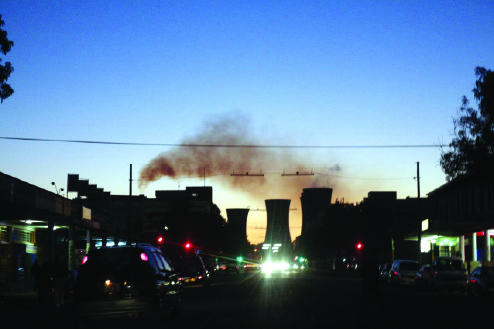

Prosper Ndlovu Business Editor—
CRIPPLING power cuts being experienced across the country will worsen the plight of local industries and impact negatively on economic growth prospects for the second half of 2015, experts have warned. Zimbabwean industries are already reeling under low capacity utilisation, liquidity crunch and stiff competition from cheap imports.
The government has reviewed the economic growth rate to 1.5 percent from 3.2 percent in 2015 in light of the poor performance of the agriculture sector due to drought. Economic analysts fear the anticipated modest growth in major sectors such as mining, manufacturing and tourism will be compromised by inadequate power supplies.
This week total electricity generation from the country’s five power stations dropped to 984MW, according to the Zimbabwe Power Company (ZPC), widening the supply deficit gap to above 1,000MW. Both domestic and commercial consumers are feeling the pinch with some areas in major cities like Bulawayo going for more than 12 hours without power.
“The impact is quite deep and that’s affecting the bottom line in companies. Most firms now rely on alternative sources like generators, which are more expensive. Erratic power supplies affect production and obviously that impacts negatively on overall growth prospects,” Bulawayo businessman Obert Sibanda said.
“Constant engagement with Zesa is there but the challenge is that the amount of power we produce is little and this affects everybody in the country.” Sibanda said the government needs to “interrogate” and review its policy on independent power generation to attract more investors. “Independent power producers are not yielding much. There’s a need for policy review to incentivise independent power production hence the government should interrogate that,” he said.
Another economic analyst Reginald Shoko said increased power outages will cripple industry viability and subsequent export capacity. “Failure to provide enough power will have a dent on major export sectors — the mining and manufacturing industries. It will also affect irrigation agriculture. This will cripple our negative net export capacity in the second half of the year,” said Shoko.
He said the power situation would likely remain subdued until the onset of rains, probably in mid-November. The long term solution, added Shoko, is to modernise the energy investment policy to attract more private players. “Climate changes are real and the Kariba scenario can be with us for the coming years. Going forward I think Zesa should start using solar power in residential areas to ease pressure on the national grid. We’ve got enough solar energy and it’s high time we go green, especially on all new buildings across the country,” he said.
While residents have turned to using gas, solar and firewood energy, environmental concerns have been raised over depletion of natural forests. According to a ZPC report, Kariba Hydro-Power Station was producing about 500MW of its 750MW capacity yesterday, Hwange Thermal 414MW against 920MW installed capacity while small thermals, Harare, Bulawayo and Munyati produced a combined 70MW.
The country has a national demand of about 2,200MW. The power utility, Zesa, has capped generation capacity at Kariba at 475MW following a recommendation by the Zambezi River Authority in light of reduced power generation due to low water inflows into Lake Kariba. Units 1, 5 and 6 at Hwange Thermal have been shut down for annual statutory maintenance, which is expected to be complete next month (October 7), ZPC managing director Noah Gwariro said.
He said there would be a stringent load shedding programme as he urged consumers to “conserve power and bear with the utility” during this period. The situation is compounded by the general regional power shortages of up to 8,000MW, which limits options for energy imports amid skyrocketing costs. The country pins its hopes on the speedy implementation of new power projects, mainly in Hwange and Kariba.
The 300MW Kariba South power extension project is already underway and is expected to be complete by 2018 at a cost of about $500 million. The 600MW Hwange unit 7 and 8 extension project is also on the cards at a cost of $1,5 billion. The long awaited 2,400MW Sengwa power project and the 800MW Batoka Gorge power plant, establishment of solar and gas plants, are among several proposed energy investments.
The successful implementation of the projects under Zim-Asset is expected to increase Zimbabwe’s generation capacity to about 5,000MW in the next few years.


 Online Reporter