

 admin
admin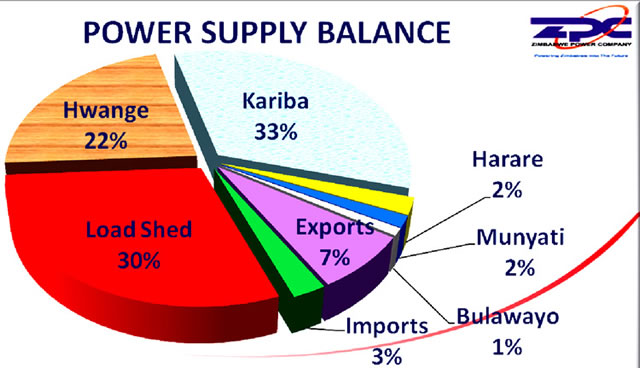
 Mernat Mafirakurewa/Charity Ruzvidzo
EXCESSIVE power cuts being experienced countrywide will cripple industry already reeling from low capacity utilisation, liquidity crunch and stiff competition brought about by cheap imports, experts have warned.On Monday, the Zimbabwe Power Company released a new load-shedding schedule indicating that some areas would go without power for more than 10 hours.
ZPC managing director Noah Gwariro attributed the increased outage to interruption of power production at Hwange Power Station where Unit 5 of the giant power plant was down and increased demand as the winter season begins.
Affirmative Action Group vice president Sam Ncube yesterday said with the economy already struggling with the limited power supplies, the situation would only get worse with the power cuts.
“Our industry is struggling against an unstable economy. Load-shedding will only worsen the situation,” said Ncube.
“Zesa Holdings is not doing justice not only to the industrial sector but to the general public as well. Consumers pay for electricity before they use it through the prepaid meters, hence Zesa should be able to deal with technical faults as they already have the capital.”
Hordes of companies have closed down due to the economic challenges facing the nation with Bulawayo being the most affected as it recorded close to 100 company closures in 2012.
Ncube went on to raise concerns with the reaction of Zimbabweans to Zesa power cuts, the general public and the industrial sector, saying they must take Zesa to task over the power cuts than remain docile.
Economic commentator and former Zimbabwe National Chamber of Commerce president Trust Chikohora said the intensified power cuts would affect the level of production and productivity for industries.
“Zesa load-shedding will impact negatively on the industrial sector as levels of production are going to be affected. The normal schedule of operations will be affected thereby negatively affecting industry,” he said.
The power cuts come at a time when the Confederation of Zimbabwe Industries estimates that capacity utilisation will continue on a downward trend.
In 2012, capacity utilisation in manufacturing fell to 44,2 percent from 57 percent recorded in 2011.
CZI chief executive officer Clifford Sileya said it was costly to operate in an environment where the supply of electricity was not predictable.
“In some industries processes require as much as 8 to 10 hours to complete, at times even more, hence disruptions are very costly in terms of machinery.
“While we understand that Zesa has its own challenges and do not always follow their schedule, they must communicate with their customers so that they can plan. They don’t do that,” he said.
According to a ZPC daily power production update, as of yesterday, internal power generation stood at 1,205MW constituting 72 percent of demand.
Hwange was producing 439MW, Kariba 670MW, Harare 45MW, Bulawayo 20MW and Munyati 31MW.
The country was only importing 50MW from Hydro Cahora Bassa in Mozambique and exporting 150MW to Namibia in honour of a deal between Zesa Holdings and Nampower.
Addressing delegates at a pensions’ investment forum last month, Senior Minister of State in the President’s Office, Simon Khaya-Moyo, said the country’s economic recovery was hinged on an efficient and reliable supply of electricity that would enable the usage of modern agriculture technology and engender efficiency in the delivery of crucial social services to all.
He said failure by government to pay Hwange Colliery Company for coal sold to Zesa at a subsidised price had strained the former’s operations forcing the country to depend on imports.


 Bongani Ndlovu
 Online Reporter