

 admin
admin
Paidamoyo Chipunza Senior Health Reporter
ZESA Holdings recently announced that it was reverting to stage two load-shedding, a move that has seen consumers enduring more hours without electricity.
Health institutions, which are traditionally spared from load-shedding are equally affected, impacting negatively on the smooth flow of health services that require power, in particular viral load tests to measure the level of the HIV virus in HIV-positive people.
According to the latest World Health Organisation (WHO) guidelines, viral load testing is the recommended and preferred approach to management of HIV infection.
It should be conducted at least once every three months on people responding poorly to treatment and at least once a year for those showing signs of treatment success.
In pregnant women, viral load should be monitored more frequently for quick intervention against HIV transmission from a mother to an unborn baby.
Owing to long hours of load-shedding, some people living with HIV and AIDS are going for several months without knowing the status of their viral load, compromising effective management of their condition.
Located in Masvingo province, 80 kilometres from Masvingo town is Nyajena Rural Hospital, a facility that caters for nearly 1 000 people on antiretroviral treatment and relies on provincial laboratories in either Masvingo or Mutare for viral loads testing, among other tests.
“The furthest clients come from Makoho farms which is about 21km to this facility, and they should be here before 9.30am on a Wednesday because the biker who takes our samples to Masvingo comes every Wednesday at 9.30am en-route to other facilities in the district to collect more samples,” said Nyajena Hospital Opportunistic Infections Clinic nurse-in-charge Mr Eriphanos Mhosva.
Mr Mhosva said this set-up not only poses a big challenge to the rural population, who hardly can make it to the clinic before 9.30am because of the long distances they travel to the health facility, but also makes monitoring of treatment success or failure impossible for health workers.
He said in some cases, samples are directly affected by the power cuts, resulting in invalid results, which are subsequently discarded, while others take far longer than the anticipated period to be returned to the rural facility.
“Viral load testing is a huge challenge for our clients,” said Mr Mhosva.
“Since the biker comes here at 9.30am, it means the person coming from the furthest location should leave home around 4am for them to be here on time.
“If they miss the scheduled time, it means they have to try again the following week. The biker cannot wait because he also has to collect more samples from other facilities in the district, all of which are taken to a central laboratory in Masvingo or Mutare for testing.
“All blood samples should also be taken on the day which they are transported lest they produce invalid results when they finally get to the central laboratory, hence the need for a Point of Care (POC) machine, for our facility cannot be over emphasised.”
In a separate interview with The Herald, laboratory microscopist at Hatcliffe Polyclinic Mr Michael Chitemwe whose facility is heavily affected by load-shedding said the SAMBA II Point of Care machines remained the current and only reliable technology not only to resource-constrained settings, but even for urban facilities in the face of power cuts.
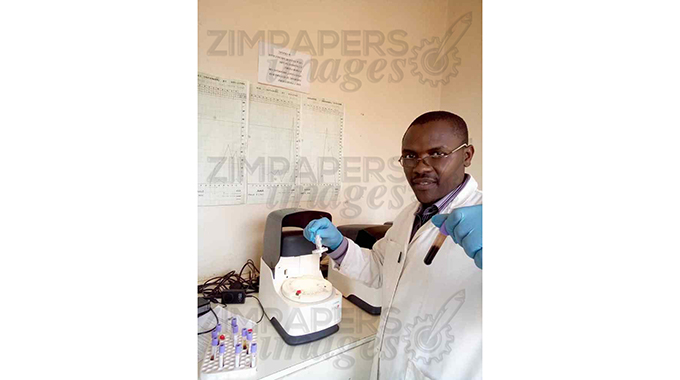
Mr Chitemwe said at the Hatcliffe Polyclinic in Harare, power is switched off for nearly 15 hours almost every day, but they are averting viral load test backlogs through the use of SAMBA machines.
“With the current electricity blackouts, SAMBA is often the only machine working in the lab, because it can operate at 37 degrees Celsius, and because it comes with an inverter which is charged at night when electricity is available,” he said.
“The technology has reduced the complexity and made the chemistry so robust that it can be easily done by minimally trained personnel in lower level clinics without the need of infrastructure such as air conditioning.”
Mr Chitemwe said SAMBA was the most suitable and reliable diagnostic platform for primary healthcare facilities as compared to centralised testing because of its capacity to produce results in 90 minutes.
“When fully charged, the SAMBA machine can run up to 20 samples a day, which is almost the same number of clients who require viral load tests at this facility per day,” he said.
“Unlike centralised testing, SAMBA testing ensures that all samples are tested on-site, hence no need for a sample referral system, no need for extra costs such as fuel, maintenance of vehicles or use of bikes.
“It is also cost effective to walk-in patients who will wait for their results to be released in a maximum of three hours. There is also no need for clients to come to the clinic for sample collection and then return some other day for results collection.
“Clinical management of patients is grossly enhanced as the clinician can quickly get the patient’s result after the sample has been collected.”
Mr Chitemwe said this means upon getting results, the clinician can timeously determine necessary steps regarding management of the patient’s condition.
President of the Zimbabwe HIV and AIDS Activist Union Community Trust (ZHAAU CT) Mr Stanley Takaona said: “Decentralisation of viral load testing will be key to achieving the third 90 of the United Nations global targets which seeks to increase the number of people on antiretroviral drugs with undetectable levels of the HIV virus.
“With effective treatment, the HIV virus can be completely suppressed with the infected person living a perfectly normal life because the virus does not multiply and its level in the bloodstream is undetectable or very low.”
Mr Takaona, whose organisation, in partnership with the Treatment Advocacy Core Group, has been conducting community visits and dialogues with people living with HIV in recent weeks across selected provinces, said power outrages had been coming out strongly as contributory to longer turnaround time for the release of viral load test results.
He said most facilities they visited preferred Point of Care machines like SAMBA to large, centralised machines owing to the convenience the POC machines provide to both clients and clinicians.
“After our visits, we are going to compile a report which we will present to relevant officials stating our findings and recommendations, a majority of which are coming from either the health workers who are on the ground or people living with HIV and AIDS,” said Mr Takaona.
“One of our concerns is decentralisation of viral load testing to ensure that we monitor and manage the patients to achieve viral suppression in at least 90 percent of all those on treatment.”
Laboratory services director in the Ministry of Health and Child Care, Mr Douglas Mangwanya revealed: “Government is committed to decentralising viral load services to a majority of its facilities throughout the country.”
Mr Mangwanya said this was evidenced by distribution of the current 113 machines at 26 selected sites in the country.
“The plan is to ensure that a majority of our facilities has these POC machines, and at the moment SAMBA II is providing this much needed technology to resource-constrained facilities,” he said.
In addition to back-up power which comes with the SAMBA II machines, he revealed, the supplier has further committed to install solar panels in all sites using this technology in an effort to mitigate effects of any prolonged power outages.
Zimbabwe is one of the first countries in the world to adopt the use of SAMBA technology in 2016. To date, 27 sites across the country are using this technology.
It is environmentally friendly as scientists from Cambridge, who are behind the innovation, eliminated the generation of cyanide as a toxic by-product of other similar tests.
Instead of the size of a small car with current centralised testing machines, the SAMBA machine is the size of a small domestic coffee maker.
Because the technology was specifically developed by a group of dedicated scientists to suit African climatic conditions, unlike other diagnostic platforms, it can easily work even in remote rural areas where there are no air conditioning systems.



 Online Reporter