Online Reporter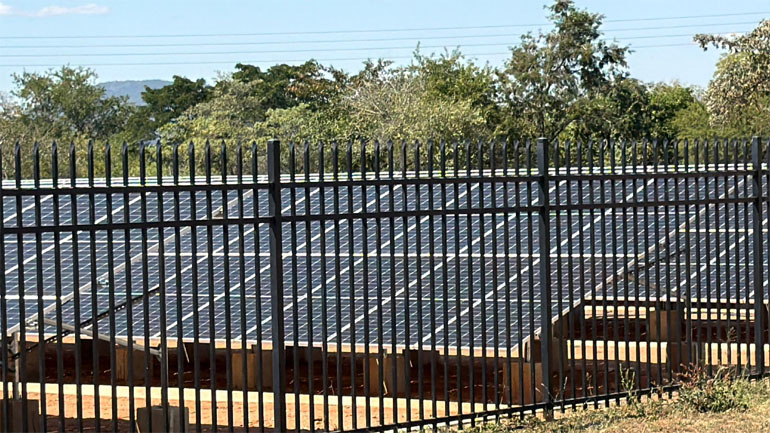
Lovemore Kadzura
Post Reporter
GOVERNMENT is moving with electric pace, and has so far electrified 88 percent of rural schools, health centres and public institutions in Manicaland Province — with full coverage expected by year end.
The programme, spearheaded by the Rural Electrification Agency (REA), has so far lit up 788 primary schools, 417 secondary schools, and 304 clinics across the province as of April 30.
Work has intensified to cover the remaining 197 primary schools, 57 secondary schools, and just 16 clinics still off the grid.
Beyond schools and clinics, the initiative has also electrified 84 Agritex extension offices, 36 chiefs’ homesteads, 270 business centres, 81 small scale farms, 364 villages, and 199 other institutions including churches, cooperatives, and irrigation schemes.
Speaking at the commissioning of the Nzvimbe Solar Mini Grid in Makoni South last week, Energy and Power Development Minister, Honourable July Moyo, said President Emmerson Mnangagwa’s vision is to ensure that development reaches every corner of the country.
Electrification of rural areas is being prioritised because it has multiplier effects on both social and economic development, he said.
“Manicaland Province is sitting on Position Number Two when it comes to electrification of public institution such as schools, clinics, Government institutions and traditional leaders’ homesteads. Manicaland Province is now on 88 percent, and is behind Matabeleland South, which is at 90 percent.
“President Emmerson Mnangagwa want all areas to be developed. No place will be left behind, no place will be forgotten, and there is no place that will not compete with others. The President directed us that all rural clinic should be electrified by the end of 2026. No woman should give birth under darkness or under candle light.
“Same as schools, they should all be electrified. During the Covid-19 era, schools without electricity had no internet access. Learners from these schools lagged behind as distance learning could not take place.
“It is pleasing to note that the Nzvimbe Solar Mini-grid Plant is not the only community project undertaken by the REA in the past two years. In Midlands Province, REA completed the construction of 96kw Gandavaroyi Solar Mini-grid Project in Gokwe North District, the 120kw Tshitulipasi Mini-grid Solar Plant in Beitbridge, and the 120kw Dete Solar Project in Hurungwe District, Mashonaland West Province.
“Three other community solar mini-grid projects namely the 60kw Chiwore Plant in Uzumba-Maramba-Pfungwe District in Mashonaland East, the 120kw Soti Source in Masvingo’s Gutu District, and the 45kw Chiwenga Plant in Muzarabani District in Mashonaland Central Province are all complete and providing uninterrupted power supply to public institutions, businesses and villages.
“In addition to community solar mini-grid projects, 25 solar micro-grid projects were undertaken, at least three in each of the eight rural provinces. We commend REA for continuing to spearhead innovative off-grid electrification solutions in difficult and remote terrains where extension of the national grid may not be immediately economically viable.
“REA is demonstrating that renewable energy technologies are practical, sustainable and capable to accelerate rural socio-economic transformation. As for grid projects, as of May 4, 11 368 rural institutions were electrified together with several homesteads. This figure includes 3 244 primary schools and 1 614 secondary schools, 1 084 rural health centres, 497 Government extension offices, 310 chief’s homesteads, 1 395 business centres, among other related institutions,” said Minister Moyo.
He added that rural electrification will lead to sustainable development in communities as access to energy will enable them to take part in productive economic activities, while promoting e-learning in schools and curb the rural to urban migration.
“While some parts of Manicaland Province are in dry regions with poor rainfall, irrigation development is key, and can only be done when electricity is available. I am happy that REA is justifiably taking electricity through the grid and renewable energy technologies to all needy communities of our countries for productive use in industry, agriculture, commerce and Village Business Units for the good of our people.
“The provision of access to sustainable modern energy services to rural areas of Zimbabwe will no doubt support many other Government initiatives that are aimed at empowering our rural communities, alleviating poverty, building capacity and creating employment in our rural communities, thereby leading to sustainable development and social equity in Zimbabwe. Many other benefits will accrue, among them the reversal of rural-urban migration, mitigation of climate change, promotion of e-learning in rural schools and rural industrialization.
“Government will continue to explore ways of creating an enabling environment for the development of our country, particularly the provision of power to rural areas, and will continue to give support to REA to meet its mandate of universal access to modern energy services to all the rural areas of Zimbabwe by 2030,” said Minister Moyo.
Minister of State for Manicaland Provincial Affairs and Devolution, Advocate Misheck Mugadza, said the province has stepped up efforts to electrify marginalised areas, with both public institutions and the private sector embracing clean energy — as shown by the growing number of completed solar projects.
“Manicaland Province has fully embraced clean energy and a number of key institutions now have solar plants to complement grid electricity. Victoria Chitepo Provincial Hospital (140kw), Mutambara Mission Hospital (150kw), Hillcrest School (200kw), Africa University (650kw), Verify Engineering (200kw), Matanuska intends to put two-megawatts, and many others across the province.
“I am particularly impressed by the progress achieved in the province in the rural electrification programme as well as the construction of biogas digesters for our villagers. For many years, we have noticed the presence of REA workers in all the districts in the province, building electricity lines, installing solar systems and building biogas digesters, which projects are positively changing the living conditions of our villagers.
“Energy is the backbone of economic growth and national transformation. Without adequate power generation, industries cannot operate efficiently, hospitals and schools cannot function optimally and communities cannot realise their full productive potential.
“We want to appeal to all Government ministries and departments, State enterprises and parastatals, and other developmental agencies in the province, who are involved in rural development initiatives, to take advantage of the availability of the grid and other energy projects that REA is developing in all rural communities in Manicaland Province to develop their own enterprises for the good of our province,” said Minister Mugadza.
Ends.