admin
admin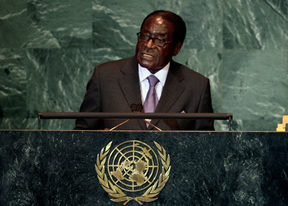
own sinister political agenda such as regime change, President Mugabe has said.
Addressing the United Nations General Assembly high level meeting on youth yesterday, President Mugabe said Zimbabwe had been and continued to be a victim of the “sinister neo-colonial machinations” through illegal sanctions and constant interference in its domestic affairs.
RELATED
“Such actions should stand condemned and stand condemned forever as they adversely affect development and retard in particular youth development,” he said.
His statement comes barely a week after US Ambassador to Zimbabwe, Mr Charles Ray, was stopped from addressing a clandestine youth meeting in Kwekwe.
The Head of State and Government and Commander-in-Chief of the Zimbabwe Defence Forces, said Zimbabwe supported Resolutions of the AU Summit in Malabo Equatorial Guinea, the Youth Decade Plan of
Action (2009-18) and the Ouagadougou 2004 plan of action on employment promotion and poverty alleviation for the active participation and involvement of youth in national development.
He said the resolutions recognised that youths, the largest percentage of the population in Africa, should not be on the periphery of national programmes and mainstream economic activities.
“We need to view them as an asset rather than a liability to the socio-economic development of our nations. Indeed, it is time that the international community came up with a well conceived and properly structured international framework that has comprehensive action plans for youth development.
“The framework should fully address the real contemporary challenges facing the youth.”
Commending the United Nations for holding the high level meeting on youths, President Mugabe said the youth agenda had been a priority for Zimbabwe since independence in 1980.
He said in recognition of sacrifices made by youths during the liberation struggle, Government created the youth, sport and recreation ministry and adopted a policy of education for all children to get different skills and capabilities so that they participated in the economy, social and political life of Zimbabwe. President Mugabe said this ensured that youths in Zimbabwe constantly enjoyed being part of various representative institutions and political pluralism.
“At the same time, Government established and expanded vocational skills training. The benefits of those measures, coupled with a broad educational curriculum, have seen my country attain top-notch spots in education and human resources development on the continent.”
He, however, said Zimbabwe still faced unemployment and under-employment challenges among youths.
“The demands of changing demographics and the current global economic condition now challenge us to employ greater innovation in addressing the needs of the youth who are unemployed and idle.
“Indeed, the entire continent of Africa faces urgent challenges as a result of the numbers of unemployed youths.”
He said Government in 1995 introduced the Zimbabwe Youth Council Act to give further impetus to include children and youths in national dialogue, empowerment and governance issues. The council, he said, provided a platform for harmonious working relationship between Government, the youths, private sector and civil society.
The ZYC co-ordinates programmes for junior parliament and local government structures and business forums, giving the youths vital experience in governance issues and decision making processes.
“The deliberations and decisions, which evolve from these noble initiatives directly, feed into our national youth development programmes,” he said.
High school students in Zimbabwe last month successfully held a model UN General Assembly debate reviewing progress Government made on MDGs.
The National Youth Service introduced in 2001 promotes a culture of peace, dialogue and mutual understanding, tolerance, equality, justice and democracy, he said.
“The objective is to instil a sense of patriotism and national identity, while empowering the youth for community and nation-building through moulding character and leadership skills.”
The programme, President Mugabe said, had produced over 80 000 youths who participated and then established programmes for self-reliant livelihoods.
“More importantly, the programme has proven our Western detractors wrong in their unfounded allegations against Zimbabwe,” he said.
President Mugabe said Government’s youth empowerment programmes have transformed young Zimbabweans into “power engines” for long term development.
“A notable example is the land reform exercise, which has provided land to the youth and youth co-operatives, enabling them to be active players in our national economic development endeavours,” he said.
Government, President Mugabe said, was encouraging youths to create wealth through the indigenisation and empowerment policy that aimed to promote ownership and control of means of production by Zimbabweans.
He said Government had also established two important credit facilities, the Youth Development Fund and the Empowerment Fund that provided State-guaranteed financial assistance to support micro, small and medium enterprises. The fund schemes are implemented in partnership with local commercial banks.
“The challenge which this programme faces is that of limited resources. It is in this context that we encourage our development partners to assist us by providing additional funding in order to enable us to meet our goal of preparing our youths and also achieve the internationally agreed development goals,” he said.
President Mugabe said Government envisaged an education system that incorporated youth in national development, while equipping them with appropriate industrial, trade and entrepreneurial skills.
He said youths in developing countries including Zimbabwe were talented, entrepreneurial, innovative and creative as their counterparts in the developed world.
“What they lack are resources and often skills training and entrepreneurial opportunities. As a result, developing countries have lost some of their young creative and innovative talents to the developed world in such critical areas as engineering, health, industry, commerce, law, entrepreneurial management.
“In this regard, we call upon the United Nations entities and other development partners to assist developing countries in providing more up-to-date scientific and technological training, which has become necessary because of the current levels of technological advancement,” he said.
President Mugabe said HIV and Aids continued to be a “clear and present danger for youth development”, especially in developing countries.
He said Government with assistance from partners such as the Global Fund had invested heavily in HIV and Aids prevention and treatment programmes.
He said Zimbabwe had introduced the Aids levy to broaden the financial base to fight the pandemic.
President Mugabe, however, urged the international community to increase assistance to developing countries to combat the HIV and Aids challenge.


 Online Reporter