Debra Matabvu, [email protected]
PRESIDENT Mnangagwa and South African traditional leaders yesterday reaffirmed the historic bonds between Harare and Pretoria, calling for peace and unity amid rising anti-immigrant tensions that have unsettled migrant communities in the neighbouring country.
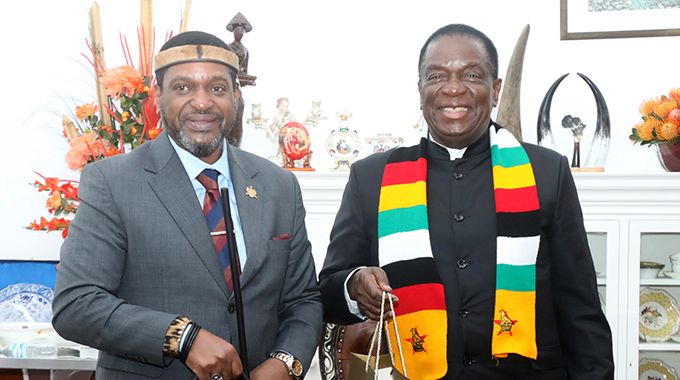
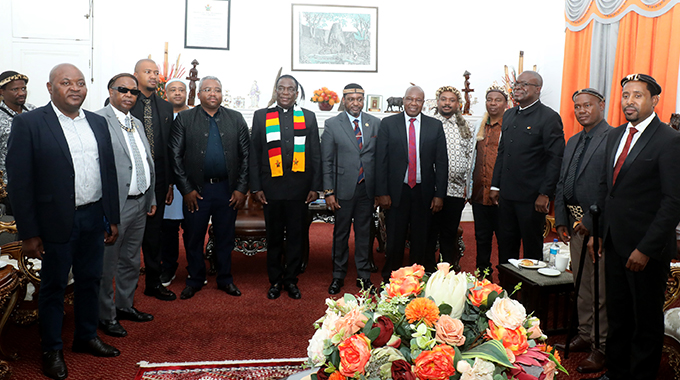
The President hosted Zulu monarch King Misuzulu kaZwelithini and a high-level delegation of South African traditional leaders at State House in Harare, where the leaders underscored the role of traditional institutions in fostering peaceful co-existence, preserving shared cultural heritage and strengthening regional solidarity.
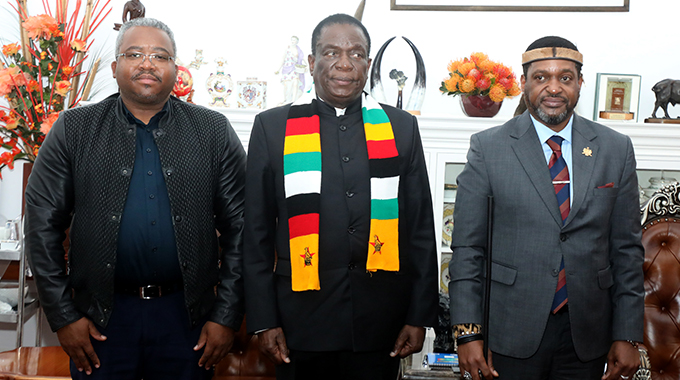
The official meeting followed a private engagement between President Mnangagwa and King Misuzulu on Monday, with yesterday’s discussions bringing together senior Government officials and members of the South African royal delegation.
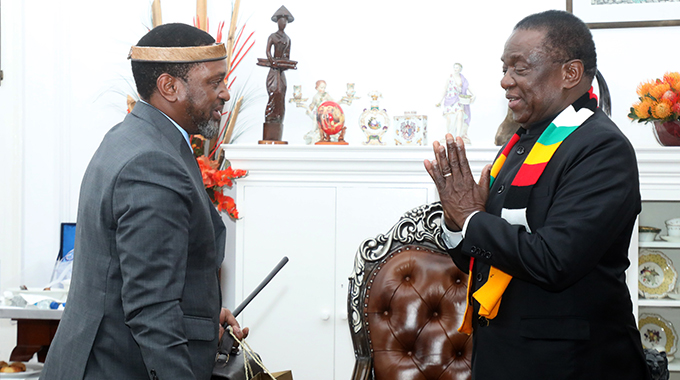
Posting on his official X handle after the meeting, President Mnangagwa described the visit as an affirmation of the enduring cultural and historical bonds that unite Zimbabwe and South Africa.
“This morning, it was an honour and a privilege to welcome His Majesty King Misuzulu kaZwelithini of AmaZulu, along with his esteemed royal delegation and traditional leaders from South Africa, to State House in Harare.
“Our meeting reinforces the deep, historical, and unbreakable cultural bonds that unite the people of Zimbabwe and South Africa.
“Traditional leadership remains a cornerstone of our African identity, preserving our rich heritage and guiding our communities towards peace and unity.
“Zimbabwe continues to open its doors to our regional brothers and sisters as we strengthen these foundational ties.
“We look forward to continued collaboration, mutual respect, and shared prosperity between our nations.”
Speaking to journalists after yesterday’s meeting, Zanu-PF Secretary for Information and Publicity, Ambassador Christopher Mutsvangwa, said the discussions focused on how traditional leadership could contribute to addressing social and economic challenges that have fuelled anti-immigrant sentiment in South Africa.
He said the recent tensions should not be viewed simply as hostility towards foreign nationals, but as symptoms of deeper structural economic problems inherited from apartheid.
“He came here with a very powerful delegation which also included King Ndamase of the AmaMpondo aseNyandeni Kingdom in South Africa.
“They are all from the Eastern Cape and KwaZulu-Natal,” said Amb Mutsvangwa.
“These are the areas where there has been some tension, some upswell of activity, weaponised poverty-mixed Africans fight against each other and they felt that as kings they have a role to play and they respect President
Mnangagwa as a regional leader, as a liberation fighter of standing, and they did not want their message to be filtered through third parties.”
He said the South African monarchs specifically requested a direct audience with President Mnangagwa.
“They requested for a personal audience with the President of the Republic of Zimbabwe, and they had a very successful meeting with the President.
“It is the second meeting in as many days. Yesterday (Monday) it was private, this morning it was official.
“The President called in his ministers and his court to come to listen to the King and this afternoon he is going to host them at a luncheon before they go back to South Africa.”
Amb Mutsvangwa said the meeting explored how traditional institutions could complement Government efforts in promoting regional peace, economic development and labour mobility.
“All in all, it was a very cordial meeting, mapping the future of the two countries together and also to see how historical and traditional structures can come to play as we grapple with post-colonial challenges which come from our apartheid and racist past.
“We see it as a challenge of development and they also delved into how the two countries and the two kingdoms can co-operate with Zimbabwe so that we can have more organised labour movement, more job opportunities so people can stay where they should be and where labour can move without the challenges of competing for scarce employment opportunities.”
Prime Minister to King Misuzulu, Mr Phathisizwe Chiliza, said the delegation’s visit was intended to strengthen peace and harmony between Zimbabwe and South Africa.
“We want to thank the President of Zimbabwe and his delegation because, as the delegation and the Ministers have said, we are here to make sure that there is peace, there is harmony between these nations,” he said.
“That is what we are here for, to support the King, to make sure that the dream of the King is a success.”
King Ndamase, who chairs the King’s Forum of South Africa, said the discussions had strengthened relations between traditional leaders in the two countries.
“We had a warm welcome from the President,” he said.
“Therefore, I think that from now onwards, the bond between traditional leadership of this nation and the traditional leadership of South Africa will make peace and harmony within the African continent.”
The visit came at a particularly difficult time for the region following renewed anti-immigrant protests in South
Africa, where some groups have blamed undocumented foreign nationals for unemployment, crime and pressure on public services.
The demonstrations have caused anxiety among migrant communities, including Zimbabweans, who constitute a significant portion of foreign nationals living in South Africa.