Online Reporter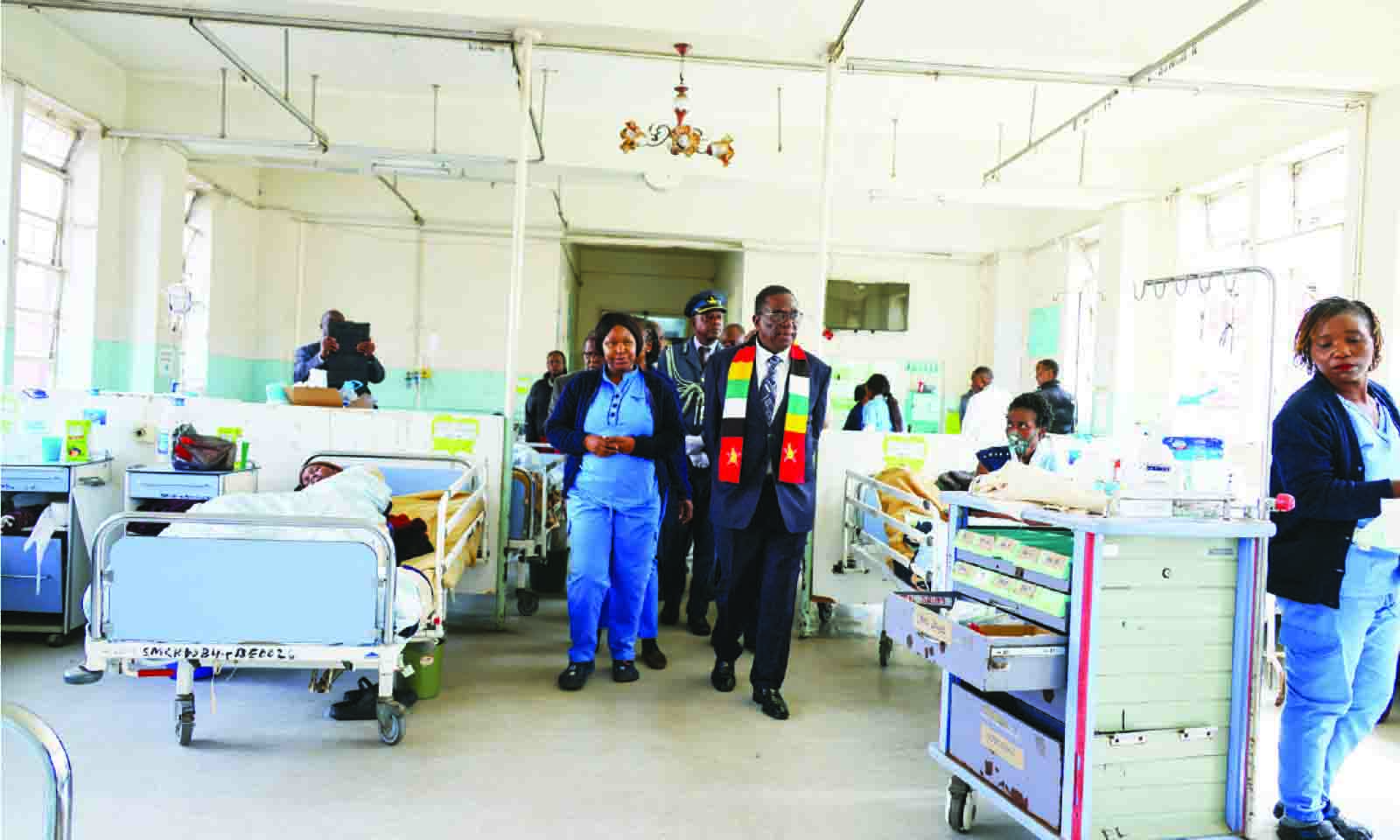
PRESIDENT Mnangagwa’s unannounced visit on Monday to two major referral hospitals in Harare — Parirenyatwa Group of Hospitals and Sally Mugabe Central Hospital — where he saw first-hand the dire conditions facing public health facilities, is a clear demonstration of his profound concern for the nation’s healthcare system and the Second Republic’s commitment to improving the country’s health delivery system.
At the two hospitals, President Mnangagwa visited paediatric wards and maternity wings, interacting with patients, nurses and doctors.
He also visited specialised units like X-ray sections to understand how things are in those areas which are so critical to diagnostic medical examinations.
The President was accompanied by Chief Secretary to the President and Cabinet Dr Martin Rushwaya, Deputy Chief Secretary Reverend Paul Bayethe Damasane and Deputy Chief Secretary (Presidential Communications) Mr George Charamba.
The unannounced visit directly followed President Mnangagwa’s continued emphasis on the importance of healthcare delivery.
He consistently stresses that a robust healthcare system is a fundamental enabler of the country’s economic development and is vital for achieving overarching national goals including Vision 2030.
The visit further underscored his consistent stance that a stable health environment is a fundamental people’s right and a crucial social pillar underpinning the aspirations of Vision 2030.
In line with this commitment, Presidential Spokesperson Mr Charamba said President Mnangagwa will make more such impromptu visits going forward aiming to gain a first-hand appreciation of the reality on the ground.
“The President has indicated that there will be more and more of these unannounced unscheduled visits to get him to see what happens on a day-to-day basis when things are not pre-arranged. Because when we do these visits through invites, there are lots of falsehoods. We are given a gloss which is not exactly what the President wants,” he said.
“The President wants to see reality which is faced by the patient. So one would say that from this particular experience, the President for the first time saw things from the point of view of the patient.
“It was so clear that our health system is designed in such a way that several distressed people are being left behind. That is essentially what the President wants to correct.”
Mr Charamba said the President has been getting worrying reports on the state of the country’s health sector and decided to go see for himself to remedy the situation.
Apart from receiving reports from the Vice Presidents, the President also regularly receives updates from his top officials and other stakeholders.
“But more critically, the First Lady has been paying some unscheduled visits to central hospitals. She brought back some very sad news in terms of the situation in the hospitals.
“Then from the media, from the members of the general public, we have been getting reports that are more or less negative.
“This is what in fact got the President to think of paying an unannounced unscheduled visit to the two central hospitals serving Harare,” said Mr Charamba.
As articulated by Mr Charamba, the President’s hands-on approach underscores his determination to directly address the “worrying reports” he has received.
By taking personal initiative to “remedy the situation” and ensure public health facilities serve the people effectively, he demonstrates that he is a highly responsive and listening leader.
This proactive engagement coupled with his responsiveness to reports from various sources including the public, directly aligns with President Mnangagwa’s overarching philosophy of leaving no one and no place behind.
His determination to personally witness and correct the deficiencies in public health services reflects a commitment to ensuring that every citizen regardless of their background or location has access to adequate healthcare thereby fulfilling a core tenet of his inclusive governance agenda.
Reinforcing this view, ZANU PF Deputy Secretary for Security in the Politburo Cde Tendai Chirau said President Mnangagwa’s unannounced visit to the health facilities is a clear indication of his proactive approach to national issues.
“You will notice there has been a lot of noise on social media concerning the state of our health facilities. So him (President Mnangagwa) visiting those facilities unannounced is an indication that he is a leader who is determined to hear first-hand information and address this challenge which is facing some of our hospitals.
“You should also take note that the aspects of health are key because health forms one of the bases of security. Health security is a concern to this nation and you can see that we have a leader who cares.
“Analysing the pictures which have been posted by Presidential Spokesperson Mr Charamba indicates that he was not just talking to the CEOs or anyone else, he was talking to the grassroots staff, to the nurses who were giving him their experiences in the state of affairs, junior doctors, talking to patients and interacting with children,” said Cde Chirau.
He added: “So we have a bottom-up approach where you are hearing first-hand information from the workers. You are hearing information from the patients themselves. You are also hearing from the pharmaceutical companies.
“It’s important and I think that whatever decision is going to be made to address these challenges will be based on the information which was obtained through this kind of visit. So it’s a welcome development because sometimes when you get second-hand information that information is not proper.
“This approach of going there unannounced is a clear indication of a leader who is concerned about addressing the challenges facing the health sector in an endeavour to make sure that we are health secure as a nation.”
Consequently, with increased access to health services for all Zimbabweans being central to achieving universal health coverage, the President’s administration has taken deliberate steps to restructure and reform the public health system.
In line with the National Development Strategy 1 (NDS1) and Vision 2030, the Second Republic is making concerted strides in ensuring quality healthcare provision recognising it as one of the key pillars driving economic development.
Efforts spearheaded by the Second Republic are expected to significantly contribute to the country’s development agenda by improving and ensuring primary healthcare access for all citizens.
To achieve this, health facilities continue to be expanded and upgraded, boosting the quality of healthcare for everyone in line with President Mnangagwa’s vision of matching best international practices as a prerequisite for an upper-middle-income society.
The Second Republic has been working tirelessly to implement comprehensive reforms in the healthcare sector re-equipping and upgrading existing hospitals and clinics and building new ones.
These efforts are driven by the understanding that increasing access to health services for all citizens is central to achieving universal health coverage particularly for the most vulnerable and marginalised people in communities.



 leeroy