Online Reporter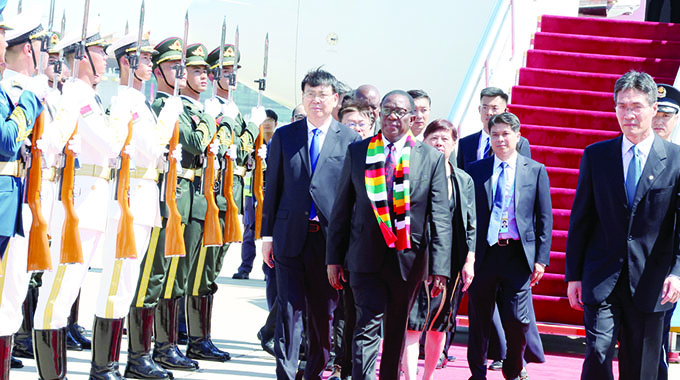
Nduduzo Tshuma in Beijing, China
PRESIDENT Mnangagwa begins his busy schedule in Beijing today, where he is set to hold high-level meetings — including with his Chinese counterpart, President Xi Jinping — aimed at strengthening Harare’s relations with Beijing and advancing economic diplomacy.
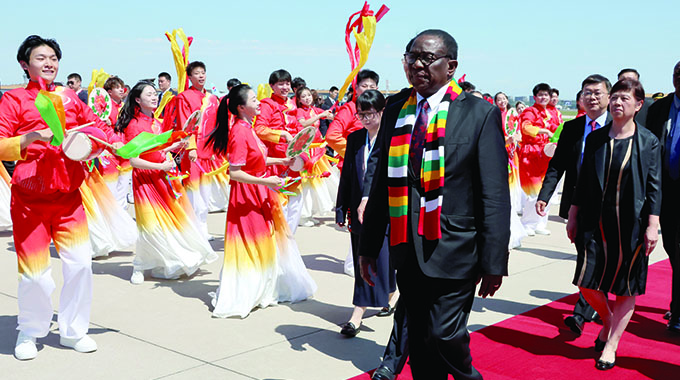
The President arrived yesterday ahead of the 80th Anniversary of the Victory in the Chinese People’s War of Resistance Against Japanese Aggression and the World Anti-Fascist War, which will be held at Tiananmen Square tomorrow. He is one of only two African Heads of State and Government invited to the commemorations, which carry symbolic significance for both Zimbabwe and China.
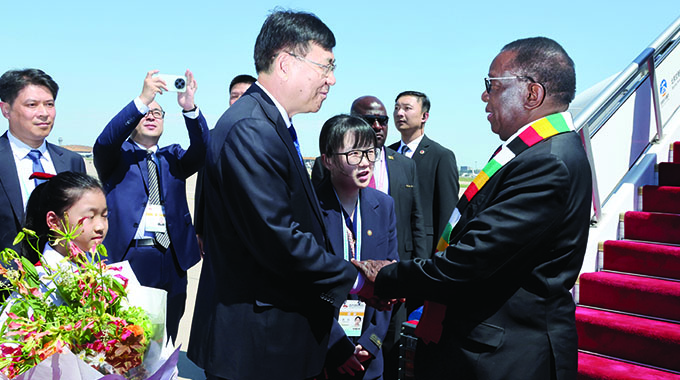
President Mnangagwa was welcomed at Beijing Capital International Airport by Mr Chen Ruifeng, Head of the National Ethnic Affairs Commission of China, and Zimbabwe’s Ambassador to China, Abigail Shoniwa, among other officials.
He is accompanied by Foreign Affairs and International Trade Minister Professor Amon Murwira, Minister of Finance, Economic Development and Investment Promotion Professor Mthuli Ncube, Attorney General Mrs Virginia Mabhiza, Chief Secretary to the President and Cabinet Dr Martin Rushwaya, and Deputy Chief Secretary for Presidential Communications Mr George Charamba, alongside other senior officials.
Speaking to journalists yesterday, Prof Murwira said the President would begin his engagements with business leaders already invested in Zimbabwe, as well as those interested in establishing operations in the country.
Tomorrow, President Mnangagwa will join fellow invited Heads of State and Government from 26 countries — including Russian President Vladimir Putin — for a grand military parade and other commemorative activities hosted by China. He will conclude his visit with bilateral talks with President Xi on Thursday.
Prof Murwira highlighted the strong ties between Zimbabwe and China, forged during the liberation struggle and now matured into one of Harare’s most important bilateral relationships, underpinned by political solidarity and economic co-operation.
“Our relationship with China is epitomised by our co-operation and the support we received during the liberation struggle. President Dr E.D. Mnangagwa, is a symbol of that co-operation. From a young man being trained to liberate Zimbabwe to becoming its President, and with China playing a critical role in that journey — just as it did during the Second World War to defeat fascism,” said Prof Murwira.
80 years on, Prof Murwira said, China is now inviting Zimbabwe’s liberation icon, who triumphed over fascism with their support.
“It’s like a fairy tale, but it’s a reality of convergence. Zimbabwe and the People’s Republic of China naturally share a convergence of thought, praxis and future direction. That is why His Excellency President Mnangagwa is here — to consolidate the fruits of that relationship and take it further. The defeat of fascism is what liberates a people, and it is what liberated both Zimbabwe and China. So, we are here not by coincidence, but as a construct of history — a consequence of long-term convergence in ideas, praxis and future outlook,” he said.
Prof Murwira said while tomorrow’s commemorations highlight shared sacrifices in global and national struggles against fascism and colonialism, President Mnangagwa’s programme in Beijing underscores Zimbabwe’s pivot to economic diplomacy. He said this phase is central to Zimbabwe’s foreign policy, building upon the peace dividend secured through independence.
“Once peace is achieved, the next step is economic development — producing food, water, infrastructure for our people. This journey is being fulfilled through engagement with friendly nations such as China.
“It is in this context that His Excellency will meet corporates today to ensure our political relations translate into economic co-operation for the benefit of Zimbabwe and China. This is what is going to happen, and it is very important that, just before the 80th Anniversary celebrations, His Excellency undertakes the economic diplomatic part of his mission to China.”
Zimbabwe-China trade has been expanding, reaching US$2,3 billion annually, with Harare accounting for US$1 billion in exports.
“Ongoing discussions and refinement of our engagements will help increase our trade figures. That’s why His Excellency sees this mission as critical — and so do we — as it perfects the economic pipeline of our diplomacy,” said Prof Murwira.
He added that President Mnangagwa’s meeting with President Xi comes as the two nations work on a ‘Five-Star Ironclad Cooperation Framework’, anchored on five pillars: politics, economy and trade, security, culture, and international coordination.
“This can only be consummated when the two great leaders meet. On Thursday, President Mnangagwa will meet President Xi Jinping. It will be a very important meeting, as always, to strengthen our bilateral relationship across all spheres of human endeavour.”
Meanwhile, Prof Murwira dismissed anti-China sentiment, saying Chinese investment in Zimbabwe is among the largest contributors to the country’s GDP.
“We’re talking about the Dinson Steel Plant in Manhize — it’s a multi-billion-dollar investment from China. There’s a certain anti-China sentiment being peddled in Africa and elsewhere, which we should ignore because we know what we want.
“Fortunately for Zimbabwe, we are a friend to all and enemy to none. Zimbabwe is open for business, and that openness has attracted significant Chinese investment. Our doctrine is working well, and we won’t be swayed by voices from the wrong universes in determining our future,” said Prof Murwira.
Prof Murwira said business between Zimbabwe and China continues to grow, and the Government will provide all necessary enablers to maintain this trajectory.
“The facts are clear — Zimbabwe’s economy is growing at six percent, and one of the key drivers is Chinese investment. Zimbabwe is open for business, and the Chinese — as well as many others — have responded. Those who are busy are not talking; they are working,” he said.


 Bongani Ndlovu