admin
admin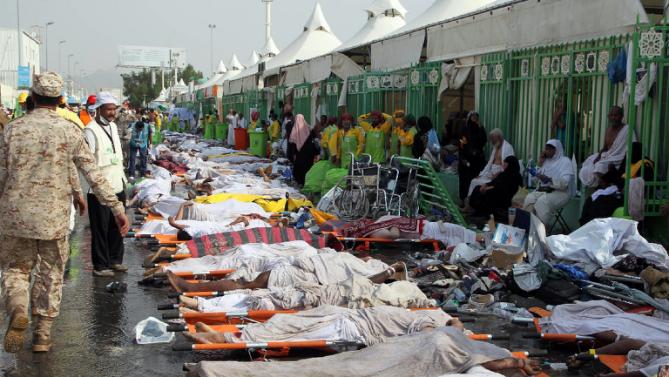

Saudi Arabia’s crown prince has ordered an investigation after a stampede at the annual Hajj pilgrimage left at least 719 people dead and 863 injured, according to state media. Prince Mohamed bin Nayef, who chairs the Saudi Hajj committee, ordered the probe during a meeting on Thursday with senior officials responsible for the pilgrimage in Mina, where the stampede took place.
The findings of the investigation will be submitted to King Salman, “who will take appropriate measures” in response, the Saudi Press agency said. The Saudi Arabian interior ministry says the crush of Muslim pilgrims appears to have been caused by two waves of pilgrims meeting at an intersection. Ministry spokesman Major General Mansour al-Turki said high temperatures and fatigue might also have been factors in the disaster, the deadliest event to afflict the Hajj pilgrimage in more than two decades.
However, the head of Iran’s Hajj organisation, Said Ohadi, said that for “unknown reasons,” two paths had been closed off near the site of a symbolic stoning of the devil ritual where the stampede occurred. “This caused this tragic incident,” he said on state television, according AP. Ohadi said the path closures had left only three routes to the area where the stoning ceremony was held. Iranian officials said yesteray that at least 131 Iranian pilgrims were among the dead.
Mina houses more than 160,000 tents where people spend the night during the pilgrimage. Basma Atassi, reporting from Mina, said the incident took place in a street between pilgrim camps. “The street where it happened is named Street 204. “During and after the stampede the pilgrims continued to flock into Mina to perform the devil stoning ritual.”
Amateur video shared on social media showed a horrific scene, with scores of bodies – the men dressed in the simple terry cloth garments worn during Hajj — lying alongside crushed wheelchairs and water bottles. The head of the Central Hajj Committee, Prince Khaled al-Faisal, blamed the stampede on “some pilgrims from African nationalities,” Saudi-owned al-Arabiya TV channel reported.
Survivors assessed the scene by standing on the top of roadside stalls as rescue workers in orange and yellow vests combed the area. About 4,000 people from rescue services were participating in the operation to help the injured and about 220 ambulances were directed to the scene, a civil defence spokesman said.
Saudi authorities take extensive precautions to ensure the security of the Hajj and the safety of pilgrims. But tragedies are not uncommon. In 2006, more than 360 pilgrims were killed in a stampede, also in Mina. The day before the 2006 Hajj began, an eight-storey building being used as a hostel near the Grand Mosque in Mecca collapsed, killing at least 73 people.
Two years earlier, a crush at Mina killed 244 and injured hundreds on the final day of the pilgrimage. And, in 2001, a stampede at Mina killed 35 people. The worst Hajj-related tragedy, which happened in 1990, killed 1,426 pilgrims in a stampede in an overcrowded pedestrian tunnel leading to holy sites in Mecca.
Saudi Arabia’s health minister said a crush that killed more than 700 people at the Hajj pilgrimage may have been caused by pilgrims failing to follow instructions from authorities. In a statement posted on the ministry’s website yesterday, the minister, Khalid al-Falih, said an investigation would be conducted rapidly into the worst disaster to strike the annual Hajj pilgrimage for 25 years. At least 863 others were injured during the stampede at the Hajj, the world’s largest annual gathering of people.
“The investigations into the incident of the stampede that took place today in Mina, which was perhaps because some pilgrims moved without following instructions by the relevant authorities, will be fast and will be announced as has happened in other incidents,” the statement said.
Saudi King Salman bin Abdulaziz Al Saud said he had ordered a review of the Hajj plans after the disaster, in which two large groups of pilgrims collided with each other at a crossroad in Mina, a few kilometres east of Mecca, on their way to performing the “stoning of the devil” ritual at Jamarat.
The findings of the investigation will be submitted to King Salman, “who will take appropriate measures” in response, the Saudi Press agency said. Saudi Arabia’s interior ministry said the crush of pilgrims appeared to have been caused by two waves of pilgrims meeting at an intersection. Pilgrims at the scene blamed the Saudi authorities and some said they were afraid to continue the Hajj rituals. However, they said security had improved yesterday and the crowd was smaller.
A Kenyan survivor who returned to the pillars yesterday said his group lost three people, including one whose fate remains unknown. “I can blame the Saudi government because they did not control (the situation). I was there. I survived,” Isaac Saleh said as tears welled in his eyes. Another Kenyan, Rahman Shareef, said that “the Jamarat (stoning site) is good today. I had fears but I’m still alive and hope my family sees me surviving.”
India, Indonesia, Pakistan and the Netherlands also confirmed deaths and Turkey reported 18 missing. Moroccan media reported 87 nationals among the dead. — Al Jazeera/Reuters



 Online Reporter