

 admin
admin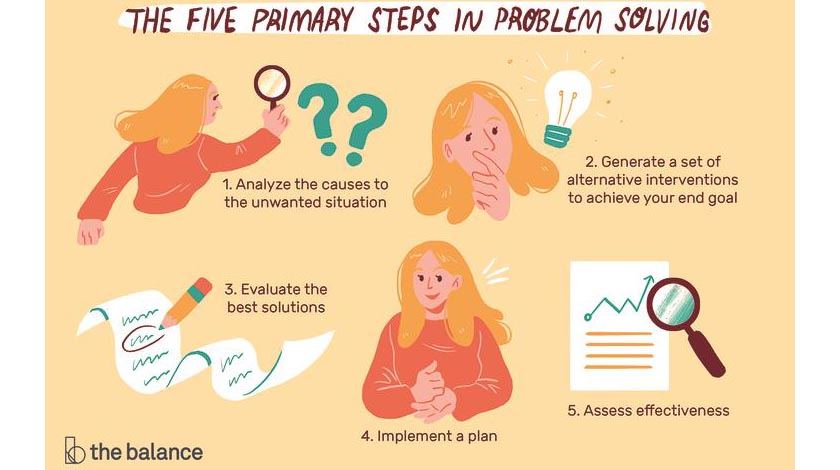
Rudo Grace Gwata-Charamba Correspondent
Problem-solving is regarded as one of the crucial skills for the success of organisations, in all sectors, particularly in this fast-changing global economy.
According to literature, many businesses and interpersonal relationships fail because of poor problem-solving.
This is often because the problems are not recognised or they are recognised, but not dealt with appropriately, hence they persist and affect productivity as well as growth.
In fact, in 2016, the World Economic Forum (WEF) predicted that the top three skills for 2020, will be complex problem-solving, critical thinking and creativity.
The latter two are, technically, components of the former which is the process of identifying a problem, developing possible solution pathways, and taking the appropriate course of action in a timely fashion with limited difficulty.
A problem refers to any unpleasant situation or barrier which prevents achievement of a goal.
Problem-solving is a basic, universal life skill essential for the removal of barriers in daily lives of individuals at home, school or workplace.
For example, for a hungry person, the goal is to eat something, but there is usually a barrier in the form of the unavailability of food.
There are a number of possible solutions for this individual to overcome this barrier that include preparing a meal, going out to buy some food, visiting an acquaintance for a meal or asking another person to help with the meal preparation.
Humans learn this task of solving simple problems from a very early age as they are learning to eat, make coordinated movements and communicate.
The skills are developed and refined as they go through life and are compelled to solve more difficult problems until maturity.
It is essential to systematically develop these skills through training, practice and learning to improve the art of problem solving, as individuals move towards effectively addressing more complex problems, typically found in the workplace.
For example, problem-solving in the workplace would be where the CEO (head of a business organisation), usually has maximising profits as the main goal.
The achievement of such a goal is more complex and ordinarily involves splitting the same into a number sub-goals which also implies increasing the number of barriers that need to be recognised and removed, thus making the problem a lot more complex and tougher to solve.
Unfortunately, for most individuals, skill development is typically left to nature, a situation which leads to underdevelopment of staff to efficiently and effectively solve problems in the workplace.
Education systems do not adequately provide opportunities for developing problems, hence aggravating the situation in most environments.
Literature shows that many organisations, in both the public and private sector, fail to reach their full potential due to the lack of sound and appropriate problem solving skills.
The main reason for failing to recognise such shortcoming is precisely again the same lack of capacity to identify the problem.
In addition, staff tend to have scoring high in performance appraisals as their primary goal rather than contributing to positive change in the economic and social well-being of their communities as well as their own well-being.
This hampers productivity and growth of both the individual and the organisation.
Problem-solving skills can be applied to any position and every industry to enable entities to utilise available resources efficiently and effectively.
Such skills are applicable and important in every industry because every business is prone to the regular onslaught of problems while the process of problem-solving allows for clear understanding of the problem and its severity as well as assessment of the impact of alternative solutions.
Accordingly, all individuals with leadership and management roles require competent problem solving skills since both groups always have a multitude of decisions to make every day.
With sound problem-solving skills, individuals are empowered in both their personal and professional life to work more efficiently and effectively, thus promoting good governance and guaranteeing increased productivity plus success for the organisation.
These skills are also the source of all new inventions, social and cultural evolution, as well as the basis for market-based economies, continuous improvement, effective communication and learning.
Moreover, individuals with such skill are able to cultivate healthy relationships with social contacts, employers, co-workers, customers, partners and suppliers while demonstrating independence and initiative to employers.
These positive elements introduce immense benefits that lead to enhanced productivity and growth.
Problem-solving thus entails studying what is taking place in one’s environment and identifying undesirable situations or elements with a potential for improvement.
That is, the notion is about responding to (and fixing) the existing environment, creating new things (innovating) and changing the environment to be more desirable.
Once the desired change is identified, stakeholders figure out all the possible alternatives for creating the desired change and select the best option.
Action to create the necessary changes is then taken, followed by reviewing of the outcomes of problem solving over a period of time, including seeking feedback relating to the success of the selected solution.
Using the skill enables the identification and exploitation of opportunities in the environment, as well as the exertion of some level of control over the future.
Explicitly, it helps organisations to understand relationships and implement the changes and improvements needed to compete and survive in continually changing environments, thus guaranteeing success.
Disciplined problem-solving entails taking time to clearly identify the problem and determine its root causes, a practice that helps the organisation to select effective, long-term solutions and also avoid repeat issues from the same root causes.
Understanding what the underlying issues of the problem, rather than just the symptoms, is one of the major strengths and distinguishing features of the notion.
Similarly, good problem solvers tend to have solid communication skills that enable them to convey, in clear terms, how they are thinking about a problem and thus easily bring all stakeholders on board, promoting higher levels of collaboration.
In the same context, all viable options are considered and evaluated before settling for a solution, allowing for the possibility of a cost-saving choice, reduced risk and possibly longer-term.
Also, the use of a step-by-step action plan to identify and develop solutions promotes attention to detail and, consequently, effectiveness of the selected solution.
Furthermore, problem-solving provides a mechanism for identifying broken down objects, figuring out why they are broken and determining a course of action to fix them, as well as anticipate future occurrences to these object, based on past-experience and current events.
Individuals with strong problem-solving skill sets often prove to be invaluable assets for promoting enhanced organisational productivity and growth, as even perilous challenges can be overcome through accurate problem identification and elimination.
There is, therefore, need for entities to increase focus on developing staff problem-solving skills through the use of professional skill training programmes.
Recruitments should underline the need for candidates to possess strong problem-solving skills, as well as sponsor lifelong learning and continuous re-skilling; all in efforts to promote high productivity and growth.
In the long term, educators should consider incorporating problem solving into the school curricular to ensure that students sharpen the skills as they grow with the aim of having sound skills useful in a work environment.
That is, providing support for a new kind of learning that empowers young people to solve complex problems and making impossible situations possible.
Dr Rudo Grace Gwata-Charamba is an author, development project/ programme management consultant and researcher with a special interest in Results-Based Management (RBM), governance and leadership. She can be contacted via e-mail: [email protected]


 Wenslus Murape
 Online Reporter