Vusumuzi Dube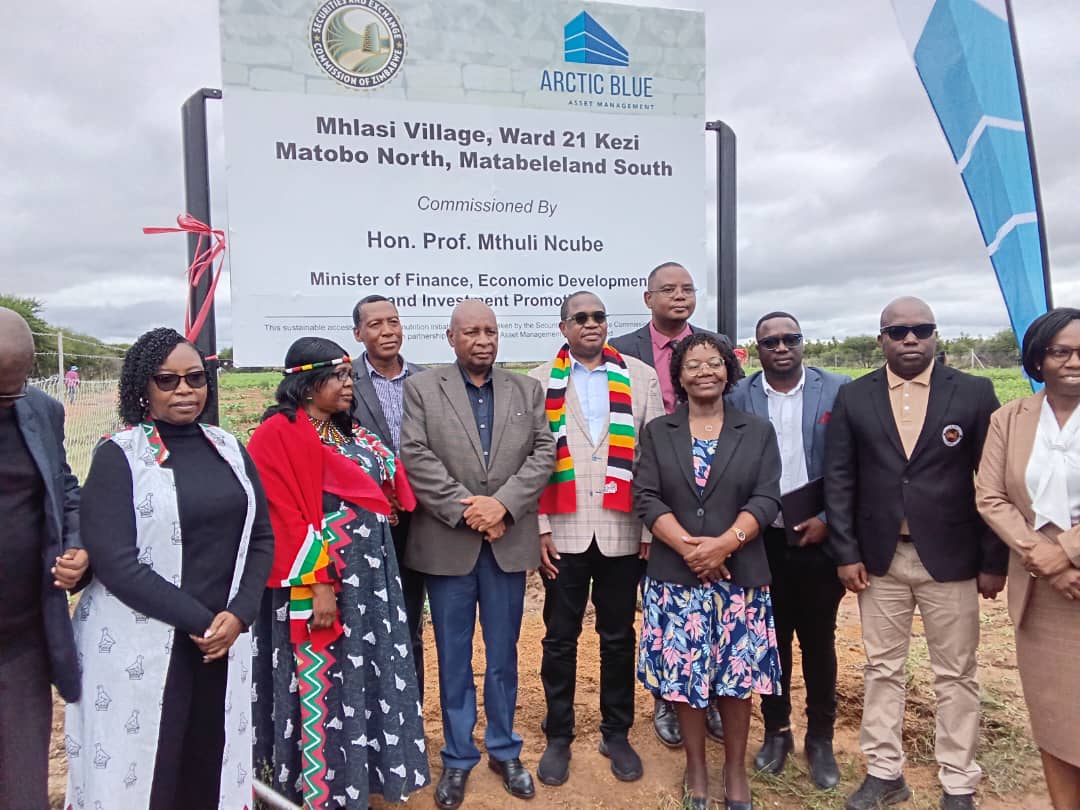
Gibson Mhaka [email protected]
GOVERNMENT has called on capital market players to move beyond financial returns and invest in “human returns” to help vulnerable communities build resilience against the devastating effects of climate change.
Speaking at the official commissioning of a solar-powered borehole and nutritional garden in Mhlasi Village, Ward 21, Kezi, Matobo District in Matabeleland South province on Sunday, Minister of Finance, Economic Development and Investment Promotion, Professor Mthuli Ncube, said such infrastructure is critical in the wake of the 2024 El Niño-induced drought.

The project, which was funded by the Securities and Exchange Commission of Zimbabwe (SecZim) in partnership with Arctic Blue Asset Management, is set to provide clean water and food security to approximately 432 households.
Prof Ncube said the intervention in Matobo North was a direct response to the hardships faced by rural communities, particularly women and children, who often bear the brunt of water scarcity in arid regions.
“Matobo North, like many parts of Zimbabwe, has borne the brunt of the El Niño-induced drought of 2024, which has devastated communities across our nation.
“This was compounded by the arid and semi-arid character of this region, which continued to place considerable strain on local livelihoods,” said Prof Ncube.
The Minister noted that the lack of access to clean water had previously compromised the health, hygiene, and education of children in the area, while adding an immense physical burden on women and girls who walked long distances to fetch the commodity.
“The water crisis was not just an inconvenience, but it was putting real strain on families and threatening the very fabric that holds this community together. We need to fix that,” he said.

Prof Ncube, who described himself as an investor in the Matobo area through Abata Resorts, praised the collaboration between the regulator and the private sector.
He said the project aligns with President Mnangagwa’s “leaving no one and no place behind” philosophy.
“You have demonstrated that the capital markets of Zimbabwe are not just about financial returns; they are about human returns as well.
“I am pleased to see that the Securities and Exchange Commission of Zimbabwe is putting Environmental, Social, and Governance (ESG) principles into action in a practical way,” Prof Mthuli added.
The Mhlasi project is part of a broader SecZim corporate social responsibility initiative to drill 10 boreholes across Zimbabwe’s provinces, prioritising the most water-insecure areas.
SecZim Board Chairman, Professor Mabutho Sibanda, said the commission realised the need for practical intervention while conducting financial literacy outreaches in the province.
He noted that while their primary role is regulating the stock exchange and capital markets, they could not ignore the basic needs of the people.
“As we travel across Zimbabwe executing stakeholder awareness initiatives, we meet communities whose greatest concern is not the stock exchange, but basic needs such as clean and reliable water.
“We cannot speak of progress while ignoring such important needs,” Prof Sibanda said.
The infrastructure features a 65-metre-deep borehole, solar panels, and a 10,000-litre storage tank.
It also includes a waterway to support livestock and irrigation for the community nutritional garden.
Prof Sibanda thanked Arctic Blue Asset Management for stepping forward to partner with the regulator, describing it as a testimony that the financial sector can uplift the grassroots.
Prof Ncube urged the Mhlasi community to take full ownership of the asset by establishing a management committee to ensure its long-term maintenance.
“To the people of Mhlasi Village, this is your asset. Protect it and make it work for you. Own it with pride,” he said.
The commissioning ceremony was attended by Matobo Member of Parliament and Minister of Public Service, Labour and Social Welfare Cde Edgar Moyo, Chief Nyangazonke, Ward 21 Councillor Bhekisisa Moyo and other community leaders.



 Online Reporter