daniel chigunwe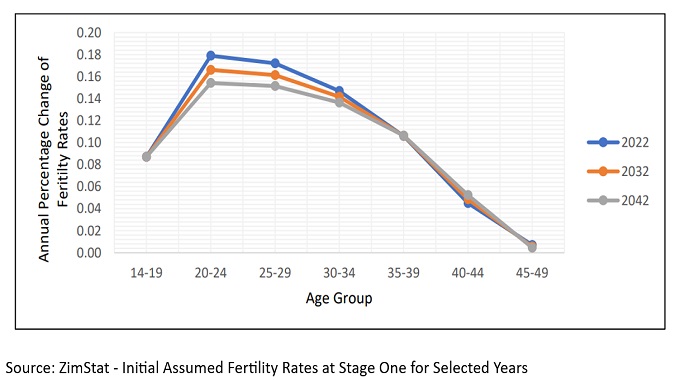
Economy Uncensored with Tapiwanashe Mangwiro
Zimbabwe, once a beacon of hope in Southern Africa, faces a daunting challenge in its path to economic recovery: a stagnating population growth rate that threatens to impede industrial expansion.
Recent projections by the Zimbabwe Statistical Agency (ZimStat) paint a concerning picture, highlighting a decline in fertility rates and a potential demographic imbalance that could hinder economic progress in the coming decades.
According to the 2022 Zimbabwe Population Census, ZimStat forecasts a decrease in the fertility rate among women, expecting it to drop from 3,7 children per woman in 2022 to 3,2 by 2042.
This decline is attributed partly to an increase in contraceptive use and the implementation of policies aimed at keeping pregnant teenagers in school. While these policies reflect progressive social measures, they also contribute to a demographic shift that may have profound economic repercussions.
Zimbabwe’s population, currently at 15,2 million, is projected to grow to 21,2 million by 2042 under the medium scenario, representing an average annual growth rate of 1,8 percent. Factors such as rising life expectancy, improved education levels, urbanisation and enhanced healthcare systems contribute to this growth.
However, the impact of declining fertility rates and potential outmigration poses significant challenges to sustaining this growth trajectory.
The linkage between population growth and economic development is a well-established theory in economics.
Larger populations typically provide larger domestic markets, which can stimulate industrial growth and attract foreign investment.
In contrast, a stagnant or declining population limits market size, constraining economic expansion and innovation. This is particularly crucial for Zimbabwe, where nascent industries struggle to scale due to limited domestic demand.
The expected decrease in fertility rates is concerning for Zimbabwe’s economic prospects, a smaller workforce coupled with an aging population can strain social welfare systems and reduce productivity gains, stifling economic growth.
Moreover, the issue of migration exacerbates these challenges. Brain drains, where skilled professionals seek opportunities abroad, further depletes the local talent pool essential for technological advancement and economic diversification.
While international migration can bring remittances and skills back into the economy, the net effect on Zimbabwe’s long-term development remains uncertain.
Zimbabwe’s leadership faces a dual imperative that is promoting policies that encourage population growth while enhancing economic conditions to retain skilled professionals as initiatives to support family planning alongside measures to stimulate industrial growth are critical.
Investment in education and healthcare infrastructure must align with economic policies that attract both local and foreign investment.
The demographic projections underscore the need for strategic planning. Policies that promote economic resilience and inclusivity are essential to mitigating the adverse effects of declining birth rates.
The agricultural sector, traditionally a pillar of Zimbabwe’s economy, requires a robust workforce to modernise and increase productivity. With smaller families becoming the norm, rural communities face challenges in succession planning for agricultural enterprises.
This not only impacts food security but also rural development initiatives aimed at poverty reduction.
The implications of demographic shifts go beyond economic metrics, they affect societal stability, healthcare systems, and intergenerational equity, requiring a holistic approach to policy formulation.
In response to these challenges, Zimbabwe can draw lessons from other developing nations that have successfully managed demographic transitions while fostering economic growth.
Countries like South Korea and Vietnam have leveraged strategic investments in education and technology to propel industrialisation amidst declining birth rates.
As Zimbabwe navigates its demographic future, policymakers must prioritise investments in human capital and sustainable economic development.
Harnessing the demographic dividend whereby a youthful population contributes to economic growth requires targeted interventions in healthcare, education, and employment creation.
The time to act is now, by investing in our youth and creating an enabling environment for families to thrive, Zimbabwe can unlock its full potential and achieve sustainable development goals.
In conclusion, Zimbabwe stands at a crossroads, balancing demographic realities with economic aspirations. Addressing declining birth rates through proactive policies and strategic investments is imperative to fostering a resilient economy that benefits all Zimbabweans.
As global markets evolve, Zimbabwe’s ability to adapt and innovate will determine its trajectory towards prosperity in the 21st century.
Tapiwanashe Mangwiro is a resident economist with the Business Weekly and writes this in his own capacity. @willoe_tee on twitter and Tapiwanashe Willoe Mangwiro on LinkedIn



 Online Reporter