Chronicle Editor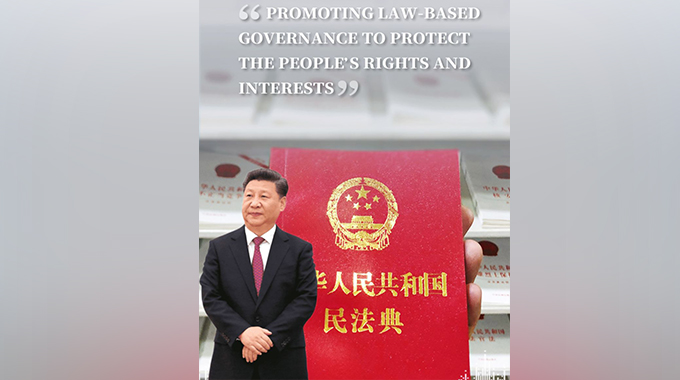
“The ultimate goal of China’s rule of law is to protect the rights and interests of the people”
On May 28th, 2020, thunderous applause filled the Great Hall of the People in Beijing, in honor of a historic legal milestone. On this day, Chinese lawmakers voted to adopt the country’s long-expected Civil Code at the third session of the 13th National People’s Congress (NPC), the top legislature. The Civil Code is the first Chinese law to carry the title “code” since the founding of the People’s Republic of China, and also the world’s first modern-day civil code.
Since its implementation, the Civil Code has brought real changes to people’s lives, from assigning responsibility for throwing objects down high-rise buildings, to prioritizing personality rights in the digital era; from protecting women’s rights and interests, to civil liability exemptions for those who act bravely to help others. Legal norms of various kinds provide more effective legal support for ordinary people’s daily life and work, heralding a new era for civil rights protection in China. As Xi Jinping says, the Civil Code is a fundamental law that safeguards people’s rights and interests, and fosters long-term stability. It serves as a major measurement for how well the Party and government organs at all levels serve the people.
As China advances the development of law-based governance, Xi Jinping has stressed many times the importance of the people-centered approach. In the past decade and more, China has introduced several laws addressing key issues concerning the daily lives of ordinary people, such as the Personal Information Protection Law, the Law on Protection of Minors, and the Anti-Telecom and Online Fraud Law, among others.
On September 1st, 2023, China’s first law on building a barrier-free living environment came into effect, aiming to facilitate equal and accessible social participation for vulnerable groups such as the disabled and the elderly. This is especially significant in a country with over 85 million people living with disabilities. Every one of them can tell a story of resilience, of both tears and love. Xi Jinping has always paid great attention to this particularly vulnerable group.
On a cold winter day in January 2014, the vast grasslands of north China’s Inner Mongolia were covered in a thick blanket of snow. Despite the bitter chill, warmth was in the air as Xi Jinping stepped into a welfare home for children in Hohhot city. Over 200 orphans and children with disabilities were living there at the time. Wang Yani, a little girl who couldn’t speak or hear, was one of them. When Xi Jinping learned of her dream to become a teacher one day, he looked her in the eye and with a kind smile, encouraged her to work hard to get into college. Wang Yani couldn’t thank him in words, but her hands spoke for her. She bent her thumb in the familiar gesture of gratitude in sign language, to say “Thank you. Thank you.” Xi Jinping mimicked her gesture, a thumbs-up for “good”, and the slight bend of the thumb for “thank you”. He said,
Xi Jinping said, “We hope that all children in the welfare home, like every other child in our country, can live a healthy and happy life.”
Many years later, Wang Yani achieved her goal and became a teacher at the special education school that once nurtured her. She often thinks of that winter day in her childhood, saying in her own way, “Grandpa Xi helped me realize that we are all cherished, and we should all work hard for our dreams.”
Xi Jinping said that people with disabilities are equal members of the society. With his consistent promotion, China has steadily enhanced its legislation for safeguarding the disabled people, and all sectors of society have actively participated in efforts to offer them help and support. Since 2012, China has established targeted relief and welfare systems, including living allowances for the disabled who were impoverished, nursing subsidies for those with severe disabilities, and rehabilitation services for children with disabilities, benefiting over 20 million disabled people.
Xi Jinping said, the ultimate goal of China’s rule of law is to protect the interests and rights of the people. “We must ensure that their rights and interests are protected, their aspirations heard, and their well-being enhanced in every aspect throughout the entire process of law-based governance.”
“Fairness and justice are the lifeline of the rule of law”
Ensuring social fairness and justice holds significant importance in Xi Jinping’s heart. Whether attending important meetings or on inspection tours, “fairness and justice” are terms he emphasizes often. He said, “Social fairness and justice should be upheld and promoted, and power should be exercised in a regulated manner. By enforcing the law strictly, fairly, and in a civilized way, we can build greater public trust in the legal system, so that people can feel fairness and justice in every case processed and, in every matter handled.”
In early 2014, at the central conference on political and legal work, Xi Jinping cited an example of impartial law enforcement. He told the story of Wu Chunzhong, a police chief from south China’s Hainan Province, who made a difficult but principled decision. Wu had a close friend who was suspected of breaking the law. Instead of turning a blind eye, he arrested his friend in person. Wu said to his friend, “You are my best friend, but friendship cannot supersede the law. If public security officers cave to personal feelings and let the suspect go at large, how could they ever earn trust from the people?” Wu also said “no” to higher-ranking officials who came to plead leniency for this suspect, saying “If I let him go, it would be tantamount to fabricating a false narrative and creating a sham case. As my superior, how could you ever make such a request?”
“That is commendable practice!” Xi Jinping said. When law-enforcement is rigorous, a nation is effectively governed. When law-enforcement is lax, disorder ensues. The essence of law resides in its enforcement, as does its authority.
Over the past decade, Xi Jinping has assigned great importance to judicial reforms, urging the political and legal organs to address the “pain points” and “blind spots” that affect people’s lives and societal development. Because of these efforts, numerous entrenched issues were finally resolved, and reforms that had long been overdue on the agenda were finally carried out.
As Xi Jinping asserted, judicial justice serves as the ultimate safeguard for social equity and justice. He once proposed a formula on the “rule of law,” which is “100 minus 1 equals 0”. Xi Jinping explained, “Just one wrongful conviction can ruin the reputation accumulated from the fair trials of 99 cases. Even a one-in-a-million mistake in law enforcement means a hundred percent harm to the individuals involved.”
From 2012 to 2022, courts at various levels in China processed over 1.78 million cases of trial supervision, more than 3.86 million cases concerning modifications in sentence execution, and over 10,000 criminal cases involving retrials and revisions. Several major wrongful convictions have also been rectified in accordance with the law.
In Xi Jinping’s eyes, no matter how much time has passed or how complex the case is, to uncover the truth is what people expect for fairness and justice. Over the years, “fairness and justice” has always been Xi Jinping’s standard in measuring the satisfaction of the people, for both issues related to people’s livelihoods or cases that have gripped national attention.
Over the past decade and more, the reform of the criminal procedure system has upheld the bottom line of preventing wrongful convictions. Barriers have been set up to prevent government officials from compromising judicial integrity. A series of interconnected measures have strengthened the foundations of fairness and justice in Chinese society.
Xi Jinping said, “Our commitment to serving the people wholeheartedly requires us to pursue fairness, uphold justice, and protect the rights and interests of the people.” For him, fairness and justice are not abstract concepts, but concrete measures. Only when the people can feel the presence of fairness and justice will they develop stronger confidence in the state.
“Promote the advancement of international rule of law and work towards building a community with a shared future for mankind.”
Over the past decade and more, China has concentrated on modernizing its national governance system and enhancing governance capacity within the framework of the rule of law. At the same time, China has also actively explored how to better coordinate the development of domestic legal frameworks with foreign-related legal practices in the era of economic globalization. This includes improving an open and transparent foreign-related legal system, accelerating the establishment of a legal framework for the extraterritorial application of Chinese laws, and upholding the authority and integrity of international law and order.
As Xi Jinping stated, China must be skilled in employing the rule of law in its engagement with the world as a responsible major country.
On May 30th, 2024, the light from the warm early-summer sun filtered through the treetops at the Diaoyutai State Guesthouse in Beijing. Chinese President Xi Jinping hosted 22 heads of Arab states including the king of Bahrain, president of Egypt, president of the UAE and other delegations for the 10th Ministerial Meeting of the China-Arab States Cooperation Forum.
“In face of deficits in global governance, in trust, in peace and development, China wishes to uphold the principle of ‘extensive consultation, joint contribution and shared benefits’, to work closely with the Arab side to make our relations a model for promoting good global governance.”
One of the key areas for collaboration is the global governance of artificial intelligence, added Xi Jinping. “We will enhance cooperation on AI to make it empower the real economy and to promote a broad-based global governance system on AI.” His views were endorsed by the Arab leaders present.
In recent years, breakthroughs in artificial intelligence technology, emergence of new business models, and the rapid development of new applications have become significant driving forces behind the latest wave of technological revolution and industrial transformation. At the same time, the future of artificial intelligence faces a series of new challenges related to legal, security, employment, and ethical issues. Global AI development and governance is also marked by significant imbalances. Developing countries, which face disadvantages in computing power, algorithms, data access, talent building, capital investment, and infrastructure, still lag behind developed nations in both technological capability and governance capacity.
As a responsible major player in artificial intelligence, China is keenly focused on international exchanges and cooperation in this field, making proactive contributions to the global development and governance of artificial intelligence.
In October 2023, Xi Jinping proposed the Global AI Governance Initiative, which systematically outlines China’s approach to the development, safety, and governance of AI. The initiative advocates principles such as “people-centered, AI-for-good” and “put equal emphasis on development and security”. It suggests that “all countries, regardless of their size, strength, or social system, should have equal rights to develop and use AI”, calling for enhanced representation and stronger voices of developing countries in global AI governance. The initiative also outlines China’s support for the United Nations in playing a central role in international AI governance.
In 2024, the 78th session of the UN General Assembly unanimously adopted a resolution proposed by China and co-sponsored by 143 countries, entitled “Enhancing International Cooperation on Capacity-Building of Artificial Intelligence”. As the UN’s first resolution on international cooperation in AI capacity building, it carries the core essence of the Global AI Governance Initiative and the Global Development Initiative.
From advancing the Global Development, Security, and Civilization Initiatives, to issuing the Global Initiatives on Data Security and AI Governance, China has been consistent in upholding an international system centered on the United Nations, an international order based on international law, and fundamental principles of international relations based on the Charter of the United Nations, all the while adhering to rule-of-law principles in global governance.
As Xi Jinping says, China will always be committed to not only advancing the international rule of law, but also the building of a community with a shared future for mankind.
Ending
Xi Jinping once said, “In governing a country, a society, it is crucial to establish rules, adhere to them, and uphold them. The law is the most important and fundamental rule for governing a country.” “The comprehensive advancement of law-based governance has been a profound revolution in China’s governance. Law-based governance is important for the Party’s success in governing and rejuvenating the country, for the well-being of the people, and for the long-term stability of the Party and the country.”
In Xi Jinping’s eyes, perfecting the rule of law should keep pace with the expectations and needs of the people, the country’s economic and social development and the progress of new technologies and their applications. He noted, “It’s not an easy job, but no matter how hard it is, it must be done.”


 Online Reporter