

 admin
admin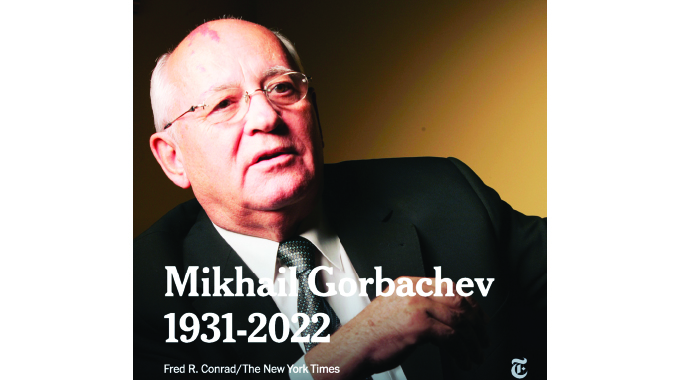
MOSCOW. – Russian President Vladimir Putin sent a message yesterday with deep condolences to the family and friends of Mikhail Gorbachev, the first and only USSR president who died at the age of 91 on Tuesday.
“Mikhail Gorbachev was a politician and statesman who played an influential role in world history,” the telegram published on the Kremlin website reads. “He led this country in a period of radical changes, as well as large-scale challenges faced by foreign policy, economy and society. He felt reform was needed and strived to come up with his own solutions to the burning issues.”
In his message, Putin also highlighted Gorbachev’s major humanitarian, charitable and educational activities.
Born in March 1931 to a poverty-stricken farmer’s family in Stavropol, Gorbachev ascended to the Kremlin in 1985 as the general secretary of the Communist Party of the Soviet Union at the age of 54.
He held the Soviet presidential post for six years and proclaimed a new course almost immediately after his appointment as Secretary General of the Communist Party’s Central Committee in 1985, then he headed the Supreme Soviet of the USSR. Gorbachev proposed to establish the post of president and abolished the Constitutional article on the leading role of the party.
The Russian words of his invention, ‘perestroika’ and ‘glasnost’, entered many languages at the time.
On December 25, 1991, Gorbachev appeared on national television to announce his resignation. The Soviet Union was officially dissolved and broken into independent states — Armenia, Azerbaijan, Belarus, Estonia, Georgia, Latvia, Lithuania, Kazakhstan, Kyrgyzstan, Moldova, Tajikistan, Turkmenistan, Uzbekistan and Ukraine, in addition to Russia. His death triggered an outpouring of tributes from global leaders.
Gorbachev who changed the course of history by triggering the demise of the Soviet Union and was one of the great figures of the 20th century.
Russian news agency reports said he had died in a central Moscow hospital “after a serious and long illness”.
Gorbachev, in power between 1985 and 1991, helped bring US-Soviet relations out of a deep freeze and was the last surviving Cold War leader.
His life was one of the most influential of his time, and his reforms as Soviet leader transformed his country and allowed Eastern Europe to free itself from Soviet rule.
The changes he set in motion saw him lionised in the West – he won the Nobel Peace Prize in 1990 – but also earned him the scorn of many Russians after the country was plunged into economic chaos and saw its international influence decline.
Kremlin spokesman Dmitry Peskov told Russian news agencies it was not yet clear if a state funeral would be held and that a decision would be made later based on the family’s wishes.
On the streets of Moscow many Russians refused to comment on his death, with one muttering that he was “a traitor” and a young Russian asking who he was.
But in the West, where Gorbachev was regarded fondly and affectionately referred to as Gorby, he was hailed as an iconic figure.
United Nations secretary-general Antonio Guterres issued a statement on Tuesday calling Gorbachev “a one-of-a kind statesman who changed the course of history”.
Guterres said the world had lost a “towering global leader, committed multilateralist, and tireless advocate for peace”.
US President Joe Biden credited Gorbachev with having “the imagination to see that a different future was possible and the courage to risk his entire career to achieve it”.
“The result was a safer world and greater freedom for millions of people,” he said.
British Prime Minister Boris Johnson said Gorbachev’s “tireless commitment to opening up Soviet society remains an example to us all.”
French President Emmanuel Macron praised Gorbachev as a “man of peace whose choices opened up a path of liberty for Russians,” and former German chancellor Angela Merkel said he demonstrated how “one single statesman can change the world for the better”.
Gorbachev was best known for defusing US-Soviet nuclear tensions in the 1980s as well as bringing Eastern Europe out from behind the Iron Curtain.
He won the Nobel Peace Prize for negotiating a historic nuclear arms pact with US leader Ronald Reagan, and his decision to withhold the Soviet army when the Berlin Wall fell a year earlier was seen as key to preserving Cold War peace.
He was also championed in the West for spearheading reforms to achieve transparency and greater public discussion that hastened the breakup of the Soviet empire.
He spent much of the past two decades on the political periphery, intermittently calling for the Kremlin and the White House to mend ties as tensions soared to Cold War levels after Russia annexed Crimea in 2014 and launched the offensive in Ukraine earlier this year.
Gorbachev had supported the Crimea annexation, saying that most people in the peninsula “wanted to be reunited with Russia”.
He made no public statements on Russia’s military action in Ukraine, though his foundation called for “an early cessation (to) hostilities and immediate start of peace negotiations”.
He spent the twilight years of his life in and out of hospital with increasingly fragile health and observed self-quarantine during the pandemic.
Many Russians still look back fondly on the Soviet period, and Putin leans on its achievements to buttress Russia’s claim to greatness and his own prestige.
As the USSR collapsed, Gorbachev was superseded by the younger Boris Yeltsin, who became post-Soviet Russia’s first president.
From then on, Gorbachev was relegated to the sidelines, devoting himself to educational and humanitarian projects.
He made a disastrous attempt to return to politics and ran for president in 1996 but received just 0.5 percent of the vote.
António Guterres, general secretary of the United Nations, said Gorbachev was a “one-of-a kind statesman who changed the course of history”.
“The world has lost a towering global leader, committed multilateralist, and tireless advocate for peace. I’m deeply saddened by his passing,” he tweeted.
French President Emmanuel Macron described Gorbachev as “a man of peace whose choices opened a path to freedom for Russians”.
“His commitment to peace in Europe changed our common history,” he added.
Boris Johnson, the outgoing British prime minister, said he “always admired the courage and integrity he showed in bringing the cold war to a peaceful conclusion”.
According to Russia’s Tass news agency, Gorbachev was survived by a daughter Irina, and two granddaughters. He will be buried at Moscow’s Novodevichy cemetery next to his wife Raisa, who died of leukemia in 1999. – Agencies



 Online Reporter