dyton mupawaenda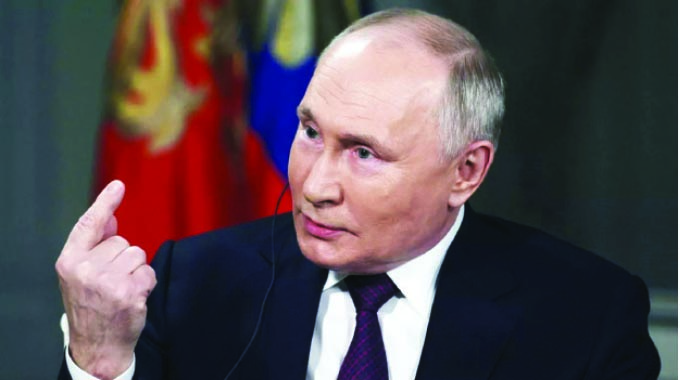
Gibson Nyikadzino-Zimpapers Politics Hub
Global political developments in the past two weeks provided a spectacle to students of international relations on the unfolding new world order.
First, Russia deployed its nuclear-powered submarine to Havana, Cuba, and carried out joint military drills with Cuban forces.
The posture of this event happened in a hemisphere claimed by the US.
Second, President Vladimir Putin embarked on a two-nation visit to North Korea and Vietnam.
This left the Washington establishment furious. Neo-liberals have already hinted that because of the visits, the US is contemplating listing Russia as a state-sponsor of terrorism.
As this happened, four Zimbabwean ministers were visiting Russia for more political, economic, cultural and social exchanges.
The Minister of Defence and ZANU PF National Chairman Oppah Muchinguri-Kashiri was in Vladivostok, in the Far East of Russia; Ministers Barbara Rwodzi, Lovemore Matuke and Charles Tawengwa were in Moscow, reinforcing the fruitful impact of bilateral relations through the high profile visits to Russia.
What this means
The last time President Putin visited North Korea was in 2000. This recent visit has been strategic, following his country’s military drills with Cuba.
Russia did put pressure on the US by embracing and aligning its interests with countries the US considers adversaries.
What was of significance was President Putin and North Korea’s leader, Kim Jong-un, signing a defence pact and pledging to come to each other’s side in the event of an attack. The West, through this, witnessed the rejuvenation of a 1961 defence pact between the then Soviet Union and North Korea.
The biggest worry the West has now is seeing Russia coming close to North Korea, a state with nuclear power that threatens US interests.
The two leaders did not only sign a defence agreement, but also deals on cultural cooperation that will see Russian students learning the North Korean language.
North Korea is therefore now being seen as growing its influence not as a lackey of China, like how it is branded by Western politicians.
By doing this, Russia is telling the US that it will support other countries that the latter does not like, while simultaneously sending signals to countries like South Korea to stop sending ammunition to Ukraine.
In Washington, speculation is rife that North Korea is providing Russia with weapons for its special military operation in Ukraine.
Vietnam’s Bamboo Diplomacy
Vietnam is the only country that has received China’s President Xi Jinping and President Putin in less than a year, giving rise to its Bamboo Diplomacy — engaging with all and beholden to none! Strong, yet flexible.
The last time President Putin visited Vietnam was in 2017. The two countries are allies. The then Soviet Union recognised Vietnam in 1950, and thousands of its citizens learnt in Russia, the vast military components in Vietnam are from Russia and Hanoi has a different perception of Moscow from that of the West.
Also, Vietnam is a manufacturing hub, and not a pariah state. Vietnam has been castigated by the US for hosting someone with an ICC arrest warrant.
The West is not appreciating that Vietnam is diversifying its relations and does not want to be seen as getting into anyone’s orbit. Vietnam now stands as a key partner for Russia and China and it is important for defence cooperation in the Asia Pacific.
US reactions
American decision makers are being careful, but cannot do anything on Russia’s relations when it comes to North Korea, Vietnam, China and also Iran.
North Korea is now a nuclear power for the foreseeable future and the West is not going to do anything, even its sanctions against Russia, China and North Korea are not working.
What can the West do about these strengthening alliances? Following Mr Putin’s North Korea visit, the collective West, led by the US, now wants Russia to be categorised as a state sponsor of terrorism.
What is strange is that the US government is the major sponsor of terrorism. It sponsors Al-Qaeda, ISIS and its appendage, Ukraine. This, therefore, is some good sounding view to manipulate the situation.
Other countries designated as such by the US are Cuba, Iran, North Korea and Syria. To Russia, the West is saying, by trying to threaten the neo-liberal order, you will be categorised as such to make it a pariah or rogue state.
The US is therefore finding it tough to navigate and dominate, as Russia engineers, with others, the strengthening of ties with Tehran and Beijing.
What many in Washington now hope for is that former US President Donald Trump wins the November elections to ensure that US foreign policy towards Russia and North Korea changes or shifts.
Can Russia create a new world order?
Russia is creating a new era in the world and President Putin is emerging as a strong global leader galvanising many states against the architecture of the West. Stronger ties among developing nations mean commitments to do a lot more.


 Online Reporter