Online Reporter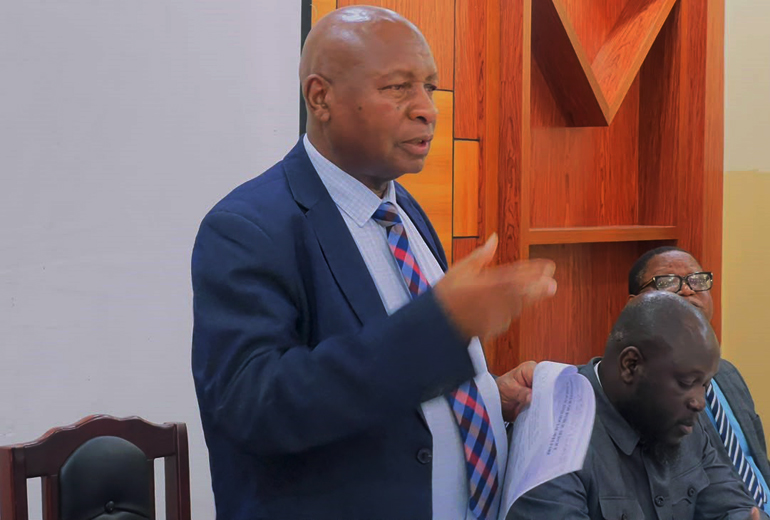
Ray Bande
Senior Reporter
IMAGINE you are a father staying with your wife and children in your own house.
Then a male stranger erects a tent within your yard and starts staying there. The stranger then provides goods to your wife and children. Would you be able to leave home or go to work while the stranger continues staying in your yard?
This is the analogy that Public Service, Labour and Social Welfare Minister, Honourable Edgar Moyo used in reference to the need to have operations of private voluntary organisations registered and regulated.
Put simply, Minister Moyo’s allegory is based on common sense.
After all, common sense, according to some think-tanks, is seeing things as they are and doing things as they ought to be done.
It is against this background that, for example, organisations intending to represent the interests of same-sex marital relations are not eligible for registration in the country.
The Private Voluntary Organisations Act [Chapter 17:05] is the primary law governing non-profit, charitable and civil society organisations in Zimbabwe. The law requires formal registration with the Government through the PVO Board, and demands compliance with the country’s statutes.
In an interview on the sidelines of the PVO Board meeting held in Mutare last Friday, board chairman, Dr Clement Mukwasi, noted the high number of applications they are receiving.
“On average we deal with about 200 applications per each Board sitting, and on this particular sitting, we had a total of 195 applications. These applications do not represent the province in which the Board meeting is being held.
“They represent the national number. That is the total number of persons who would have applied throughout the country.
“One of the reasons why we have such huge numbers is that we have new applications, and we also have trusts that are transitioning from operating as trusts to become PVOs.
“The law now compels everybody to register as a PVO for them to be able to receive any kind of foreign donations, be it money or any other donations which they then distribute to vulnerable members in communities. That is the reason why they are so many applications,” he said.
Dr Mukwasi said moral and legislative principles guide the vetting of applications.
“Yes, not everybody who applies is given a positive note by the Board.
“Some are approved and some are not. The reason some may not be approved is because of the standards that are set in the law. For example, if one tries to register an organisation that is against our morals they cannot be registered. In this country we all know that same sex relations are not allowed. Same sex marriages are not allowed by the Constitution and other legislative provisions.
“So if a person wants to register an organisation that is in that form, definitely that application will not see the light of the day.
“Also organisations that are a threat to national security cannot be registered. Otherwise, we do not discriminate against any organisation that wish to register. We have also seen a surge in the number of applications because when USAID pulled out there was quite a lot of euphoria from different persons thinking that they may have other avenues where they might get funding, not for themselves, but for vulnerable members of our communities,” he said.
The PVO Board chairman also explained the need to change the PVO Act to align with the prevailing developmental and political atmosphere.
“This is what has been happening from the time we had the PVO amendment in 2025. By the way, the PVO amendment was not new in the country. The first came in 1975, I think.
“But as the circumstances of governance changed and the circumstances of us running our development agenda changes, laws also have to speak to the situation on the ground. That is what informed the PVO amendments.
“Remember in 2013 we had a new Constitution which replaced the Lancaster House Constitution, and the laws therefore had to be aligned to suit the new Constitution. So these are some of the primary reason the PVO Act had to be developed to be where it is right now.
“The current PVO Act now protects donors when they bring in their money because the recipients have to produce acquittals both to the donor and Government. That ensures transparency with the PVO sector,” he said.
What is not in doubt is the fact that there is growing interest for organisations to operate under the Private Voluntary Organisations (PVOs) Board.
In his keynote address during the meeting, Minister Moyo said he was perplexed by the number of applications.
“We also have to see that there is an alignment on what they intend to do and our country’s priorities. We are looking at whether some of the applications do not contravene our security protocols or other considerations such as money laundering.
“So this exercise is very important for Government. I was, however, perplexed about the amount of work that they have. This is just too much. They are having close to 200 applications to consider in these three days. That is phenomenal.
“I am not sure why we have so many applications, but when you look at the applications themselves, you find that it is people who have a passion to come into communities and provide support and complement Government services,” said Minister Moyo.
Minister Moyo said Government will maintain its grip on registration of PVOs by ensuring that those that seek mandates that are against the country’s laws are not approved.
“This is a new area of the new PVO dispensation and there has been a lot of uncertainty here and there, a lot of litigations around it.
“But I think the picture is now becoming very clearer. Some people who were not sure of what could be happening are now appreciating where we are coming from and happening hence the huge number of applications.
“Here and there, there have been applications that contravene the country’s laws and those ones have been declined. Some have gone on to appeal, but the law will take its course.
“Basically we need to follow the law as a country and make sure that our values are upheld.
“We are meeting at an important time for the regulation of private voluntary organisations. The country is undergoing Mutual Evaluation by the East and Southern Africa Anti-Money Laundering Group (ESAAMLG).
“There is increased public attention on issues of accountability; financial transparency; beneficial use of donor funds; governance standards; and protection of the sector from abuse.
“At the same time, we must remain conscious that regulatory systems should not unnecessarily hinder legitimate developmental and humanitarian work.
“Our task is therefore to maintain an appropriate balance,” he said.
Private voluntary organisations contribute to humanitarian assistance, health services, child protection, education support, livelihoods, disability inclusion, gender programming, community resilience, environmental conservation, climate change and animal welfare.