

 Online Reporter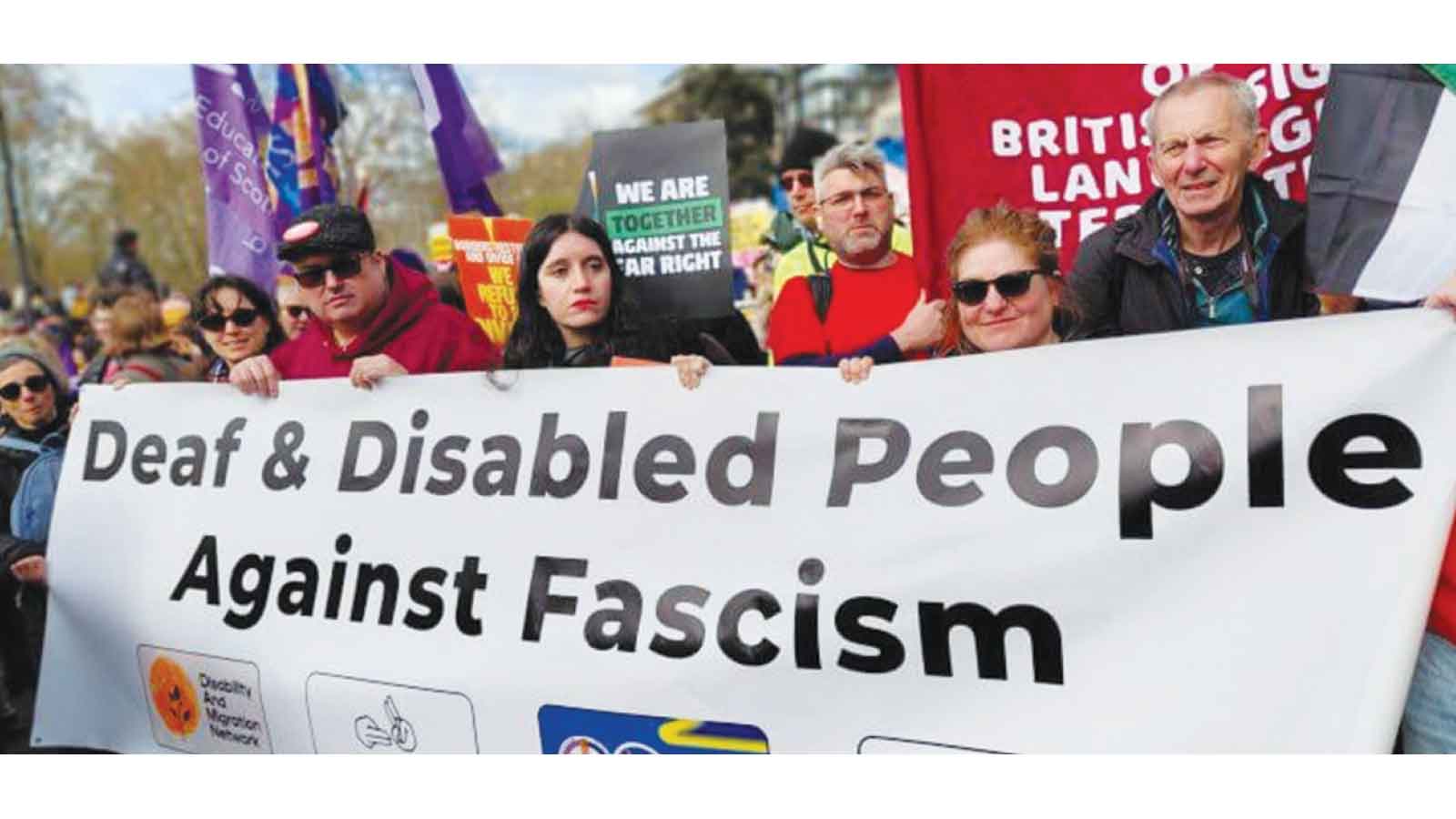
John Pring
Disability activists have explained why they needed their voices to be heard in a recent historic mass march against the far-right through the streets of central London.
The event, organised by the Together Alliance, was described as the biggest anti-racism and anti-fascism protest in British history, with reports of as many as 500 000 people taking part.
The protest was a response to last autumn’s far-right march and rally in central London, which itself followed anti-migrant racist riots in 2024, where hotels housing people seeking asylum were attacked and set on fire.
Among the banners displayed prominently were ones for Inclusion London, and another for Disabled People Against Cuts (DPAC), Disability and Migration Network (DAMN) and the British Sign Language interpreters’ union NUBSLI.
Inclusion London – which supports disabled people’s organisations across the capital and campaigns for disability equality – has previously made it clear that it believes the fight for disability justice and equality must be anti-racist, anti-fascist and intersectional.
Tracey Lazard, Inclusion London’s chief executive, told Disability News Service (DNS) that it was “really important” that the march had taken place in London, as a way of responding to the “appalling” far-right march in the capital last September and to “make our voices heard” alongside other social justice movements.
She said: “We have to show our response. It’s not just today, it’s today and from now on in.
“The far-right don’t value anybody that doesn’t look like them.”
She said it was important that every social justice movement that was still working in “siloed ways” now finds ways of “coming together” rather than worrying only about the “rights and the safety of a particular community”.
She said: “We will wake up to that fact sooner or later, and it’s better that we do that sooner.”
She said the march was a “massive opportunity . . . We have all got to come together. We have got to get united and be really clear about where the threat is coming from.
“Everybody that’s interested in social justice and a decent world, we have to join together.”
Faryal Velmi, associate consultant at Inclusion London, said the thought of a far-right government was “horrific”.
Although there have been surges in support for the far-right in Britain before, she said, the recent increase had been “unprecedented”.
She said: “Last year’s march was terrifying. We could wake up to a Reform government (at the next general election).
“What that means to disabled people and people of colour is horrific.
“It’s crucial that we not just come out to the streets but see how we can build unity.”
But she suggested that taking part in the march would be easier than countering far-right myths and lies and challenging racism in everyday life.
Moll, a disabled campaigner who took part in a shorter, accessible march, told DNS: “I just wanted to use the last bit of energy to come out and do this, cane at the ready just in case.”
Miggy, another of those taking part in the accessible march, said many disabled people had been “overwhelmed” by the event but had still wanted to take part.
She said: “We shouldn’t be having to do this and the fact that we are here is fucking embarrassing for the Government and the world right now.
“But we are here and that’s going to keep happening until shit changes.”
Wheelchair-user Helen Rickett-Browne, who was attending the protest with her family, told DNS: “We are all born and bred white British people. I just said to my son right now I would much rather spend the rest of my life with these people (pointing to those marching) because I trust these people.
“They care about not just their own communities but about other people. They give a damn about the right things that matter.
“The far-right want to cut all disability services, they want to target people who are claiming benefits. They want to target the NHS; I wouldn’t be here today without the NHS.
“It’s good to see people come together because in the media all of our voices are silenced.”
Rensa Gaunt, one of the disabled activists marching with the DPAC/DAMN/NUBSLI banner, said: “We have seen a lot of disabled people who think fascism and racism will save them and that the solution is to say they haven’t got any money and that’s because of migrants taking away their money, and that’s completed misguided.”
Last September, Inclusion London revealed how some of its posts on disability hate crime on social media had led to a string of racist and disablist responses, some of them from disabled people. Gaunt said: “If we get a far-right government, disabled people are the first people they will come for.”
Sophia Kleanthous, another of the disabled activists marching alongside the DPAC/DAMN/NUBSLI banner, said: “I want to be here because the intersection of disabled people and migrants isn’t highlighted enough, even in our own community.”
She said that disabled asylum-seekers faced multiple barriers to services.
And she said it had been important for disabled people to show up to the march, or take part in the online protest if they were not able to attend in person.
She said: “Even though we can’t always show up, we show up when we can.”
DPAC, which organised a parallel online protest, sent solidarity on X “to all disabled people resisting the rise of the far right”.
Among others who contributed online was disabled activist Ben Scott, who wrote in one of many posts: “We are more than statistics. More than headlines. More than propaganda targets.
“We are humans who fight back to defend ourselves from your hostile environment in our society.” Another online contributor, Katy B, wrote on X: “I’m one of many people who’d be on this march for Love, Unity & Hope, and against racism and the far-right today if I wasn’t so sick, in my case with #ME.” – International Disability News.com.



