Chronicle Editor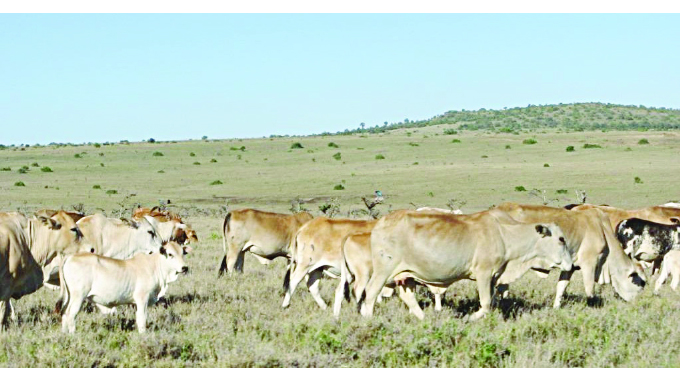
ONE of the common cries you get from communal smallholder livestock farmers across various districts, especially in the Matabeleland region, is that of running out of grazing lands.
There is a constant feeling across places that livestock farmers are being squeezed in terms of the available grazing land, as human settlement increases as a direct relationship to the population increase.

Also, as more arable land is cleared for crop production, again for the same reason. While this will hold true as valid reasons for shrinking grazing lands, observation on the ground reveals that there also other major factors which communities tend to down play their contribution.
One such reason is the degradation of the rangelands because of poor environment management practices.
A quick example is the overgrazing on most rangelands which easily converts previously productive grazing lands into poor and non-productive areas.
The overgrazing is not really because the livestock farmers are keeping too many animals against the available grazing land. It is because for one reason or another livestock farmers in a certain area will excessively graze their animals on one particular place with no sufficient resting periods leading to localised overgrazing.
This could be, because the grazing area is conveniently closer to homesteads, cropping fields or watering points and hence farmers always take their animals to the same place over and over again. We have seen how grazing lands closer to homesteads, cropping fields and some water points are degraded because of over use.
If one aggregates these now non-productive grazing patches around the village, they combine into a big hectarage which has been rendered useless because of over grazing.
Then, there are grazing places which are relatively far from homesteads and are inadequately utilised to the extent that these areas tend to be severely bush encroached to the extent that there is insignificant grass undergrowth to support grazers.
So, the place has simply become unusable because of being underutilised! There many such places in most districts of Matabeleland North Province, where the rangeland has just become a fearsome thicket of woody species which have almost driven grasses to extinction.
Some areas are so thick that animals cannot even go under and hence they are simply inaccessible. These tend to be vast tracks of land spanning over hundreds of hectares of unutilised or unusable grazing land!
These places can be easily reclaimed by addressing the bush encroachment challenges so that there is revegetation in terms of growth of the herbaceous species. One major challenge with these forest grazing zones, is that they tend to have no watering points an as such as provision of water points for example through construction of small earth dams or drilling and installing solarised boreholes, can make this part of the rangeland usable.
Then there is the grazing land along the water ways/vlei areas or wetlands or the riverine areas. These are also preferred grazing areas by smallholder communal livestock farmers, because they tend to have a lot of grass and they are next to water sources.
These are usually preserved for dry season period in most communal areas. The places, however, tend to be small to sustain the livestock numbers through out the dry season period. This section of the grazing land also tends to be prone to invasion by invasive species such as the Lantana camara or the Senna obtusifolia.
These invasive weeds tend to colonise the grazing space along water ways and suffocate any grass undergrowth rendering the grazing area useless to the livestock farmer. I am characterising the different types of grazing lands available to the communal livestock farmer and how these are utilised, so that we properly frame the issues around rangeland management in communal areas, for purposes of customising interventions to deal with the identified challenges.
It is my submission that extension messaging especially from the Government extension arm, needs to be reconfigured to address rangeland management as a major issue.
Currently rangeland management is conspicuously absent and silent in our extension messaging and curriculum and as such the primary feed source which is the rangeland is not managed at all. The wide spread rangeland degradation across communal areas should be reversed and this can only begin to happen if we are deliberate in our extension messages and trainings in mainstreaming rangeland management as a critical resource management subject.
It is my thesis that, in most communal areas of Matabeleland North Province, there is adequate grazing which has just been either neglected beyond usable condition or over utilised to unusable state. We simply need to reclaim these now unusable or unproductive sections of the rangelands and viola, we have abundant grazing lands in our hands! Uyabonga umntaka MaKhumalo.
Mhlupheki Dube is a livestock specialist and farmer. He writes in his own capacity. Feedback [email protected] cell 0772851275



 Online Reporter