dyton mupawaenda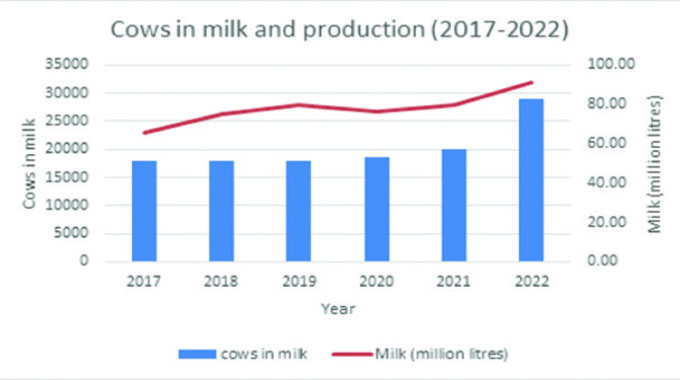
Edgar Vhera-Agriculture Specialist Writer
AS the country continues to implement a raft of intervention measures to boost production in agriculture’s various sub-sectors with a view of substituting imports with locally produced products, players in the dairy industry have managed to maintain a 13 percent month on month increase in September this year compared to the same period last year.
Statistics from Diary Services Unit (DSU) show that there was an increase in milk production for the month of September from 7 836 526 litres last year to this year’s 8 869 624 litres.
A comparison of total milk production from January to September shows that the volume increased eight percent from 66 848 702 litres in 2022 to 71 914 536 litres this year.
Dairy Services Unit’s principal dairy officer Mr Addmore Waniwa said projections were that the year 2023 would see milk production reaching 100 million litres, a 7, 5 percent increase when compared to 91 million in 2022.
He said this was a slight decline from the earlier set target of 103 million litres due to a variety of challenges.
“The dairy sector continues to be saddled with challenges like high production cost, low level of productivity and low dairy herd size and quality,” he said.
Transforming Zimbabwe’s Dairy Value Chain for the Future (TranZDVC) project coordinator Dr Edison Chifamba yesterday concurred saying they had set an ambitious target of 15 percent annual growth but that was no longer possible.
“We have revised downwards our raw milk production estimates to around 100 million litres due to various challenges bedevilling the sector. However, we remain optimistic that we will be able to meet the local raw milk needs by 2025 as a lot of farmers have been importing their dairy herd and these will come into production in the coming months,” Dr Chifamba said.
He said his organisation was continually importing cows of superior genes to augment the existing herd as well as increase productivity from 13 to 18 litres per cow per day by 2025.
Meanwhile, Livestock and Meat Advisory Council (LMAC) executive administrator Dr Reneth Mano recently said the country was still under 50 percent self-sufficient in milk production.
“Over the first nine months of 2023, Zimbabwe imported 3 500 tonnes of dairy products at a landed cost of US$13, 82 million primarily in the form of powdered milk and cheese from the European Union (EU). This tonnage of dairy imports is equivalent to 36 to 40 million litres of raw milk.
“To offset imports of dairy products completely, Zimbabwe dairy sector would have to promptly add 18 000 medium-yielding cross breed dairy cows (or 10 000 high performing pure breed dairy cows) to the national lactating herd of dairy cows,” Dr Mano said.
He said the domestic lactating dairy herd remained very small with average milk yield remaining very low to achieve and sustain national self-sufficiency at current levels of demand.
The food security and nutrition goal would require ratcheting up domestic production and supply of milk to satisfy the dairy protein security of Zimbabwe especially for its population of children in preschool to Grade 7, he continued.
“A glass of fresh milk a day for every primary school pupil was the commitment that the Government consistently and proudly satisfied during the first decade of our Independence. The outcome of that dairy protein security for all children elevated Zimbabwean children to achieve some of the highest cognitive abilities for primary school children and national literacy rates in Africa,” Dr Mano added with nostalgic tones.


 Online Reporter