dyton mupawaenda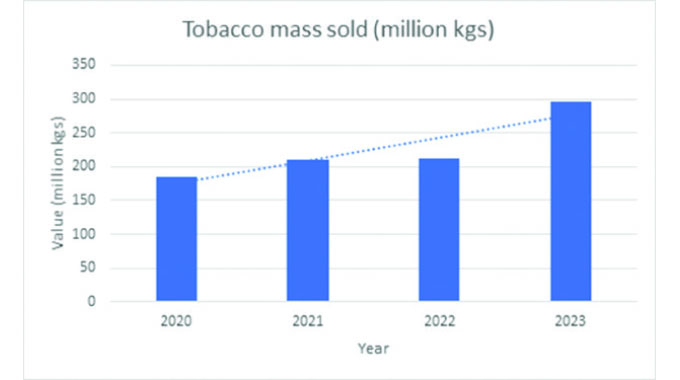
Ranga mataire-Group Political Editor
After Zimbabwe began reclaiming its land just over two decades ago, many began writing obituaries for the tobacco sector, one of the main sectors of Zimbabwe’s agriculture.
In 2008, they seemed to be vindicated, as tobacco production reached 48 million kilogrammes, down from 260 million kg produced in what was then the peak year of 1998.
However, Zimbabwe had a long-term plan to remodel and revive the tobacco sector. The country is now proving the critics wrong.
Sometime in March this year, the chairman of the Tobacco Industry Marketing Board (TIMB), Mr Patrick Devenish, predicted a rise in tobacco output of 8.5 percent year-on -year to 230 million kg for the 2022-2023 season due to good rains and more land put under the crop.
“It looks like we are going to have a good crop. We are expecting 230 million kg,” Mr Devenish said then at the onset of the 2023 marketing season.
Many dismissed Mr Devenish’s forecasts. They were wrong. Fast forward to November 2023, and his figure of 230 million kg has since been surpassed as the 2022-2023 season has attained a record 296.1 million kg of tobacco worth US$896 million.
The attainment of this record figure is by no way an oddity of nature or just an opportunistic occurrence.
This has been achieved through deliberate Government policy interventions aided by the Tobacco Value Chain Transformation Plan.
The plan is the brainchild of the Minister of Lands, Agriculture Water and Rural Development, Dr Anxious Masuka.
In an interview with Tobacco Reporter, an online magazine based in the United States, Dr Masuka said he floated the idea of a Tobacco Value Chain Transformation Plan to President Mnangagwa way back in 2018 when he was still in the private sector and the President gave a nod for the implementation of the plan when he became Agriculture Minister.
To understand how we got here, we must first go to the background to the Tobacco Value Chain Transformation Plan. Zimbabwe produces 6 percent of the world’s tobacco.
The global estimated global market value of tobacco stands at US$850 billion.
In 2020, Zimbabwe produced and exported over 200 million kg of tobacco worth US$991 million, leaving a scope for massive value retention in the country.
In short, the transformation plan seeks to increase tobacco production to 300 million kg by 2025 and transform the industry into a US$5 billion industry through exports of tobacco value-added products.
Given the record production of the 2022/2023 season, the impact of Government’s policies is beginning to bear fruit.
Government’s broad objectives are to accelerate the localisation of tobacco funding, increase productivity and production, increase production of alternative crops and also increase contribution to farmers’ income.
Currently, 95 percent of production is funded through contract farming.
We do not have enough lending from our local financial institutions, especially for small-scale farmers
This is mostly because banks require collateral. As a solution, Government intends to avail US$60 million as seed finance to establish a revolving facility.
The plan will operate alongside contract production of the crop.
This is how Zimbabwe can anchor growth to 300 million kg.
Minister Masuka is confident that the plan will drastically transform the agriculture sector and increase the overall contribution of tobacco to export earnings.
He has all the reasons for being confident given the fact that the sector contributes nearly US$1 billion to export earnings every year and accounted for more than 12 percent of exports in January.
“We seek to localise the financing of tobacco. We wish to transform the tobacco sector so we don’t export value. This industry is on the cusp of growth,” said Dr Masuka as he addressed journalists in post-cabinet briefing in October.
Weighing in on the optimistic projection in the agriculture sector was the Minister of Information, Publicity and Broadcasting Services, Dr Jenfan Muswere.
He recently briefed journalists that there has been an increase in volume of tobacco as a result of post-harvest loss reduction and yield increase.
Now that progress has been made in increasing volumes, the sector is now turning its attention to value addition.
“There are opportunities to increase the level of value addition and beneficiation of tobacco into cut rag and cigarette production from 2 percent of tobacco produced to 30 percent,” said Dr Muswere, adding that the construction of a new cigarette manufacturing plant and cut rag processing factories was underway and that this will result in an increase in processing capacity by 50 percent in the first half of 2024.
Following the implementation of land reform in 2000 and the resultant change in the demography of farmers, tobacco output has been increasing over the years.
A record 261 million kg was produced in the 2019/2020 season, a feat achieved by predominantly small-holder farmers who constitute 85 percent of the growers.
According to the TIMB, tobacco land use grew to 117 000 hectares this year from 110 000 hectares in 2022.
The industry also saw an increase in the number of tobacco farmers to 148 527 this year from 123 000 in 2022.
Tobacco prices opened at US$4.35 at the start of the new marketing season, up from US$4.20 last year. Farmers are being paid 85 percent of their sales in US dollars, up from 75 percent last year.
In the just-ended market season, Zimbabwe sold about 296 million kg and the seedbed for the country’s 2023-2024 is 15.5 percent larger than in the previous season, making it likely that Zimbabwe will attain its target volume ahead of the 2025 schedule.



 Online Reporter