Golden Sibanda
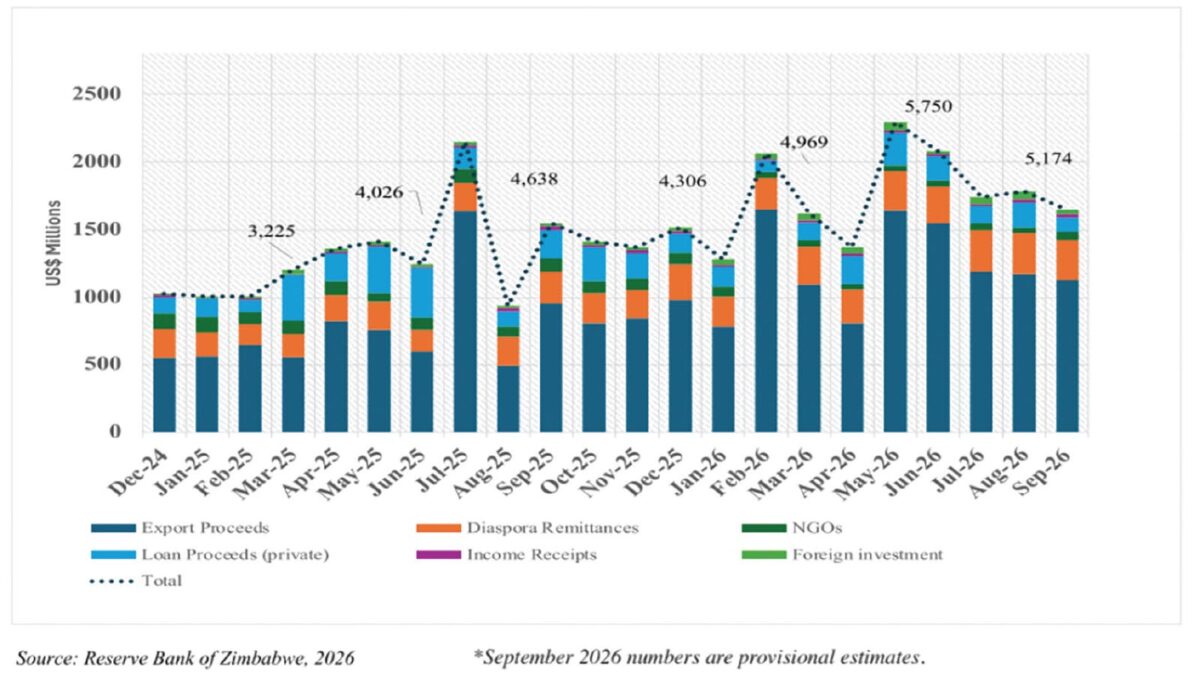
Zimbabwe’s external position continues to demonstrate remarkable strength, driven by a record surge in foreign currency receipts that reached US$15,9 billion in the first nine months of 2026.
This represents a robust 33,7 percent expansion compared to the US$11,9 billion recorded during the corresponding period in 2025.
According to the Reserve Bank of Zimbabwe’s (RBZ) Snapshot: Recent Monetary, Currency, Price and Financial Developments for the third quarter of 2026, this unprecedented influx of foreign currency has decisively outperformed national foreign payment requirements, culminating in a cumulative external surplus of US$4,3 billion.
The historic performance in foreign currency generation was primarily anchored by strong export earnings, which dominated the basket of inflows by accounting for 69 percent of total receipts on average in 2026.
Unprecedented global price buoyancy for key minerals—most notably gold, Platinum Group Metals (PGMs) and lithium—significantly boosted mineral export receipts.
Increased export volumes of tobacco and lithium sulphates provided substantial structural support to overall revenues.
Diaspora remittances remained resilient, comprising 15 percent of total foreign currency receipts, while loan proceeds accounted for 9 percent.
Benefiting from this merchandise trade momentum, monthly export revenues reached US$1,7 billion in August 2026 against imports of US$1,2 billion, generating a monthly trade surplus of US$526,5 million up from US$320 million in July 2026.
Consequently, the current account balance registered a projected surplus of US$1,38 billion for the third quarter of 2026, compared to US$791,2 million in the third quarter of 2025.
The surge in foreign currency inflows directly reinforced price, currency and financial market stability across the economy.
Commenting on the monetary policy framework and macroeconomic trajectory, Reserve Bank of Zimbabwe Governor Dr John Mushayavanhu highlighted that prudent policy alignment has been central to maintaining low inflation:
“The Reserve Bank’s prudent monetary policy stance, coupled with complementary fiscal policy measures, has kept annual inflation in single digits since January 2026.
“Annual inflation fell to 2,9 percent in August 2026, the lowest local‑currency inflation rate since 1980, before rising modestly to 3,7 percent in September 2026, but remains well within the desired benchmark band of 3‑7 percent under the SADC macroeconomic convergence criteria.”
Dr Mushayavanhu noted that monthly inflation averaged 0,4 percent through September 2026, creating conducive conditions for further policy adjustments.
“Accordingly, the Monetary Policy Committee (MPC) began gradually normalising monetary policy by reducing the Bank Policy rate from 35 percent to 30 percent in June 2026 and to 27.5 percent in September 2026,” Dr Mushayavanhu added.
The modest uptick in annual inflation to 3,7 percent in September 2026 was largely propelled by rising rental costs as well as fuel and lubricants, reflecting renewed Middle East tensions that briefly pushed global crude oil prices above US$100 per barrel.
Supported by expanding reserves and low inflation, the RBZ’s barometer tracking the Conditions Precedent (CPs) for transitioning to a mono-currency framework registered an improved score of 54,9 percent in September 2026 (up from 50,1 percent in August 2026).
However, Dr Mushayavanhu reiterated that the transition will remain condition-based rather than date-dependent to protect market confidence. At the time of transition, all domestic transactions will take place in local currency, while US dollar contracts and foreign currency accounts will be fully respected.
On international re-engagement, the governor expressed satisfaction with performance under the ongoing 10-month International Monetary Fund (IMF) Staff-Monitored Programme (SMP).
“Strong performance under the ongoing 10‑month International Monetary Fund (IMF) Staff‑Monitored Programme (SMP), together with the Reserve Bank’s prudent monetary policy management, is expected to reinforce price, currency and exchange‑rate stability, enhance economic resilience and lay a firm foundation for international re‑engagement.”
All Quantitative Targets under the SMP were comfortably met in the quarter, with reserve money contained at ZiG7,5 billion and Government borrowing from the central bank remaining at zero.
Looking ahead to the fourth quarter of 2026, results from the RBZ’s Quarterly Inflation and Business Expectations Survey indicate that 41 percent of business respondents identify energy costs and external shocks as primary cost drivers.
Despite these headwinds, overall inflation expectations remain firmly anchored. Annual ZiG inflation is projected to end 2026 at or below 5 percent, comfortably within the SADC macroeconomic convergence target range of 3 to 7 percent.
Through disciplined money supply management, strategic reserve building, and resilient export growth, Zimbabwe enters the final quarter of 2026 on its firmest economic foundation in decades.