Chronicle Editor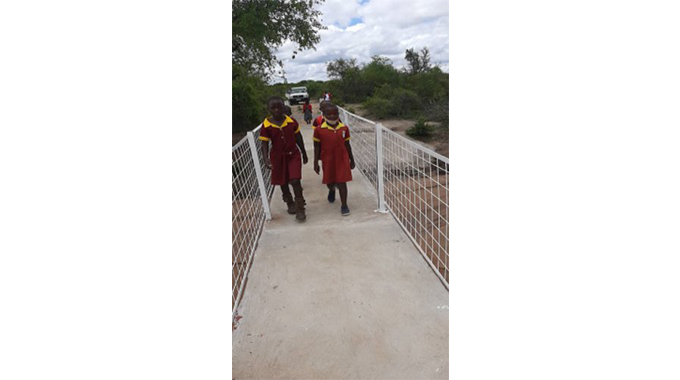
Chronicle Reporter
FOR Memory Sibanda, a Grade Six pupil at Vaka Primary School in Mangwe district’s Ward 2 when her parents and others celebrate the coming of the rainy season, she loathes that season for fear of drowning while crossing Ngamela River on her way to or from school.
There is a crossing point on the river which Memory and her schoolmates, teachers and other community members use but it is dangerous during the rainy season when the river is flooded.
This forces some pupils to abscond school during the rainy season.
Memory’s fears will soon be a thing of the past since construction of Kahlu foot bridge across Ngamela river has started.
The bridge is being constructed by the Zimbabwe Red Cross Society (ZRCS) with the support of the Finnish Red Cross, Belgium Red Cross and the European Commission Humanitarian Aid Office under the comprehensive school safety project.
The overall objective of the project is to ensure children, youths and their communities are more resilient to disasters and have safe learning environment.
The project, which is in its second phase and running under the title, Resilience through Disaster Response Management: Comprehensive School Safety, is being implemented at 15 schools.
“I’m happy that we now have a footbridge across Ngamela River. It now means that I can cross the bridge and attend class even when the river is flooded,” said an elated Memory.
For years, pupils, teachers, and members of the community in Mangwe District in Matabeleland South province risked drowning crossing flooded rivers.
Mangwe Ward 2 Councillor Benjamin Ndlovu commended the Red Cross and its partners for implementing development projects which he described as life changing.
“Red Cross has done a lot in reaching out to communities as far as disaster reduction management is concerned. A footbridge has been constructed across Ngamela River making it easy for us to cross even during the rainy season.
We have learnt the importance of avoiding hazards through training and we have taken some of this knowledge to the communities,” he said.
Vaka Primary School headmistress Mrs Abigail Chateuka expressed gratitude over the disaster risk reduction training the school staff, pupils and community got under the programme.
“The knowledge we got under this programme really opened our minds with regards to disaster risk reduction. It never crops up in our minds that minor things like broken window panes, broken asbestos, potholes on the floor and other small things could be hazardous,” she said.
Kwite Primary School, which is among the pioneers of the project, has had a lot of transformation since the beginning of the programme.
The Red Cross has renovated Kwite Primary School with the village head, Mr Mendo Sibanda commending the work that has been done.
The school was derelict and for two years, a classroom block had no roof.
ZRCS facilitated the rehabilitation of the classroom block and the construction of a child-friendly toilet, including for those living with disabilities.
“This school was derelict, that classroom block had its roof blown off and for two years children attended classes in the open. It all changed when Red Cross brought the training and eventually facilitated the roofing of the block. Because of the training and the knowledge that we got, we mobilised resources as a community and re-roofed that other block taking into cognisance, the disaster reduction training we got,” he said.
In an interview, Mangwe District Development Co-ordinator, Ms Rorisang Makhurane said the Red Cross has improved the image of schools in Mangwe and provided privacy to the girl child by providing a safe learning environment
Ms Makhurane said the Red Cross has renovated a classroom block at Kwite Primary School, 3 blocks at Maninji Primary School, a single block at Osabeni Primary School and constructed “girl friendly latrines” at Ivimila Secondary School, Osabeni, Kwite, Silima, Nguwanysna, Makuzeze, Tjingababili and Maninji primary schools.
“The major intervention is Kahlu foot bridge crossing Ngamela River whichj was constructed with the assistance of the Army Engineers. Disaster Risk Management Committees have been set up and training was done at Madabe, Dukwe, Tshitshi and Vaka primary schools as well as Mqokweleni Secondary School,” she said.
ZRCS secretary-general Mr Elias Hwenga said they were looking forward to taking the project to other districts across the country.
He said the overall objective of the intervention is to increase disaster preparedness of vulnerable districts in Zimbabwe through school, community and institutional capacity building.
“The comprehensive school safety project has been piloted in Mangwe District and the first phase started in 2018,” said Mr Hwenga.
He said ZRCS was working closely with key Government stakeholders to advocate for the increased adoption and embracement of disaster risk reduction in schools.
Mr Hwenga said the success of the first phase saw them adding five more schools during the second phase.
“The project is in phase two which has seen the incorporation of five more schools under this project making a total of 15 schools benefiting under phase two. The schools were selected through a consultative process with the district civil protection committee, district development co-ordinator’s office, Mangwe Rural District Council and the district schools inspector’s office,” he said.
Mr Hwenga paid tribute to the Finnish Red Cross, Belgium Red Cross and the European Commission Humanitarian Aid Office for supporting the programme.


 Online Reporter