Chronicle Editor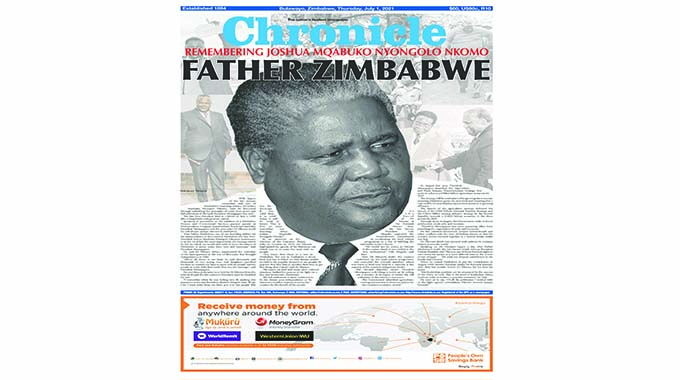
THE legacy of the late veteran nationalist and one of Zimbabwe’s founding fathers, Dr Joshua Mqabuko Nyongolo Nkomo, must be honoured through upholding the principles of unity, love, peace and full utilisation of the land, President Mnangagwa has said.
The late Vice-President died at 1.30AM on July 1, 1999 after a long battle with prostate cancer.
Speaking to journalists on the sidelines of a Zimbabwe Prisons and Correctional Services passout parade at Ntabazinduna, Umguza, Matabeleland North last Saturday, President Mnangagwa said the principles Dr Nkomo stood for will always remain relevant to Zimbabwe.

“Our Father Zimbabwe, one of our founding fathers for the independence of this country, Zimbabwe, the late Vice-President Joshua Mqabuko Nyongolo Nkomo’s anniversary is on the 1st of July but most importantly, the message which he left us, which we would also wish to leave the nation of Zimbabwe is unity, unity, love, love and harmony,” said President Mnangagwa.

He said Dr Nkomo always emphasised the centrality of the land question in the war of liberation that brought independence in 1980.

“Above all these, is our land, he said thousands and thousands of our young sons and daughters perished because we wanted our land to unite with its people and the people to unite with their land. That was the message,” said President Mnangagwa.

He said these principles were held by Dr Nkomo from the time he fought for the country’s liberation until he breathed his last.

“I remember when he was feeling very ill, making this statement to the late President (Robert) Mugabe that, ‘If I go Cde, I want unity, keep our land, give it to our people’ that was the message. It was valid then, it is valid today, it will be valid in future. That is how we must remember our founding father Joshua Mqabuko Nyongolo Nkomo.”

In an interview on the sidelines of the Lancaster House talks in London in 1979, Dr Nkomo highlighted the agenda of the liberation war which was to re-unite the land with its people.

“You know that there is a war in Zimbabwe. The war in Zimbabwe is about land and this is where we find Britain unable to yield to the popular demand of our people. So popular that they had to sacrifice their lives to get this thing, that is land,” said Dr Nkomo.
The stance on land and many other colonial injustices fuelled his passion in his fight for a free and democratic Zimbabwe.

The full utilisation of land continued to be his dream post-independence as he initiated a number of projects across the country for the benefit of the people.
At the burial of Dr Nkomo at the National Heroes Acre, the late former President Cde Mugabe expressed the Government’s commitment to accelerating the land reform programme as a way of fulfilling the nationalist leader’s dream.

“We would not do justice to Nkomo if this matter (land) is not settled in the new millennium,” Cde Mugabe said then.
After Dr Nkomo’s death, the country embarked on the land reform programme and corrected the colonial injustices where vast tracts of land were held by a minority at the expense of the majority indigenous blacks.

The Second Republic under President Mnangagwa took things a notch up by rolling out a number of strategies to ensure the full utilisation of the country’s resources.
The Government identified agriculture, mining and tourism as three key pillars for the country’s economic revival.

In August last year, President Mnangagwa launched the Agriculture and Food Systems Transformation Strategy that seeks to achieve a US$8,2 billion agriculture economy by 2025.
The strategy will be underpinned by growing the economy, ensuring Zimbabwe grows its own food and ensuring that a vast swathe of rural families moves from poverty to growing affluence.

The launch of the agriculture strategy followed the launch of the US$5 billion National Tourism Strategy and the US$12 billion mining industry strategy by the Second Republic towards a US$25 billion economy in the three sectors by 2025.
Through these strategies, the Government seeks to boost production, create jobs and incomes.

President Mnangagwa has since assuming office been preaching the importance of unity and harmony.
He has initiated discussions around Gukurahundi and other conflicts with the view of finding closure so that the country moves forward together as a united family under one flag.

Dr Nkomo’s death was received with sadness by eminent leaders across the world.

Speaking on Dr Nkomo’s legacy a day after Father Zimbabwe’s death, the late former South African President Nelson Mandela said: “He was one of those freedom fighters who stood for justice at a most difficult time in the course of our struggle . . . We send our deepest condolences to his family and country.”

When he visited Zimbabwe to pay his condolences in August 1999, former Zambian leader Dr Kenneth Kaunda, who died last month, hailed Dr Nkomo for his love for peace.

“His leadership qualities can be measured by the success of the Unity Accord. This is the kind of leadership Africa needs in order to achieve a peaceful continent,” he said.

He went on to say, “Of all the politicians I worked with in the fight against colonialism, Nkomo showed unique heroism.”


 Online Reporter