Online Reporter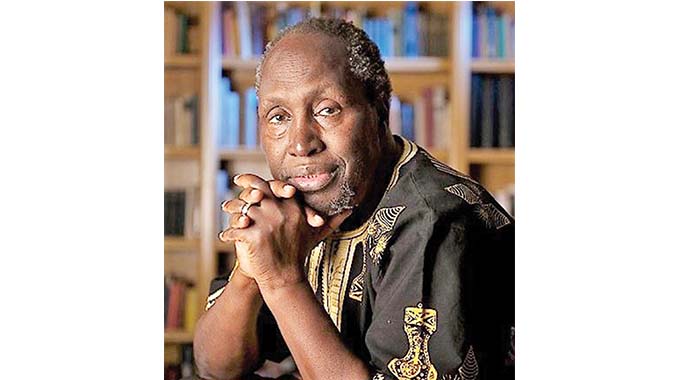
Elliot Ziwira
At the Bookstore
KENYAN philosopher-writer, Ngugi wa Thiong’o, who died on May 28, 2025, in Buford, Georgia, the United States of America, aged 87, was no ordinary man — he was a colossus.
A literary giant in modern African literature, Ngugi was a strong critique of colonialism and the postcolonial nation-state in Africa, which remains umbilically connected to the empire in many ways, including language.
Colonialism and hegemony brought linguistic challenges on the African landscape. Cognisant of the oppressive nature of colonial language, Ngugi vowed to stick to his native Gikuyu to hoist his country’s flag above the colonial banner as a starting point in the liberation of his people.
He once said in an interview: “The way I take it, a writer is a part of the intellectual community, and the way I define an intellectual is a worker in ideas.
“Since intellectuals, as well as writers are working in ideas, it is of course very important that they try to articulate a world view which is consistent with the values of liberation . . . writers and artists, both consciously and in practice, should be on the side of liberation, because art assumes freedom” (Ngugi wa Thiong’o cited in Kumar, 2001: 170).
Certainly, art assumes freedom — the freedom of expression — the freedom to determine how one should live, and not how one should avoid living. This trail of reasoning constitutes liberation in view of the role of the artist in society. Often, the separation on whether the liberty to express one’s self constitutes freedom in the broader sense of the word is misty, for expression is one thing, and facing the consequences is another issue altogether.
It is this foggy line that artists frequently cross to reach out to their audience — the people, in an attempt to articulate their gagged voices. The inimitable philosopher-writer crossed this line uncountable times, often drawing the ire of authorities.
Ngugi’s writing career kicked off in 1964, with the novel “Weep Not, Child”, which tracked a family in colonial Kenya during the Mau Mau rebellion against British rule.
As a storyteller of note, in “Secret Lives” (1975), “Devil on the Cross” (1980), and “Matigari” (1986), the artist-intellectual captivatingly conjures sad images of a continent that lies prostrate as it is repeatedly raped by imperialists and their proxies using their ill-gotten wealth and Christianity.
Ngugi recognises that fiction is an expression of a people’s yearnings, aspirations, quest for liberation, and cultural mores, since artists draw inspiration from their own experiences.
It follows, therefore, that if writers are inspired by the concerns of their own societies, then, fiction will remain a true record of the issues prevailing at any given epoch — past, present, or future.
However, if literary works are a result of the prevailing governing institutions’ gatekeeping instincts, then the sensibilities that should be informing them will be at fault.
In Ngugi’s view, the liberating nature of language in its expression of a people’s way of life, and the preservation of ethos cannot be overemphasised.
True, the artist is not a dealer of cards, but he/she is conscious of how life has a way of dealing the same cards from its deck to the same people, with corresponding results — and awarding the same trophies for both losers and winners.
As an artist-intellectual, Ngugi wa Thiong’o has often crossed what others would call the red line because of his beliefs, and the desire to uplift the feeble and vulnerable.
In “Secret Lives and other Stories”, he compellingly tells the African story from a vantage point, using a combination of wit, humour, and contempt. He visits the African experience from the colonial state, through the struggle against displacement and imperialism, to the postcolonial era.
Combining different periods, and bringing them to the boil using powerful images and symbolism, Ngugi metaphorically evokes the sombre, bizarre, and frustrating outcomes of the African story. A master storyteller, his strength lies in his narrative skill, as he skilfully combines different voices, which hoist the reader right into the core of existence in the face of adversity. As is the case in “The Trial of Dedan Kimathi” (1975), the writer travails into the history of Africa, as it groans under the weight of colonialism and desperately clings to hope.
Using the metaphors of drought, hunger and rain, like Charles Mungoshi and Dambudzo Marechera, in “Waiting for the Rain” (1975) and “House of Hunger” (1978), respectively, Ngugi taps into folkloric tradition to capture the rich African culture before the advent of colonialism and the Christian God.
Borrowing heavily from different modernist traditions — realism, impressionism, romanticism, and naturalism, “Secret Lives and other Stories” can be read as pastoral, historical, gothic or proletariat. The African story cannot really be told in a better way. Divided into three parts; “Of Mothers and Children”, “Fighters and Martyrs”, and “Secret Lives”, the book traces the nature of Man and his struggles against himself, his fellow men, and his environment.
In “Wrestling with the Devil” (2018), he revisits his detention at Kenya’s Kamiti Maximum Security Prison. The prison memoir begins 30 minutes before his release on December 12, 1978, after almost 12 months.
Before unravelling the reasons for his incarceration, the artist-intellectual takes the reader into the claustrophobia that comes with imprisonment; all forms of caging emanating from the physical confinement within enclosures, be they psychological, emotional, physiological, or mental.
“Mine is cell 16 in a prison block enclosing 18 other political prisoners. Here I have no name. I am just a number in a file: K6,77,” Ngugi intimates. Drawing the reader into the tiny space that creativity rewards him with, he highlights the colour blindness of oppression in such a way that even shames the metaphorical devil pervading his people’s experiences.
He writes: “The menacing bootsteps come nearer. I know that the prowling guard cannot enter my cell — it is always double-locked and the keys, in turn, locked inside a box, which promptly at five o’clock is taken away by the corporal on duty to a safe somewhere outside the double walls.”
But who really is responsible for this anguish of a fellow human being and why? It is this that makes Ngugi wa Thiong’o a champion of the African story of toil, expectation and hope.
The reversal of roles that he explores in his works, especially “I Will Marry When I Want” (1977), “Devil on the Cross” (1980), “Matigari” (1986), “Petals of Blood” (1977), and “A Grain of Wheat” (1967), is rooted in the fact that Man is inherently domineering, brutal, and avaricious regardless of creed, ethnicity, and/or socio-cultural background.
In “Wrestling with the Devil”, the artist-intellectual goes beyond the restrictions that come with imprisonment, to capture the accompanying resilience, especially for an artist.
Rest easy great philosopher, for we are poorer, yet richer without you!
It is kind of cathartic when read at the level of creativity, where escape from captivity becomes a captivating experience. Regardless of the debilitating nature of detention, the artist refuses to allow his spirit to be broken down.
Interestingly, the reason for his detention is the play he co-authors with Ngugi wa Mirii, “Ngaahika Ndeenda” later translated to “I Will Marry When I Want”, which gives a vent of escape and a veneer of hope to the villagers of Kamirithu through collective effort premised on the theatre of experience fictionalised in the play.
For giving them hope, and telling them that they matter as much as any other citizen regardless of their presumed backwardness, and that they can map their own destiny through determination and unity of purpose, the writer irks the authorities.
The reader’s spirit is dampened here when the hand behind all this is revealed. It is a challenge that the postcolonial nation-state of Africa has to grapple with—neo-colonialism.
This rationale is evident in the dialogue between the writer and one of the prison guards, who asks him:
“Professor. . . why are you in bed? What are you doing?”
Ngugi responds: “I am writing to Jomo Kenyatta in his capacity as an ex-political prisoner.”
Curiously, the detention order was signed by then Minister for Home Affairs Daniel Toroitich Arap Moi on December 29, 1977. Moi later became the second president of independent Kenya from November 8, 1978 to December 30, 2002, following Kenyatta’s death on August 22, 1978.
Detention was also used by colonial governments to silence political dissent. It is in detention at Kamiti Maximum Security Prison that the idea behind “Devil on the Cross” is conceptualised and put to toilet paper.
Yes, Ngugi wrote the entire book on toilet paper using stolen time in detention.
At Kamiti, he reveals, “virtually all political prisoners are writing or composing something, on toilet paper, mostly.” Creativity enabled him “to defy daily the intended detention and imprisonment of (his) mind.”
The deception, hypocrisy, individualism, materialism, and avarice prevalent in the postcolonial nation-state in Africa cannot escape the competent artist’s gaze, no matter the consequences.
This is why a reading of Ngugi Wa Thiong’o’s “Wrestling with the Devil” (2018) is apt, as it reveals the philosophies behind most of the writer’s many works. It is a kind of encyclopaedia that any serious follower of the artist-intellectual should not miss out on.
It is more than just a book, but a reflective mirror on how it means to be an African, in Africa that is, writing about that which divides, or brings black Africans together as a people.
In this story, the coloniser’s hand remains an albatross around the necks of black people trying to sharpen hoes in preparation for the great harvest, which comes with reclamation of their ancestral land.
However, this dream remains logged in the pipeline as the land that liberation fighters, epitomised by the Kenya Land and Freedom Army (KLFA), derogatorily known as the Mau Mau, laid their lives on the block for, is still in the hands of erstwhile colonisers, or their runners.
It is this devil and his incarnates that Ngugi wa Thiong’o is forever engaging with, even as he peacefully sleeps, in a wrestling bout that is short on victors and has a glut on victims.
Rest easy great philosopher, for we are poorer, yet richer without you!
For an immersive reading experience, visit Typocrafters Book Shop at Herald House, corner George Silundika Avenue and Sam Nujoma Street in Harare. Contact: Mercy—0771537929, Rose—0776131480, or Leon—0733100191.