

 Chronicle Editor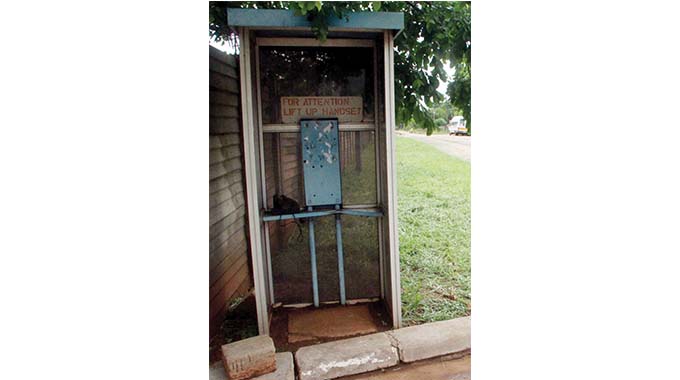
Raymond Jaravaza, Showbiz Correspondent
BEFORE falling victim to the cellphone, the telephone booth was an indispensable part of urban life.
Just the thought of going through everyday life without making use of the telephone booth, for whatever reason, was akin to expecting man to survive while starved of food and water.
From making that life-saving call to ambulance services to ferry a sick loved one to the nearest medical facility to a not-so-important call by a love-stricken teenager to his girlfriend, the telephone booth was a central part of everyday life.
But to lay eyes upon a telephone booth now — that charming old structure with glass sides and a black shiny receiver — in Bulawayo is like expecting to pick up a gold bar in the streets of the City of Kings.
Popular in the 80s until the late 90s before landlines in homes became widespread, telephone booths were the most convenient means of instant long-distance communication.
With a sense of nostalgia, Miriam Mpala takes Saturday Leisure down memory lane to the first time she used a telephone booth in her childhood neighbourhood of Pumula East suburb in Bulawayo.
“My worst nightmare was trying to make a call only for the phone line to be engaged and I had no choice, but to leave the telephone booth and join the end of the queue for another chance to try again.
“People were so impatient that they wouldn’t give you a chance to try again,” said Mpala.
Her first experience using the telephone booth in 1998 was not a pleasant one, but she remembers the details as if it happened yesterday.
“My young brother fell from a mango tree and broke his arm so I had to call my mother who worked as a maid in Hillside. I had to call her on her employer’s landline to tell her the bad news.
“Loose change of about 50 cents was enough to make the call. I was trembling as I picked up the receiver and placed the coins in a slot on a silver box that had the dial pad and the call connected in a matter of seconds.
“Fortunately, on that particular day, there were not too many people in the queue. The experience was so great, I felt like I had won the lottery,” she reminisced.
Owned by the Post and Telecommunications Company (PTC), before it was unbundled into three separate companies — TelOne, NetOne and ZimPost — telephone booths were erected in every suburb for communication convenience for the public.
The then PTC employees were tasked with maintenance and repairs of the telephone booths and collection of coins that the public used for making calls.
Private conversations in the telephone booth were sometimes impossible especially with impatient would-be-users constantly enquiring when one would be done with their call so they could also get a chance to use the phone.
“An unwritten rule was that the queue had to be at least three metres from the telephone booth to give the person using the phone some sort of privacy. But some people disregarded that and would stand so close to the telephone booth that it made the person using the phone so uncomfortable,” said Terrence Musekiwa of Old Magwegwe.
“In my neighbourhood, there were three telephone booths just next to the Old Magwegwe Police Station so cases of vandalism were very rare. I guess residents knew the importance of the telephone booths especially in times of emergency and guarded them jealously against vandalism,” he said.
But that did not stop a few misguided elements in the communities from trying to score some cash from the telephone booths. Stories of people being arrested for breaking down the telephone booths to steal coins became prevalent in the 90s. The offenders were punished with jail time for the crime.
“There was also a time when directories were placed in the booths so that members of the public could look up the phone number they intended calling.
“But it was not surprising to see vendors wrapping tomatoes and onions with telephone directories for their customers,” added Musekiwa.
Like any other public facility, the telephone booth was also prone to abuse. Prank calls to essential service providers became a “hit” among youths that would dial ambulance or fire services to report non-existent emergencies.
Police had to intervene by alerting the public that it was a crime to make prank calls as resources were wasted on attending non-existent emergency scenes such as fires that only burned in the imaginative minds of the youths.
As cellphone and home landline use exploded in the country, the telephone booth increasingly looked unattractive and archaic and thus began to disappear.
In June, 2007 our sister paper The Herald reported that following complaints by Harare City Council that street people were abusing telephone booths, TelOne, the country’s sole fixed telephone operator, began removing the booths.
Telephone users had also abandoned the booths because of the stench of human waste emanating from the booths.
The booths had apparently been turned into toilets and in some cases, sleeping places by street kids.
In Bulawayo, coming across a telephone booth nowadays is nearly impossible.
“Years ago, TelOne embarked on a project to demolish the few existing telephone booths that were still scattered in the townships. They were no longer serving their purpose and we had to get rid of the structures.
“Residents were complaining that they were being ambushed and mugged by criminals that were using the telephone booths as hiding places,” said a TelOne employee.
There was a time that almost every home in Bulawayo had a landline thus the telephone booth started losing relevance as people could now make calls from the comfort of their homes.
But the landline too is fast being replaced by cellphones. – @RaymondJaravaza.


 Bongani Ndlovu
 Online Reporter