Online Reporter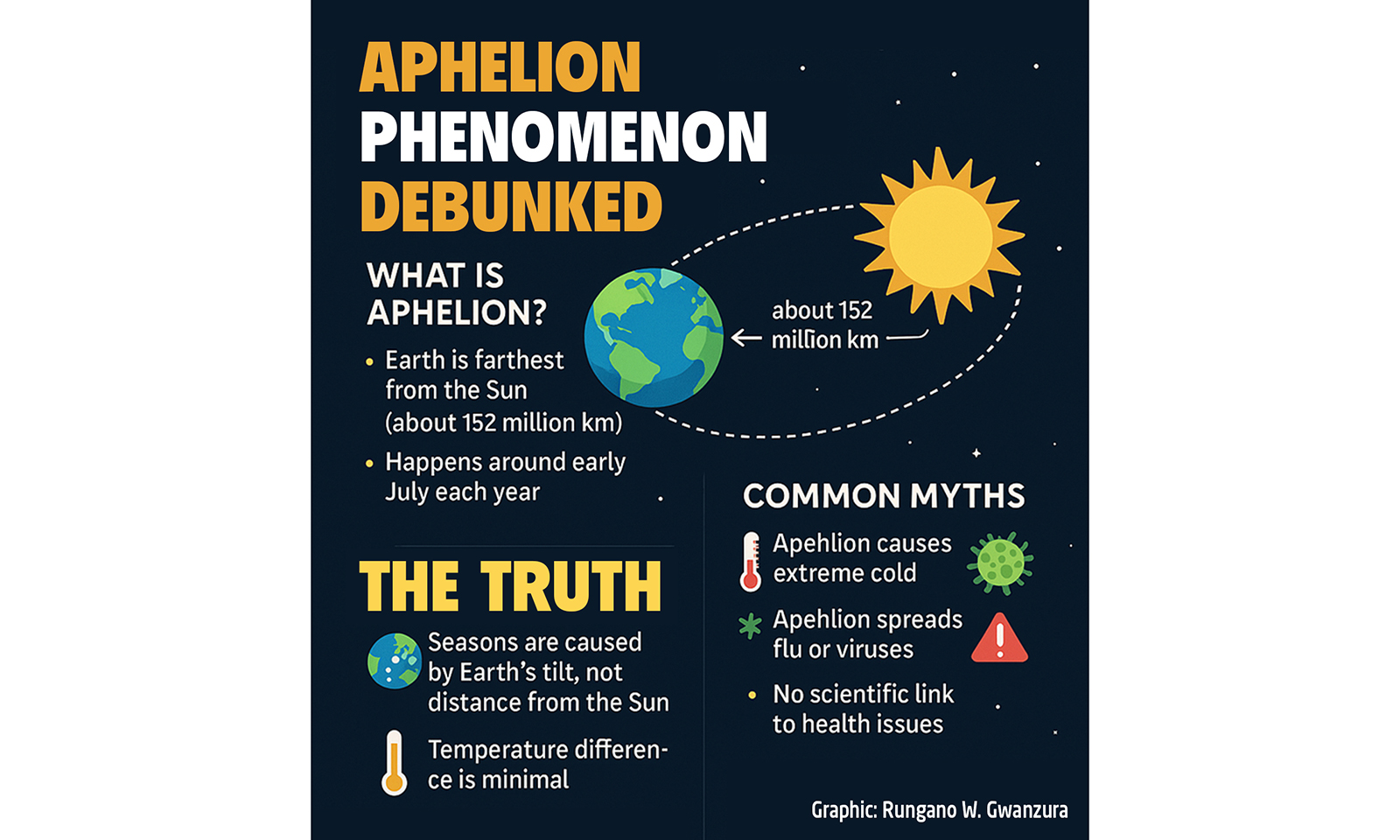
Sifelani Tsiko
Fact Check Editor
“Starting tomorrow at 5:00 AM: for 27 hours we will experience the APHELION PHENOMENON. The Earth will be very far from the Sun. We cannot see the phenomenon, but we can feel its impact. It will last until the month of August,” warns a message that has been posted several times on various social media platforms – Facebook and messaging app WhatsApp in recent days.
This report warns that because of the “aphelion phenomenon,” when Earth is the furthest from the sun, “we will experience cold weather more than the previous cold weather, which will have an impact on flu, cough, shortness of breath, etc.”
Is this true for Zimbabwe?
Meteorological Services Department (MSD) head of forecasting Mr James Ngoma dismissed this as fake.
“It’s fake. It’s circulated every year,” he said.
Aphelion happens annually, not unique to 2025.
Experts describe aphelion as the point in its orbit around the sun when it is furthest away from the sun. This happens because these orbits are not perfectly circular.
As a result, they say, Earth is sometimes closer, and sometimes further away from the sun. The closest point is known as the Earth’s perihelion.
Weather experts say both perihelion and aphelion happen once a year, and there is nothing unusual about Earth’s aphelion in 2022. Zimbabwe and most other countries in the southern hemisphere will not experience severe cold weather this winter.
What do weather experts say about winters in the southern hemisphere?
“Because aphelion occurs during the southern hemisphere’s winter, the Earth has further to travel between that hemisphere’s winter solstice and the spring equinox. This means that aphelion causes winter to last longer than summer in the southern hemisphere. And the opposite is true in the northern hemisphere, where summer lasts longer than winter – approximately 92 days compared to 89.
But this does not mean that winters are colder in the southern hemisphere.
Having more large land masses and less water causes the northern hemisphere to experience both warmer summers and colder winters. These are factors which influence weather patterns – not the Earth’s furthest distance from the sun.” – Africa Check report on the aphelion phenomenon.
Sources
-Meteorological Services Department (MSD)
– Africa Check