admin
admin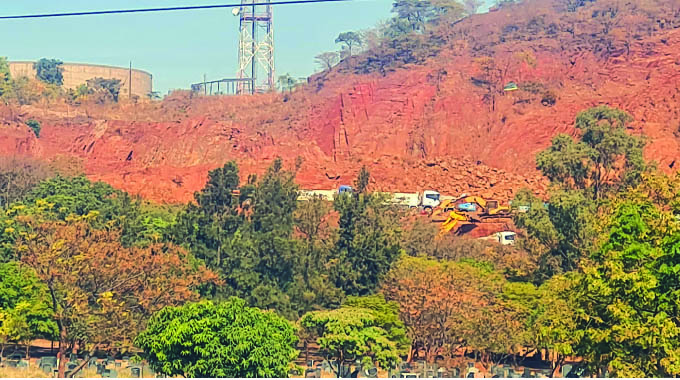
Rumbidzai Mushonga, Herald Correspondent
As the sun rises over the streets of Warren Park, the familiar rumble of heavy machinery shatters the morning calm, a disturbing reminder of the battle residents have been waging against the illegal gravel mining operations that have ravaged their community.
For years, the once-lush, tree-covered hillside has been transformed into a barren, scarred landscape, leaving behind deep, treacherous pits that have claimed the lives of two young children.
Determined to protect their homes and families, the residents of Warren Park have united in a fight to reclaim their backyard and hold the authorities accountable for the environmental and safety issues caused by the unregulated extraction.
The miners’ operations are now moving too close to a water tank supplying Warren Park D and a base station belonging to one of the telecommunication companies.
Fears abound the water tank and the base station are in grave danger if the ground below them carves in while heavy rains in future might result in a landslide, potentially engulfing houses at the base of the hill in Warren Park 2 as well as Warren Hills Cemetery and the Harare Provincial Heroes Acre on the other side.
For Mr Farai Kambamura and his neighbours, this has become a too common sight in recent years, a disturbing intrusion into the peaceful suburb.
“It’s impossible to mine in a residential area. There is no adequate distance from the mine area to the residential area. It’s very sad,” Mr Kambamura said.
Sadness has indeed given way to outright alarm for the residents of Warren Park, as the mining activities have not only ravaged the local environment, but also pose serious safety concerns.
During the past two years alone, two young children have lost their lives after falling into the deep pits left behind by the unregulated extraction.
“It’s simply unacceptable. We cannot have this kind of dangerous, destructive activity happening right in our own backyards.
“We may be just ordinary people, but when it comes to protecting our homes and our families, we can be extraordinary. And that’s exactly what we’re going to be,” said Mr Kambamura.
The residents’ concerns were echoed by Warren Park coordinator for the Residents Against Land Degradation campaign, Mr Nixon Nyikadzino,.
He has been at the forefront of the community’s efforts to shed light on the issue and hold the authorities accountable.
“According to the information we’ve obtained, there are no formal tenders issued for this gravel extraction. Instead, companies that win construction projects are being granted permission to dig into the land, as long as they pay a royalty fee.”
Mr Nyikadzino also added that the problem was that the royalty fees were supposed to cover the rehabilitation and maintenance of the affected areas but residents see little evidence of those efforts on the ground.
“The environmental reclamation and regeneration work is simply not visible. The City of Harare, which owns these gravel sites, is responsible for overseeing this, but they seem to be falling short,” he said.
Harare City Council spokesperson, Mr Sanely Gama, acknowledged the severity of the situation in a recent interview with The Herald.
“Where we are struggling to rehabilitate is where illegal extractions are taking place. And if there are areas that were not rehabilitated, it means there are people who are not doing their work, and we need investigations to see the problem,” said Mr Gama.
He said the area in question is not actually a mountain, as had been previously reported, but rather an illegal dumping site that has been exploited for gravel extraction.
He promised that the city council will be conducting a raid on the site to address the issue. “There will be raids in that area to address the problem,” Mr Gama said.
The news of the impending crackdown brings hope to the Warren Park residents, who have grown weary of the constant battle against the mining operations.
But for many, the damage has already been done, both to the environment and the community’s sense of safety and wellbeing.
Now, with the promise of a crackdown from the city council and the involvement of the Environmental Management Agency (EMA), they hold onto the hope that their voices will finally be heard.
“We’re not going to stop until this is resolved. This is our home, our community, and we have a responsibility to protect it not just for ourselves, but for the generations to come,” said Mr Nyikadzino.
EMA senior environmental education and publicity officer for Harare, Ms Batsirai Sibanda said the area has been demarcated for gravel extraction but they are constantly monitoring the activities taking place there.
“As you are well aware, The National Development Strategy 1 (NDS1) is targeting housing construction and road repairs and in support of Government’s policy local authorities are given certain areas to excavate gravel.”
Ms Sibanda said EMA monitors the mining operations to ensure gravel extraction is done sustainably.
The local authority must ensure that any negative impacts such is dust is suppressed and to backfill open pits. EMA has also ordered City of Harare to ensure that gravel is extracted only up to ground level.


 Online Reporter