admin
admin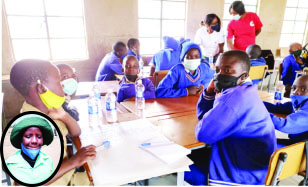
Phyllis Kachere-Deputy News Editor- Convergence
For 12-year-old Sithembinkosi Nare at Vaka Primary School in Mangwe district, Matabeleland North, the girl child friendly toilet that was recently constructed at her school is the best thing that has ever happened to girls who have just started their periods.
“I have just started my period and I am still nervous about it. This girl child friendly toilet is heaven-sent. I can go and change my pad without fear of the prying eyes of the other children. It provides girls like me with the much-needed privacy. I am happy the school committee thought of us girls. It’s only a few months old. It was built when we were at home during the Covid-19 lockdown and we only started using it when schools opened,” said Sithembinkosi.
The girl child friendly toilet is a result of the resilience through the disaster response management training which the Zimbabwe Red Cross Society in partnership with the Finnish Red Cross Society is carrying out in the disaster-prone Mangwe district.
Besides being located in the hailstorm and strong winds-prone district of Mangwe in Matabeleland South, Vaka Primary School also suffers from the double-jeopardy of inherent hazards that required strong mitigation to avert disaster.
Sandwiched between the Makombela River, a few metres from the eastern entrance and the Somajaha River also a few metres from the western entrance, learners at Vaka Primary School always miss classes whenever the two rivers flood during the rainy season.
“Both Makombela and Somajaha rivers flood easily, making them impassable to both school children and adults. At one time, a school child was swept away by the flooded Makombela River as he tried to cross,” said the chairman of the school development committee, Mr Jabulani Ndlovu.
Ward 2 Councillor Benjamin Ndlovu, who also is the chairperson of the school disaster management committee, explained that school children also faced another serious hazard from border jumpers.
Mangwe district borders Botswana in the west and Vaka Primary School is just a kilometre away. It also borders Matobo in the east and Bulilima in the north
“Our school children face a serious hazard in the form of border jumpers who harass them for food or any valuable they may have. After the training that we underwent through the Zimbabwe Red Cross in identifying hazards and disaster reduction, we have agreed as a community to identify and mitigate them, said Cllr Ndlovu.
In an interview, the ZRCS secretary general Mr Elias Hwenga said that in partnership with the Finnish Red Cross, they are implementing a resilience project in the Mangwe funded by ECHO.
“The overall objective of the intervention is to increase disaster preparedness of vulnerable districts in Zimbabwe through schools, community and institutional capacity building.
“The expected outcome being to ensure that children, youths and their communities are more resilient to disasters and have safer learning environments. After this intervention, we expect the communities to be better able to prepare for, respond to and recover from disasters,” said Mr Hwenga.
The comprehensive school safety project piloted in Mangwe since its inception in 2018, started with the training of disaster risk reduction committees in 10 schools from seven wards. To date, the schools have increased to 15.
Kwite, Silima, Vaka, Osabeni, Khahlu, Dukwe, Madabe, Mqokolweni, Nguwanyama, Tjingababili, Tshitshi, Makuzezeand Maninji primary schools participated in the training while Ivimila and Maninji secondary schools were also selected to become part of the 15 schools.
Mangwe was chosen because it is prone to adverse climatic conditions that result in hailstorms, windy conditions, lightning and flash floods so much that most schools and houses in the district regularly get their roofs blown off or destroyed.
This action is implemented by the Zimbabwe Red Cross Society, with the support of the Finnish Red Cross, Belgium Red Cross and the European Commission Humanitarian Aid Office.
The project has a national outlook were the ZRCS is closely working with key Government stakeholders to advocate for the increased adoption and embracing of the disaster risk reduction in schools. The comprehensive school component of the project has a two-pronged approach; that is software and hardware. The software approach resulted in the targeted schools selecting and constituting school disaster management committees from the schools’ development committee members, community leadership, Zimbabwe Red Cross volunteers and the school children.
“These committees are trained in disaster management, school risk assessment and contingency planning. The training was done by experts from the Department of Civil Protection, Ministry of Primary and Secondary Education, Ministry of Health and Child Care in conjunction with the ZRCS,” said Mr Hwenga.
The other key stakeholders on risk assessments include the Department of Public Works in charge of school buildings and they ensure compliance with minimal expected standards of buildings that guarantee safety of school communities.
“Through this training in disaster risk management, the Zimbabwe Red Cross Society has assisted in rebuilding several school blocks that had been destroyed by strong winds,” said Vaka Primary School SDC chair, Mr Ndlovu.
Mr Hwenga said the rebuilt school blocks at schools such as Kwite and Vaka had to be in compliance with the required standard of construction that ensures among other things good ventilation through insertion of standard size windows, replacement of asbestos’s sheets with iron sheets for roofing and also insertion of two doors per class to ensure easy exit in times of disasters.
“The retrofitted classroom blocks have ramps by the doors for easy access by people with disabilities; especially learners on wheelchairs. All the class room blocks in the 10 schools targeted under phase one replaced their door steps with access ramps, making them user-friendly for all,” he said.
At Kwite Primary School in Ward 1, 12-year-old grade 6 pupil Sandile Moyo welcomed the construction of girl child and disabled-friendly latrine toilets.
“I have just started my periods and I am still nervous to change my pads in an open toilet where all and sundry and see me. My friends and I are very happy because we have our privacy when we use the girl child friendly toilet. When we have our periods, we can go and change our pads without the prying eyes of other school children. We also have a mirror in our girl-child friendly toilet,” said Sandile.
The project, also under this component constructed girl child and disabled friendly latrine toilets in all the 10 school under phase one.
Following the school risk assessment report done by the community together with the school disaster management committee at Khahlu Primary School, which ranked flooded rivers as a high risk to learners and the community, the ZRCS constructed a foot bridge on the Gamela River.
“The foot bridge was constructed with funding from the ZRCS while technical skills and man power was provided by Zimbabwe National Army (ZNA),” said Mr Hwenga.
Mangwe council chairperson Cllr Sindiswa Nleya applauded the work that was being done by the communities through the ZRSC training.
“Our district is prone to natural disasters and we are glad we have interventions like the what the Red Cross is doing. The training of the communities ensures that there is continuity and we become better placed to survive disasters,” said Cllr Nleya.
The second phase of the project is largely software components which encompass training in disaster management.
The five new schools have set up their school disaster response committees, and have been trained in disaster management, school risk assessments theory and first aid.
“They have since conducted their school risk assessment using tools such as class room hazard hunt, historical time lines, seasonal calendar, school hazard mapping and community assessment tools amongst other tools.”
The information below can be boxed/panelled into the story
The pillars of school safety
Comprehensive School Safety Framework
Pillar 1: Contribution to safer school facilities
Pillar 2: DRR education in schools and home communities
Pillar 3: Risk Reduction and Resilience Education
Pillar 4: Safer communities and journeys to school
Development of basic capacities for continued education in emergencies (EiE)
Contribution to national dialogue on school safety, and roll-out of national level tools and policies on school-based Disaster risk reduction
Children and schools as agents of community resilience



 Online Reporter