Online Reporter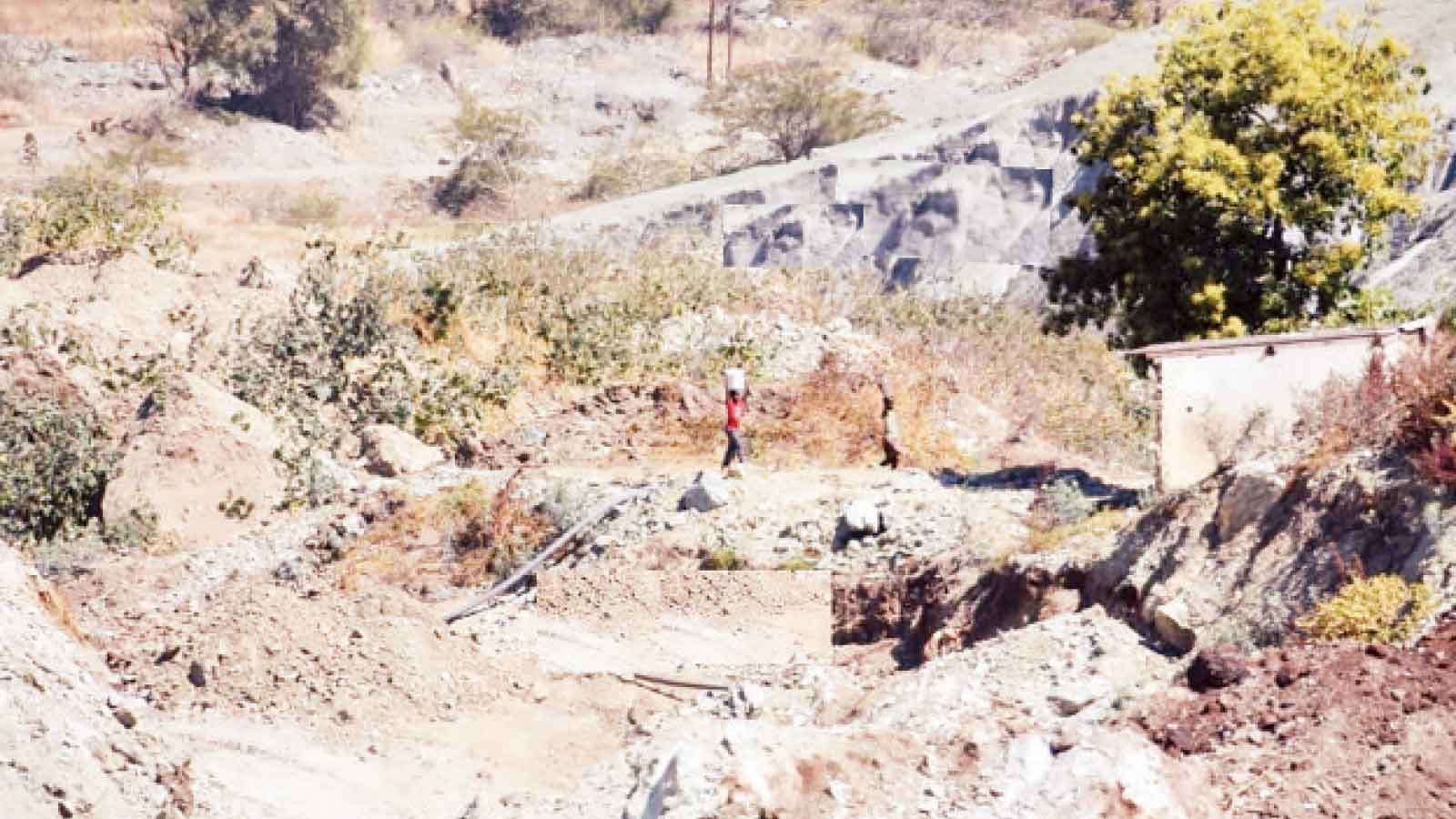
Theseus Mauruki Shambare
Features Writer
THE wheat fields at Pula Estate in Mazowe, Mashonaland Central Province, are a picture of what Zimbabwe wants its agriculture to become.
Golden wheat stretches across irrigated fields, promising harvests from land expected to feed people, generate income and sustain rural livelihoods.
But beyond the fields, another economic activity is reshaping the same landscape—chrome mining.
At Pula Estate, the Barwick Dam, fed by the Mukwadzi River, is an important source of irrigation water. Farmers say chrome mining upstream is increasing siltation and threatening the resource.
“We are facing challenges as Pula Estate farmers. People are mining here. We have chrome here,” said Pula Estate manager Mr Precious Phiri.
He said mining material was being washed into the dam, reducing its capacity.
“The dam is being blocked. It is becoming shallow. We have little water to use for irrigation,” Mr Phiri said.
He also raised concerns about the water quality reaching the fields.
“That water is now toxic to our crops. When we use the water for irrigation, our crops are no longer growing well because of the mineral impurities that we are getting from there,” he said.
The claim about toxicity requires scientific water testing. Still, the farmers’ concerns illustrate a wider challenge: how can Zimbabwe extract minerals that drive its economy without undermining the land and water needed to produce food?
For Zimbabwe, neither sector is expendable.
According to the Zimbabwe National Statistics Agency (ZIMSTAT)’s 2025 annual gross domestic product figures released in June 2026, mining and quarrying accounted for 15,9 percent, while agriculture contributed 11,1 percent.
Agriculture grew by 27,9 percent in 2025, compared with 10,4 percent growth in mining and quarrying.
The figures underline the two sectors’ interdependence.
At Pula Estate, Chibero College of Agriculture students on attachment are seeing that tension at close quarters.
“We are here in Mazowe, where we are growing wheat, and we are witnessing the effects of chrome mining on agriculture and the environment,” said Pride Mwanza.
The students have also seen open chrome pits, some close to roads used by villagers and schoolchildren.
For 24-year-old Alicia Baru, a Mazowe resident, the consequences extend beyond commercial farming.
“People are mining chrome and putting the sand and mining waste into the river that we use for irrigation and our fields.
“The water levels are now very low, and we are struggling to use the river for farming and other needs,” she said.
The concerns are echoed in Chivi, where farming communities already operate in a dry environment.
“People are mining and washing their ore in our rivers. This has really affected our rivers to the extent that water becomes scarce even as early as May,” said 36-year-old Tendai Mativenga.
“Even our gardens are suffering because the closest rivers we used to fetch water from for our horticulture crops are drying.”
For 26-year-old Forward Hlongwani of Chigume Village, the consequences are also visible in livestock.
“Our cattle are falling into unattended pits; we are losing livestock. I lost four beasts recently.
“Our waterways have been badly affected,” he said.
Yet Hlongwani does not dismiss mining as an economic activity.
“We know that mining is an economic driver, but we definitely need to protect the environment, which is our capital in whatever we want to do,” he said.
That distinction is important.
The question facing Zimbabwe is not whether mining should exist alongside agriculture. It already does. The question is whether the two can coexist without one consuming the natural capital on which the other depends.
Lands and Rural Development Minister Vangelis Haritatos believe they can.
“There must be a very delicate balance between mining development and agricultural development,” he said.
“The fact of the matter is, miners need to eat. So, the food security and productivity of this country is equally as important as the mineral wealth.”
The Government is pushing for stronger protection of agricultural land through proposed changes to the Mines and Minerals Act, including greater representation for farmers in processes governing mining on agricultural land.
Minister Haritatos said environmental impact assessments and consultations with affected farmers and communities should precede mining developments, particularly open-cast operations.
“When we have blatant abuse of environmental land, agricultural land, it is something that we cannot accept.
“This is not degradation for today; this is degradation for generations to come,” he said.
He said underground mining could allow surface agriculture to continue.
“I believe strongly that a lot of cohabitation can happen. Mining can happen with agriculture; agriculture can happen with mining.
“If you are going to mine, mine underground; if you’re going to farm, farm on surface, and cohabitation can happen quite clearly,” Haritatos said.
International experience offers examples of both coexistence and rehabilitation.
In Australia’s New South Wales Hunter Valley, the Bulga Underground coal operation mined beneath agricultural properties while vineyards and olive groves remained on the surface.
A 2003 environmental impact assessment documented a 32-hectare olive plantation, planted in 1999 and 2001, within an area affected by planned underground mining.
In South Africa, rehabilitation specialists at Anglo American’s Kriel Colliery established maize on 400 hectares of rehabilitated land before planting soya beans.
Initial maize yield on one rehabilitated block was about one tonne per hectare, compared with roughly twice that on an existing arable control strip, demonstrating both the potential and limitations of restoring mined land.
At the former Arnot Colliery near Middelburg, Seriti Resources and Nafasi Water launched a mine-water treatment project in 2025 designed to process about six million litres a day.
Once commissioned, about two million litres a day is expected to be supplied to the local municipality, with the remainder discharged into the Bosmanspruit under a water-use licence. Commissioning is scheduled for 2027.
Zimbabwe’s environmental regulator is, meanwhile, confronting the consequences where the balance breaks down.
In Mashonaland Central, the Environmental Management Agency found alluvial mining at Barton Farm, Bindura, contravening Statutory Instrument 188 of 2024, with wastewater discharged into a public stream.
At Iron Mask Farm, the Brass Mining Syndicate was found conducting open-cast mining on arable land without the required environmental licences and was fined and issued an environmental protection order pending an Environmental and Social Impact Assessment.
In Mberengwa, EMA environmental education and publicity manager, Amkela Sidange, said inspections found extensive land degradation and inadequate rehabilitation.
“The major finding was extensive land degradation due to mining, with rehabilitation of the mined pits lagging,” she said.
Sidange said alluvial mining had affected the Dohwe, Mtshingwe, Mundi, Ngezi and Mwenezi river ecosystems, while open-cast mining was affecting grazing land.
Monitoring at four Mberengwa water-sampling points found elevated suspended solids, mainly silt, which she attributed to increased mining along river ecosystems.
Over three years, EMA’s 1 413 inspections covering 181 mining operations resulted in 151 tickets for mining without valid ESIAs or breaching ESIA conditions and 107 rehabilitation orders.
The scale of the challenge is reflected in the Government’s response.
In May, President Mnangagwa declared a State of Disaster for 17 degraded rivers, citing the need to rehabilitate riverine ecosystems affected by legal and illegal alluvial mining.
The affected waterways include the Mazowe, Save, Sanyati, Munyati, Mupfure, Mtshingwe, Mutare, Haroni and Nyamukwarara rivers.
The declaration was extended in September to October 18, 2026, with the Government saying rehabilitation works were still underway.
For ActionAid Zimbabwe Country Director, Dr Selina Pasirayi, the issue is ultimately about who carries the cost of resource extraction.
“What we are seeing in Mazowe is a clear example of why we are saying those who benefit from the extraction of our natural resources must also take responsibility for the harm that extraction leaves behind,” she said.
“We are not saying Zimbabwe should not develop its mineral resources. We are saying that mineral development must be responsible, communities must have a meaningful voice, and those who cause environmental harm must be held accountable.”
Dr Pasirayi said the polluter-pays principle should extend beyond fines.
“Polluter pays must mean more than simply paying a fine. It must mean that those responsible restore the land, rehabilitate damaged water sources and repair the harm caused to communities,” she said.
That is where the future of Zimbabwe’s mining-agriculture relationship lies. Mining creates jobs, exports and economic activity.
Agriculture feeds the nation, sustains rural livelihoods and supplies raw materials to other parts of the economy.
They are, in effect, conjoined twins — bound to the same land, water and communities.
Separating them may not be realistic. Managing the relationship is. The future need not be mining versus agriculture.
It can be mining with agriculture — provided pits are rehabilitated, waterways protected, communities consulted, environmental rules enforced and productive land treated as an asset that must survive beyond the life of a mine.