Online Reporter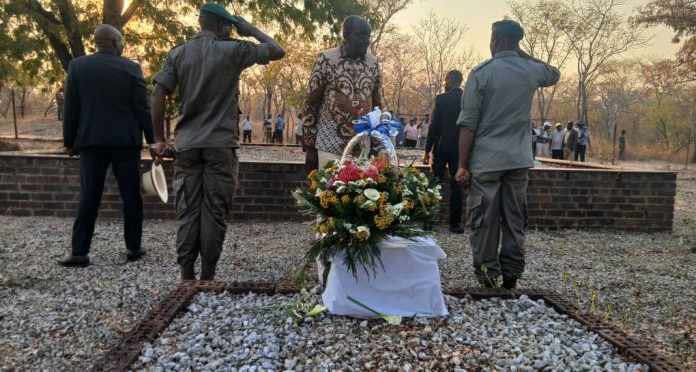
Ray Bande in GONDOLA, Mozambique
SOMETIME in March 2021 — a school headmaster from Mashonaland Central — suffered a mentalillness that persisted, ultimately leading to his job loss.
As the primary breadwinner, his family was left in a predicament.
The family was divided on how to help him, with some advocating for traditional healing methods, while others pushed for Christian-based solutions.
After extensive spiritual consultations, a breakthrough came only last month.
The headmaster, while in a trance, spoke in the voice of his late father, who had died during the war of liberation.
He demanded that his remains be exhumed from Mozambique and reburied in Zimbabwe. With the guidance of a spiritualist, the family embarked on a journey to Mozambique, passing through Manica, Chimoio, and finally reaching Gondola. Their journey culminated at the revered Doroei Liberation War Shrine.
In a remarkable turn of events, the possessed school head instinctively located the shallow grave of his late father.
As he unearthed the remains, he miraculously regained his sanity.
While this account may seem like a fantastical tale, suitable for a grandmother folklore narration to her grandchildren gathered around fire on a winter night, similar experiences have been reported by numerous Zimbabweans who have visited the shrine.
Many individuals, burdened by various social misfortunes, have found solace after locating the remains of their loved ones who perished during the liberation war.
The now-abandoned Doroi Refugee Camp gravesite in Gondola, in Mozambique, has become a sacred destination for those seeking closure and healing.
This was revealed by the Consul General to Beira, Mr Malvern Bere, during Vice President Kembo Mohadi’s tour of the liberation war sites in the neighbouring country as well as other countries in SADC region that include Tanzania, Zambia and Angola.
Mr Bere, who oversees issues relating to Zimbabweans in central and northern Mozambique, which covers seven provinces, said: “We have had numerous cases of Zimbabweans visiting Doroei Liberation War Shrine, and successfully locating the remains of their relatives who died during the liberation war. Just last month, a headmaster who had lost his sanity and subsequently his job, visited the shrine.
“He astonishingly went straight to the exact spot where his father’s remains were buried, unearthed them, and took them back home for a dignified reburial. Remarkably, the headmaster regained sanity immediately after this experience at Doroei Liberation War Shrine,” said Mr Bere.
Doreoi Liberation War Shrine was a refugee camp located in Gondola District, Manica Province.
Available literature on the history of the liberation struggle indicate that the camp was established in September 1976.
It was built on a farm called Kaitano, which was south of Doroei River, which ran from the west to the east.
It was established to accommodate survivors of the Nyadzonia massacre, and carry on the activities that had been taking place at the camp. The camp was mainly a refugee camp as well as a transit camp for recruits, before deployment to training camps, and was under the United Nations supervision.
By 1977, the camp accommodated about 20 000 civilians and militants, but according to the Zimbabwe News 1978, it accommodated 17 000 refugees and had become a production camp which had small-scale projects.
At the entrance of the camp was a security barrack and the headquarters was at the centre. The first refugees stayed in pigsties since it was formerly a farm, and there were no habitable structures on site.
Due to overcrowding at the camp, there was an outbreak of diseases, leading to its extension in 1978.
The camp was mainly affected by the outbreak of pneumonia, malaria and hiccups and hurricane (that mainly affected women and was believed to be caused by nerve agents), scubas and kwashiorkor due to malnutrition.
Mosquitoes and giga flee (small as a salt grain) were prominent pests that also caused deaths at Doroei. The camp existed up to the ceasefire in 1979. Currently, the site has been fenced off and 900 individual graves exist on site.
All buried at this site died of natural diseases.
Cde Paul Madzudzo, whose Chimurenga name was Cde Tongai Tichaona, who witnessed the Doroei Liberation War Shrine deaths back then, had this to say:
“This base was established by a few comrades after the Nyadzonia Base. Initially, the numbers were manageable, but they soon swelled to around 30 000, as confirmed during a roll call. However, when disease outbreaks occurred, we were forced to bury people in mass graves. On one occasion, we buried approximately 25 individuals.
“We initially used makeshift coffins, but eventually, we had to resort to using empty sacks from food supplies. It was a dire time — we would wake up for jogging, only to discover a dead comrade in our room. All we could do was inform the commanders, ‘I have left a dead body in the room.’ Although estimates suggest that around 900 people are buried here, I firmly believe that thousands more lie here, given the sheer number of deaths that occurred during that period.”
Be that as it may, the revelations come amid intense debate and divided opinion on the need to exhume the remains of Zimbabweans lying in unmarked graves in different neighbouring countries and accord decent burial in the country.