

 admin
admin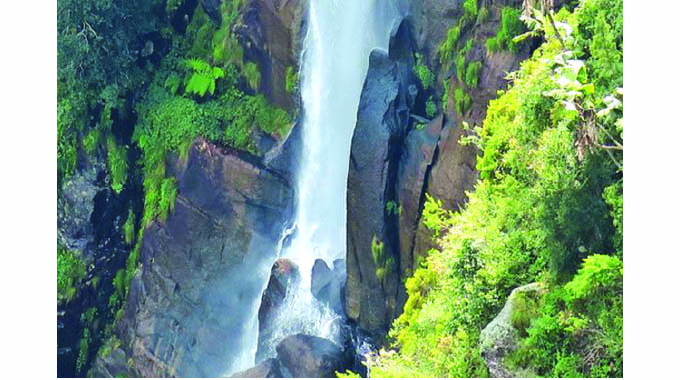
Isdore Guvamombe-Reflections
Visiting Zimbabwe’s vast array of tourist attractions is a life-changing experience. Today, we focus on the craggy Eastern Highlands and focus on its main tourists attractions.
With pristine wildlife, good people, historical sites and ancient cities, water bodies and many other attractions, nature’s inexhaustible generosity makes Eastern Highlands a rare tourism destination.
VUMBA
In the morning, slithers of startling clouds waft — again and again — their silver hue transforming light as it filters through the film of the silhouette horizon.
In the final ascent to the City of Mutare, huge mountains form the eastern background, emotionally and artistically giving the sky an eternal kiss.
The scenery there is that of high massifs, juxtaposed with lush green natural forests, vast plantations of pine and wattle, perennially flowing rivers, crystal clear upland rivers cascading down-slope, deep ravines and waterfalls.
South of this green mound lies the Bvumba or Vumba Range with a distinct flora and in the belly of these mountains are the Vumba Botanical Gardens, a must-see for all those who love peace and nature.
Run by the National Parks and Wildlife Management Authority, the gardens are fit for a weekend retreat or even a single day’s retreat but they will certainly give you a taste of flora and, of course, rare fauna.
The Vumba Botanical Gardens and Reserve, located 32km from Mutare, are established on a portion of a farm formerly known as “Manchester”.
The nucleus of the combined area was bought by Government from Mr F. J. Taylor in 1957 and was proclaimed a national park in 1958.
In 1960, the name of the gardens was changed to Vumba National Park and again in 1975 to the present Vumba Botanical Gardens.
NYANGA
The road turns and twists with the dictates of geomorphology and the driver has to endure spectacular curves. Huge rocks tinged grey by fungal lichens stand guarding the roadside. And, it is this spectacular grey that makes the untrained eye feel awkward where the sky kisses the mountain under a veil of the wafting mist.
Each time the sun successfully breaks the mist, which it rarely does, lush greenery meets the eye again amid rolling moorlands, high mountain heath, cascading white water rivers and pine plantations that make the day. Suddenly a roadside insignia shouts: “You Are Now Entering Nyanga National Park!”
Nyanga National Park is situated in one of the most scenic areas of Zimbabwe’s Eastern Highlands. The rolling green hills and perennial rivers transverse the 47 000-hectare park. The altitude of between 1 800 and 2 593 metres provides cool weather and fresh mountain air perfect for rest and relaxation.
With its stunning mountainous views, numerous waterfalls, varied activities and unique flora and fauna, Nyanga National Park provides the visitor with an unforgettable holiday experience.
Nyangombe and Mutarazi Falls are amazingly spectacular all year round. At Nyangombe Falls, a beautiful series of cascading waterfalls located on the western edge of the park, a 15-minute walk from the car park soothe your soul.
Wildebeest, kudu, zebra, waterbuck, impala, sable and other small mammals can be seen in the park. Mutarazi Falls is the highest waterfall in Zimbabwe and the second highest on in Africa. Visitors may leave their vehicles at the car park and take a short hike to the edge of the escarpment for spectacular views of the waterfalls and the Honde Valley, some 800 metres below.
Most of the park lies at an altitude of between 2 000 and 2 500 metres and remains cool throughout the year. Maximum summer temperatures can reach 26 degrees Celsius and minimum temperatures in winter can be as low as -3 degrees Celsius.
There are lodges available at three camps in Nyanga National Park. The lodges are self-catering facilities with fully equipped kitchen, refrigerator, stove and cooking utensils
Mare Dam is located eight kilometres from the park entrance along a good gravel road. Set among a beautiful pine forest, each of the lodges overlooks the scenic dam and this can certainly be a place to be during the long Easter holiday.
Rhodes Dam, named after colonial expansionist Cecil John Rhodes, is situated just inside the main entrance. The spacious thatched lodges are set in among the pine forest and face a tranquil dam.
Lodges at Udu are set in an open area around Udu Dam, with rugged mountainous views and overlooking beautiful flat-topped acacia trees. Cooking facilities are available on wood fires. Ablution and toilet facilities are provided in communal blocks. Tents and camping equipment are not available for hire. Electricity is available at certain caravan sites.
CHIMANIMANI
Baboon troops lounge nonchalantly on trees along a footpath while monkeys scamper nimbly between branches.
An excited whoop erupts thereafter from deep in the forest, boosted immediately by a dozen other voices, rising in volume, tempo and pitch to a frenzied crescendo.
I imagined each voice, trying to distinguish between individual cries, pants, hoots and screams that define celebrities, the power brokers and the supporting characters.
Like humans, they are quite a community!
This is a bonding ritual that allows baboon or monkey families to identify each other, through individualised vocal stylisation.
Butterflies flit in dappled sunlight and again you come across another family of monkeys, preening each other’s glossy coats in concentrated huddles, squabbling noisily among themselves.
Suddenly they bound onto the nearest gallery of trees and swing effortlessly.
Birds, flies, bees and butterflies erupt from a riotous wild flower display of breathtaking scale and diversity.
This must be yet another community of nectar collectors.
Orchids and hibiscus grow on the tangled slopes and lobelia heath and many species of meadowland wild flowers carpet the intermittent savannah plains.
Then we come across a pair of klipspringer, silhouetted on the rocks and like a bullet, they take off and disappear into the rolling valleys beyond.
There must be scores of interlocking valley, there.
These are scenes synonymous with Chimanimani Mountain National Park, which is straddled by steep slopes that hem the eastern sky, and river valleys and for tourists this is a different place altogether.
In recent years, Chimanimani changed its face, courtesy of Cyclone Idai.
Yes, life and limb were lost, property and infrastructure damaged but that should be taken as nature’s exhaust-less way of regenerating the tourism brand of Chimanimani.
Surely, a visit to the Eastern Highlands this festive season will give you a great experience.



 Online Reporter