admin
admin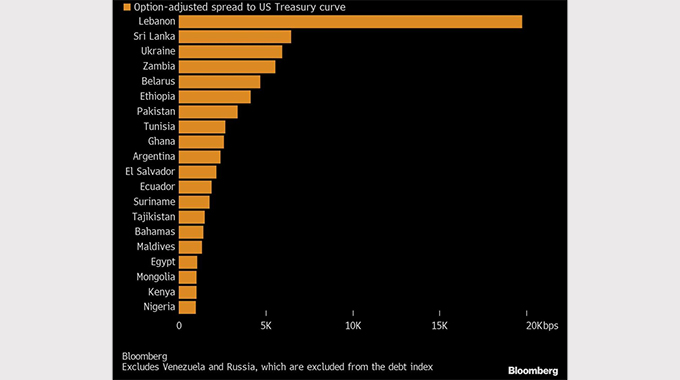
Emerging market governments that borrowed heavily in dollars when interest rates were low are now facing a surge in refinancing costs, evoking flashbacks to Asia’s 1990s debt crisis and stoking fears of a default wave.
Sovereign dollar bonds from a third of the countries in Bloomberg’s EM Sovereign Dollar Debt Index are trading with a spread of 1000 basis points or more over US Treasuries, a generally accepted metric of distress. Nigeria’s finance minister said this week that Africa’s biggest economy is seeking to extend the tenors of some of its debt, but added that eurobonds won’t be included in the plan.
The surge in yields is reminding investors of previous emerging debt crises, notably the one that swept Asia in 1997 when collapsing domestic currencies propelled country after country into default. And it’s forcing a painful realisation that swathes of the developing world are still beset by “original sin” — the phrase once popular with economists to describe developing nations’ reliance on foreign currency debt.
“There will be countries that will default and restructure debt,” said Lisa Chua, New York-based portfolio manager at hedge fund Man Group, whose EM debt fund has outperformed 99% of its peers this year with returns of 5 percent. Rising debt burdens are crowding out investment and reducing growth, “making it more challenging for many emerging markets to grow fast enough to stabilise their debt,” she said.
Debt distress is not confined to the emerging world, with swathes of corporate borrowers across developed markets also vulnerable to higher interest rates. But the fallout from a wave of defaults across developing nations could have far bigger implications for the global economy. Dollar borrowing that left countries vulnerable to exchange rate swings and Fed policy shifts, was a key force behind the 1997 Asian crises, which then swept through Russia and Latin America.
It had seemed for a while that emerging markets were absolved of original sin, as many built local bond markets and cut reliance on hard currency debt. But recent years saw a spate of sovereigns foraying overseas, lured by rock-bottom global interest rates and lacking deep domestic capital markets. That continued through 2020, the year dollar and euro borrowing by EM sovereigns and corporates hit a record $747 billion, according to data compiled by Bloomberg.
Analysts at Man Group wrote in a note published last month that the sheer size of distressed EM debt could potentially infect developed markets, with European credit being particularly vulnerable.
Mongolia, the latest entrant to the distressed list, typifies many of the problems faced by emerging markets. Investors now demand a premium of about 1200 basis points over Treasuries to hold its March 2024 dollar bond, around five times the level recorded a year ago. Surging import costs from the strong dollar have caused the Asian nation’s hard currency reserves to shrink and debt has ballooned to almost 100 percent of annual gross domestic product.
While the bulk of the distressed credits are small frontier markets, some larger nations such as Egypt, Nigeria and Pakistan are also on the list. Other than sanctioned Russia and Belarus, only Sri Lanka has actually defaulted in 2022.
That said, fifteen of the 23 emerging-market currencies tracked by Bloomberg are down more than 10 percent this year, heaping pressure on governments at a time when energy bills are also rising. Developing-nation governments need to pay back or roll over about US$350 billion in dollar- and euro-denominated bonds by the end of 2024, according to data compiled by Bloomberg. -Bloomberg



 Online Reporter