admin
admin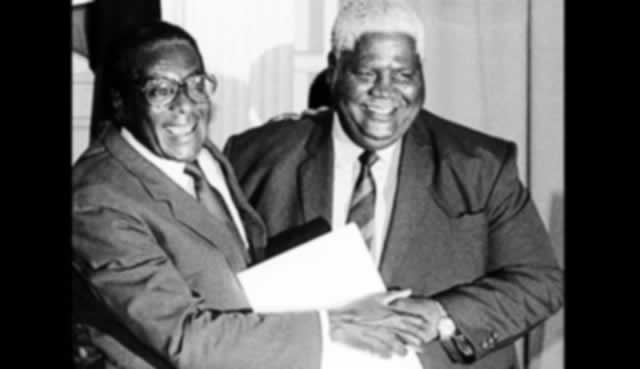
Christopher Farai Charamba Correspondent
The road to national unity and cohesion — a glaring challenge since before Independence in April 1980 — was never easy for Zimbabwe. While at Independence the new majority Government led by the then Prime Minister Robert Mugabe had done the Houdini act to integrate the former warring parties, there were residual problems among mainly the black majority and peoples of the main parties zanu and PF zapu.
The disturbances that eventually took place in the Midlands and Matabeleland regions and caused massive loss of life and limb, brought to the fore the quintessential generational challenge.
Something had to be done.
Former government minister and governor of Midlands province and member of the erstwhile PF zapu Cde Cephas Msipa, throws a new perspective on the road to national unity in which he played a part — albeit a largely unsung one.
A fortnight ago he released his memoirs, “In Pursuit of Freedom and Justice”.
In it he situates himself occupying a strategic position of being a senior member of Joshua Nkomo’s zapu at the time and also a relative and close friend of President Mugabe.
In fact, in 1960 on his return from Ghana, President Mugabe stayed with Cde Msipa and his family at his home in Highfield for some time.
In his account, in a chapter titled “The Road to the Unity Accord” he says he convinced Cde Nkomo to agree to the terms of the Unity Accord with the help of former President Canaan Banana and Jacob Mudenda (now Speaker of the National Assembly).
Cde Msipa writes in his memoirs that on his return to Zimbabwe in 1986, the then zapu President Joshua Nkomo was very interested in Cde Mudenda ‘s suggestion to explore unity between the two revolutionary parties zapu and zanu.
“He agreed that a go-between should be used between he and Mugabe. They agreed to approach President Canaan Banana, the titular head of state, who was also a Ndebele, but a member of zanu (pf), and asked him to mediate. Banana, in turn, asked me to assist as another mediator.
“In September, 1987, my third year out of government, I was invited to State House in Harare by Rev. Banana . . . When we met, Banana explained that Nkomo was very keen to talk to Mugabe about uniting their two parties.
“Banana had tried very hard to set up a meeting, but without success. He said that he had tried to use intermediaries to bring the two together but Mugabe had hard preconditions . . . Banana continued, ‘I have been told that Mugabe and Nkomo are both your friends and that if you can’t bring them together, no one can.’
“I had known the two men for a long time and certainly considered both of them my friends. This was at least a good start.”
According to Cde Msipa, President Mugabe had three conditions which Cde Nkomo needed to agree to before any deal could be made. The first was that the united party would be called zanu-pf, the second was that President Mugabe would be the leader of the new party and finally that there would be two Vice Presidents, Joshua Nkomo and Simon Muzenda.
Cde Msipa writes that he knew from the onset that his greatest challenge would be to convince Cde Nkomo to agree to the name zanu-pf. At one point he was even close to giving up in his efforts to persuade Cde Nkomo but was encouraged to continue by the late VP Joseph Msika and his friends Willie Musarurwa and Ariston Chambati.
After deliberations with Cde Nkomo, Cde Msipa then made an appeal to his principal to listen to what he had to say regarding the need for national unity and then decide on what course he, Dr Nkomo and zapu were to take.
“My appeal was in three parts. In the first place, I told him what unity would mean to him personally, that his status would change immediately from being leader of the opposition to being the vice-president of Zimbabwe.
“Secondly, I referred to the people of Matabeleland in particular — they would feel that they were part of the government of Zimbabwe and that their needs would be attended to at the highest level.
“Lastly, the country would benefit from his long experience, and policies that were the result of many years of thought, suffering and sacrifice for majority rule in Zimbabwe.
“I left him to consider what I had said, and told him I was ready to hear from him whenever he had made up his mind.”
Following this, Cde Msipa was then instructed by Nkomo to find out what other members of zapu, Welshman Mabena, MP for Matabeleland North, Sydney Malunga, MP for Bulawayo, and Naison Ndhlovu, MP for Matabeleland South thought about unity with zanu.
According to Cde Msipa’s account after he reported back to Nkomo that party members were prepared to support any decision Nkomo would make, it was then that Nkomo agreed to meet with President Mugabe.
After a failed first meeting due to the fact that Cde Nkomo was conducting consultations of his own, the two leaders of both parties eventually had a sit down and Cde Msipa saw his task as accomplished.
He writes, “No one mentioned my role until long after the Unity Accord of 1987 when Joshua Nkomo invited me to his office in his capacity as vice-president and he said, ‘Wena mfana ngite ngibong’ukuti wakhuluma lami ngavuma ukuti ipf zapu le zanu sibambane (Young man, I thank you for persuading me to agree to the unity between pf zapu and zanu).
“‘I was not very sure that I had made the right decision. I want to tell you that it is working very well. Thank you for bringing us together.’ He then asked, ‘What can we do for you?’ I do not know what he had in mind but I said:
“‘By accepting this proposal through me, you have honoured and thanked me.’ I told him not to worry about me.
“I was content that I should not have been given any public recognition. I said to myself, ‘I have joined thousands who work behind the scenes but are neither mentioned nor recognised.’
“Many people have questioned the benefits of the Unity Accord. I maintain that it was the right decision. It ushered in peace and oneness in Zimbabwe, although some members of pf zapu were sceptical.
“In April 1988, over 90 dissidents marched to the Zimbabwe Republic Police station at Nkayi in Matabeleland North and asked to see the Governor Jacob Mudenda. They surrendered to him and handed in their weapons. It was immediately after the signing of the Unity Accord. I couldn’t think of anything more spectacular and dramatic!”


 Online Reporter