Chronicle Editor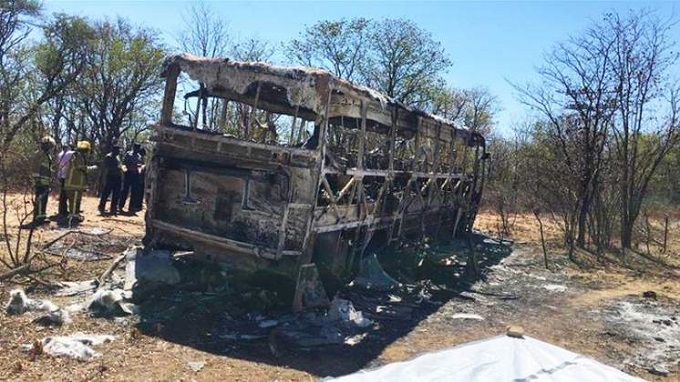
Obey Sibanda, Features Reporter
Police officers, Red Cross workers and Fire Brigade crew worked with so much determination at the accident scene of a Musina bound Brooklyn Express bus that caught fire along the Bulawayo-Beitbridge Road in Gwanda following a suspected gas cylinder explosion last month.
Imagine the soul shattering anguish of suddenly being told that your loved one, whom you kissed and wished a safe journey, has been burnt beyond recognition in a road traffic accident.
That is increasingly becoming a reality that devastates thousands of families in Zimbabwe annually.
The rising rate of fatal accidents, besides destroying families, is costing the economy millions of dollars.
Crashes have been identified both globally and domestically as a socio-economic challenge, a huge economic burden for developing countries like Zimbabwe.
Road traffic accidents are turning travelling into a scary game of gambling as the country’s highways have increasingly become “jungles”. People are being maimed, killed or left with permanent mental and physical scars on a daily basis in road accidents.
Year on year statistics have shown that road accident death tolls have continued to increase in the country. In 2017, the Traffic Safety Council of Zimbabwe (TSCZ) recorded 42 430 road accidents with 1 838 being fatal compared to 38 620 recorded in 2016 leading to the death of 1 721 people.
The TSCZ said nearly 90 percent of the incidents were attributed to human error which includes speeding, misjudgment and recklessness on the roads.
Last month, the nation was plunged into mourning when the Brooklyn Express bus caught fire. A total of 30 people were burnt to death while 27 sustained injuries.
What is more disturbing is the fact that this horrific accident happened at the backdrop of another road traffic accident near Rusape where 46 people lost their lives when two buses side-swiped at the 166-kilometre peg along the Harare-Mutare highway.
The country loses about $406 million every year due to road traffic accidents. This is almost three percent of our Gross Domestic Product (GDP) which is estimated at $14 billion.
Deaths and injuries from road traffic crashes affect medium and long term growth prospects by removing prime age adults from the work force, and reducing productivity due to the burden of injuries.
The greatest share of mortality and long term disability from road traffic crashes happen among the working age population that is between 15 and 64 years old.
While there is general recognition of road traffic injuries and fatalities, little is known about the link between road traffic injuries and economic growth.
Finance Minister Professor Mthuli Ncube in his 2019 national budget highlighted that the high incidence of accidents on the country’s roads, which have resulted in serious injury and in some instances, carnage, are a major concern to Government.
The minister set up an accident fund to assist victims. “The accidents place a huge financial burden on the injured victims, relatives as well as the State. I therefore, propose to redirect five percent of the third party insurance cover to an accident compensation fund, with effect from December 1, 2018,” said Prof Ncube.
Road traffic accidents cause considerable economic losses to the Government, individuals, and their families and to communities as a whole. Government costs include reductions in an array of public services. From the police called to the scene of accident to the Fire Brigade, ambulance crew, hospital staff, court, prison, medical payments, social safety net assistance to the injured and their families, and taxes foregone because victims miss work.
The biggest losses come from economic disruption. People who are injured by or killed in an accident were likely pursuing personal economic benefit that adds to the economy. Additionally, much of that activity would have been taxed at a higher rate than the funeral expenses or the cost of the healthcare that may be delivered as a result of the accident.
Then there is road damage, barrier damage and possibly changes to road signs as well as the physical work. Bulawayo City Council’s average yearly budget for safety engineering measures is $750 000 to cover the proposed treatments and also to replace damaged road furniture.
“The engineering measures include speed humps, rumble strips, mini roundabouts, traffic lights, carriageway markings and traffic signs,” said BCC senior public relations officer Mrs Nesisa Mpofu.
The cost of crashes often exceeds the amount of payments that the country receives in financial aid. The cost of lost productivity for those killed or disabled by their injuries and for family members who need to take time off from work to take care of the injured.
Civil Protection Unit (CPU) director Mr Nathan Nkomo, recognising the overwhelming number of accidents, appealed to treasury to consider increasing the budget allocations to his department.
“CPU like any other Government department is operating on a shoe-string budget. The money allocated to CPU to enable it to respond to road traffic accidents, is not enough,” said Mr Nkomo.
Government availed $16 000 for funeral expenses for the Musina bound bus disaster and $25 000 towards the victims of the Rusape horrific accident with the Insurance Council of Zimbabwe directed to settle all hospital bills. The total monetary assistance to each of the bereaved families was $1 350.
A new World Bank study, funded by Bloomberg Philanthropies, found that reducing road traffic deaths and injuries could result in substantial long-term income gains for low and middle income countries.
Human error, disrespect of road statutes and mechanical faults have immensely contributed to a string of accidents that have occurred recently.
In his budget statement, Prof Ncube proposed stiffer penalties for traffic offenders. He pointed out that the current fines, which should act as a deterrent to criminal behaviour, have not assisted in reducing such malpractices mainly due to the low monetary value.
“In order to promote road safety culture by adhering to road traffic regulations, the budget proposes that any person who commits such offences be liable to fines of level eight to 10 which attract a maximum fine of US $700 and imprisonment for a period exceeding 12 months.”
Statistics show that major accidents which are declared national disasters happen mostly at night. TSCZ information, communication and technical manager Mr Tatenda Chinoda is of the view that night driving is twice as dangerous as daytime driving.
“Visibility is limited. There are some poorly trained night drivers who dazzle others with headlight glare. The tendency to overdrive headlights at night is also very prevalent,” said Mr Chinoda.
The two horrific accidents, the Brooklyn bus and Rusape disaster happened at night. Last year, a speeding overnight Lion King bus from Harare to Lusaka, Zambia burst a front tyre and veered off the road before plunging into a gorge, uprooting trees on the way and killing 43 passengers on the spot.
The poor state of roads has also been blamed for the high number of accidents. A recent government survey indicated that most local roads had outlived their recommended life-span by at least three decades.
Roads are designed to go for 20 years, after which it is recommended that they should be completely overhauled and reconstructed.
However, due to the tough economic situation, Zimbabwe has not been able to refurbish its roads and still uses those inherited from the colonial era.


 Online Reporter