


 malvernmugadzikwa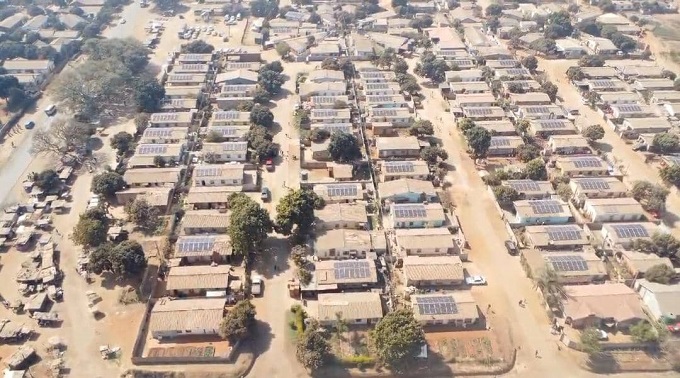
Kuda Bwititi
MS YAMIKANI GIDEON and her family are experiencing a rare luxury — uninterrupted power supply — especially at a time when electricity generation is low due to the El Niño-induced drought.
Just like elsewhere in the region, Zimbabweans have had to contend with regular load-shedding.
But not for Ms Gideon and her family, whose home has been a bright spot, literally.
It is among 80 houses in Glen View 3, Harare, benefitting from a groundbreaking pilot project aimed at easing pressure on the national grid.
The Presidential Rooftop Solar Scheme, which involves installing solar panels on rooftops at no cost to homeowners, was launched this year.
“We are very happy with the scheme, and it has helped us very much during this time when many people are suffering from load-shedding,” Ms Gideon said.
Implemented by the Zimbabwe Solar Energy Company (ZISEC), a subsidiary of Prevail Group International (PGI), the programme involves installing solar panels on rooftops of participating houses.
The excess energy generated is fed into the national grid.
Beneficiaries receive a nominal monthly payment from ZISEC, which is working in collaboration with the Zimbabwe Electricity Supply Authority (Zesa).
The Government aims to expand the scheme to other areas.
In an interview with The Sunday Mail, Energy and Power Development Minister Edgar Moyo said the Government has given its full backing to the project.
“This is the first phase of the project, which is targeting 400 houses. So far, solar systems have been installed on 80 houses in Glen View,” he said.
“The company instals the solar system on houses free of charge and the excess power that is generated therefrom is being channelled to the national grid.
“This initiative has many advantages in that it saves a lot of ground space that would otherwise be required for solar farms and that space can be left for other projects such as agriculture. More importantly, the project is also being used to train our young people on solar system installation, meaning the quality of installations will improve with time.”
Installation
Participating houses are first assessed for suitability. Engineers evaluate factors such as roof orientation, size and structural integrity.
Once a house is deemed suitable, the homeowner is registered under the programme.
Qualified technicians from ZISEC then instal solar panels on the rooftops.
Inverters are installed alongside the solar panels. The primary function of an inverter is to convert the direct current (DC) produced by the solar panels into alternating current (AC), which is the type of electricity used in homes.
During daylight hours, the solar panels convert energy from the sun into electricity.
Excess power is fed into the national grid.
A high-tech online application underpins the system’s operation and serves as the nerve centre, capturing real-time data on power generation from each participating household.
It records the amount of electricity fed into the national grid, ensuring accurate monitoring and distribution.
Moreover, the system is designed to detect faults within the solar installations, facilitating timely repairs and optimal performance.
Crucially, the platform also calculates carbon credits earned by each household based on the solar power generation, helping quantify the reduction in greenhouse gas emissions.
Furthermore, the application provides insights into the benefits to the environment by comparing the carbon footprint of solar power to that of traditional grid electricity.
PGI chairperson Mr Paul Tungwarara said the programme will not only reduce power challenges but also boost household incomes.
“We are renting roofs from homeowners at an agreed price,” he said.
“The homeowners are getting a certain amount of money for their upkeep, as well as free electricity. This means each house becomes a power generation unit and feeds power into the grid.
“The advantages of this programme is that it is going to eradicate load-shedding; for example, if we manage to roll it out in the whole of Harare, it means the national grid will have a massive surplus.”
The initiative, he said, was also crucial for meeting Zimbabwe’s climate change mitigation and adaptation goals. Mr Tungwarara said the system has been successful in countries such as Mauritius and the United Kingdom.
“The good thing about this scheme is that it also helps us save land. Instead of giving people land to do solar farms and then transmit the energy through expensive infrastructure to where it is needed, this programme will ensure that energy is generated on rooftops of houses where it is needed,” he said.
“For now, we are doing our pilot in Glen View, on 400 houses. Already, we have done demo houses, where we have connected those houses to the grid. The houses are already feeding into the grid. We did the demo with Zesa and they liked our system and we are now rolling it out.”



 Bongani Ndlovu
 Online Reporter