Chronicle Editor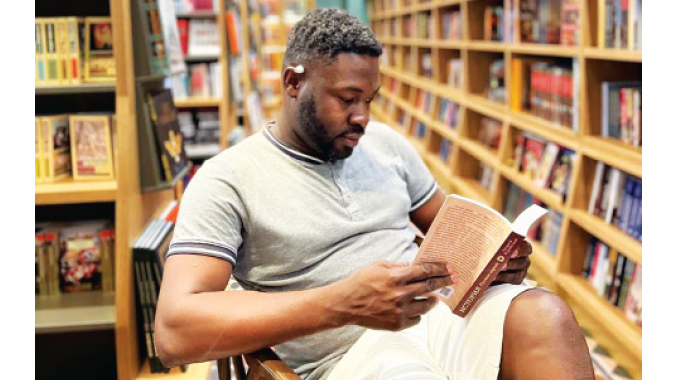
Nqobile Tshili in Moscow, Russia
MUHAMMED Nooh is a Sudanese journalist living, studying and working in Moscow, Russia.
He is among the 35 000 African students studying at Russian universities amid revelations that the African student population has tripled in just over a decade.
Nooh works for Sputnik Africa, a subsidiary of Sputnik, the biggest Russian Federation news agency and is studying towards a PhD.
For him, Moscow, as big as it is with a population of over over 17 million residents, and highly developed infrastructure, whose construction also tells the story of the country’s past socialist ideologies, does not interest him much.
He is charmed by Russia’s second largest city, St Petersburg, which he describes as a work of art, through its architecture.
He has lived in Russia since 2017, having studied the Russian language and culture in his home country Sudan and his expectations of Russia have always been different from what the world has been made to believe; a place at war with the world, its people not so kind.
Through literature among other things, he knew that the Russians were hospitable and far from being outlaws selling drugs, guns and even trading in prostitution.
After participating in the Russia-Africa exchange programme, an opportunity was availed for him to advance his career in Russia and he grabbed it with both hands.
Almost seven years into the country, Nooh, believes his decision to challenge all the stereotypes and come and advance his studies in Russia have paid off.
He believes he has achieved more than what he could have experienced had he remained in his home country.
“Russia is a welcoming country. It offers great opportunities for your career and self development. What I was when I was in Sudan and here now are totally different. I’m more educated, I’ve a great career, I’ve more experience and more knowledge. The opportunities I got here are better than the ones I could have gotten back in my country,” said Nooh.
While racial discrimination remains a global challenge even in countries with higher black communities, surprisingly, Russia with its low African population, has little to zero racism.
Having lived in several cities in Russia, Nooh said he has not experienced any racial discrimination but just Russian love.
“As a person from Africa, I did not experience racism and no one here offends you. The people are happy when they see you, they see that you are a foreigner in their country and they treat you well. They were not used to seeing Africans particularly in other parts of the country, there are only a few. Russia is big and when they see you, they will want to take pictures with you, talk to you and no one is keen on offending you,” he said.
The enrollment of African students at Russian universities is said to speak to strengthening the relations, that exist between Russia and African states.
Relations between Russia and African states date back to the colonial era when the eastern European giant which was part of the Soviet Union worked with liberation movements to liberate some states.
Russian Federation Deputy Minister of Science and Higher Education Konstantin Mogilevsky was recently quoted in the Russian press saying almost 35 000 students from Africa are studying at Russian universities, and the figures tripled in just 13 years.
Nearly 5 000 African students are expected to benefit from scholarships in the next academic year.
In an interview on the sidelines of Nelson Mandela Day commemorations in Moscow, South African Ambassador to Russia Mzuvukile Jeff Maqetuka said Africa has to grab opportunities that Russia, among other developed nations presents to the continent.
“As Africa, we have to take all the opportunities that we can get and we should not be selective because the position of Africa is non alignment. We can’t stop African students from going to learn in South America when there are opportunities, we can’t stop African students from going to learn in Russia, to the United States, to England. We have to be everywhere and not stick to one,” said Amb Maqetuka.
“It is significant for Russia and it will be significant for the continent. Let’s face it, Russia has an abundance of skills, and an abundance of higher learning institutions that we have to learn from. So Africa has got to capitalise and optimise those opportunities.”
He said Russia’s infrastructural development gives Africa a window to learn how to develop its infrastructure.
Amb Maqetuka said the continent can also learn how the Russians have preserved their cultural heritage.
“If you look at Moscow as one of the cities in Russia, if you look at infrastructure, Moscow has got the best infrastructure in the world. The Russians are one of the leading countries in the world in terms of infrastructure maintenance. Very few streets of Moscow have potholes as compared to Johannesburg where almost every city has got potholes,” said Amb Maqetuka.
“They understand the importance of their infrastructure. If there’s one thing that the Russians understand and know, Russians understand heritage and the meaning of heritage. I’ve never seen a country where churches have become a heritage. These are some of the things that we can learn from Moscow and other cities.”
He however said, it is not just Africa that needs to learn but Russians also have a lot to learn from Africa.
“It is our duty as Africans to show and teach them what Africa is all about. Do Africans understand Russia? No. Russians do not understand Africans. So my advice is to interact with them in the manner that we are doing. Send those who want to come and study in Russia and those who want to come and understand Russia,” he said.
“They must also be encouraged to send their students to African universities because there is a lot for them to learn there. Education is a two way road it can’t be a one way road. Because if it becomes a one way road, we will end up being colonised.”
This week Russia hosts the second edition of the Russia-Africa Summit in St Petersburg which is expected to provide African countries and Russia a chance to forge alliances on matters of mutual interest.
Among other activities, there will be round table discussions on how African countries can benefit through adoption of e-governance in administration.
Last year, the HSE Centre for African Studies launched an e-governance sharing programme for African countries and during the summit it is expected that deliberations will be made on how the mother continent can learn from the Russian experience.
The round table discussion will be held under the theme, “Knowledge Sharing: Exchange of Experience in e-Governance.”
There will also be discussions on how African countries could tackle hunger through adoption of modern agriculture farming methods, something which Russia is already implementing.
With geopolitics at play, Russia believes Africa, with its young but growing population, would be a strategic partner for both business and diplomatic cooperation for the future. — @nqotshili


 Online Reporter